





Q&A: Cummins' Samperio On Rapid Pace of Technological Change
Cummins Establishes Dedicated Zero-Emissions Business Unit
Citing the need to magnify its zero- and net-zero emissions efforts, Cummins has founded Accelera, a new company focused on green power technology and transportation.
March 8, 2023
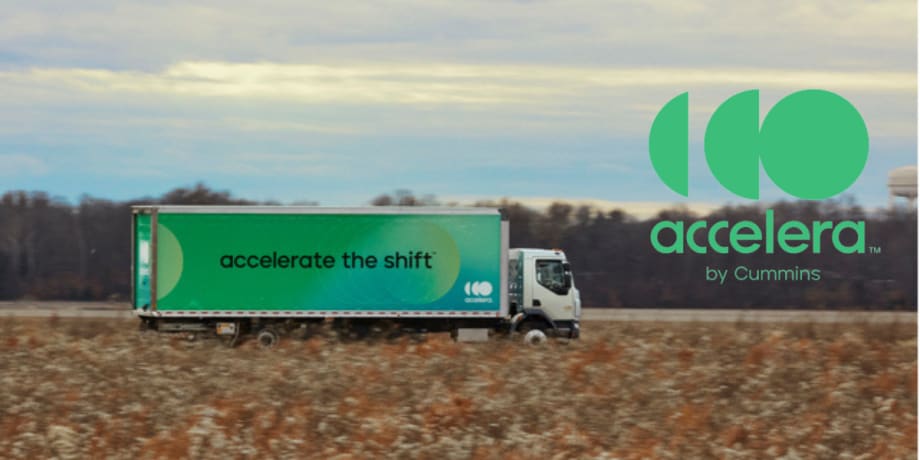
Cummins has founded a new business unit called Accelera, which will be devoted entirely to the company’s zero- and near-zero emissions technologies.
Image: HDT based on Cummins Images
4 min to read
Citing the need to magnify its zero- and net-zero emissions efforts, Cummins has founded Accelera, a new company focused on green power technology and transportation.
Cummins is known the world over for its advanced diesel engines. But the company has changed quite a bit over the past two decades. Cummins today is a global leader in many emerging green transportation technologies, including battery-electric vehicles, hydrogen fuel cells, green hydrogen infrastructure and fuel-agnostic internal combustion engines. But the extent of those efforts tends to get lost in the OE’s century-plus role in developing and expanding the use of diesel engines in a wide array of applications.
During a press conference at the Rubell Museum in Washington, D.C., on March 8, Jennifer Rumsey, Cummins president and CEO, introduced a new, wholly owned subsidiary of Cummins called Accelera, and its new president, Amy Davis. Davis has led Cummins’ New Power business unit since 2020.
“We are pleased to announce a brand-new power business that will pursue the broadest range of zero- and net-zero emissions technologies as possible,” Rumsey said in her opening remarks. “While Cummins is very well known as a diesel engineer innovator, people may not recognize our leading position in zero-emissions technology. And it is time for that to change.”
Rumsey noted that new power options for transportation, construction, mining, industrial and other applications is already an important and growing market segment. Currently, she said, Cummins expects revenues from $350 million to $400 million this year. It expects that figure to grow to an astounding $6 billion to $13 billion per year by 2030.
“Accelera will help both our customers and policymakers understand that Cummins will be a leader in zero-emissions technologies,” Rumsey added. “And it will also allow us to bring together the 2,000 (and growing) employees from Cummins and the various companies we have acquired as our green technologies efforts have grown, into one business unit and unite them for that purpose.”
Building on Rumsey’s comments, Davis said that Accelera would enjoy the full support and backing of Cummins and its global footprint.
“Accelera and Cummins is now an evolution in process,” she said. “We will pursue complementary products and systems when that is appropriate. And we commonize in areas to gain scale with new products and technologies quickly.”
Destination Zero
In a news release, Cummins explained that the launch of Accelera is a significant step forward in Cummins’ efforts to achieve its Destination Zero strategy, focused on evolving Cummins technologies to reach zero emissions across its product portfolio.
“Cummins’ Destination Zero strategy is rooted in the understanding that multiple solutions are required to achieve industry-wide decarbonization across the diverse applications the company powers,” the news release explained. “Over the past several years, Cummins has invested more than $1.5 billion in research and technology, capital and acquisitions to build Accelera’s leadership and technological capabilities. Accelera is now a global leader in zero-emissions technologies, providing battery electric and fuel cell electric solutions across commercial and industrial applications, with hundreds of electrolyzers generating hydrogen around the world today.”
Early Focus
Noting that Cummins already produces a wide range of electric products, including batteries, battery packs, energy management systems, invertors, motors, traction systems, and control systems to tie all of those components and systems together, Davis said that Accelera’s early efforts will be focused on industrial and stationary green power applications, which she said will become more important over time.
Expanding on that theme in a follow-up interview after the press conference, Srikanth Padmanabhan, president of Cummins engine business, explained that certain applications — long-haul trucking, in particular — will be more difficult applications for zero-emissions powertrains in terms of delivering comparable range and performance.
“That’s why Accelera’s focus will be to start with the easier green power solutions, first,” he said. “That way, we can gain experience, learn about these technologies and find ways to improve them. So that when the time comes that we can start to tackle much more difficult market segments like long-haul trucking, we’ll be much farther along in understanding these technologies and better able to apply them in ways that help our customers immediately.”
More Fuel Smarts
Electric Yard Tractors Move Beyond Pilots
Operating-cost savings have overtaken sustainability goals as the leading reason surveyed fleets are adopting battery-electric terminal tractors, according to new NACFE research.
Read More →
Geotab Links Fleet Card to Vehicle Data
The new card combines fuel discounts with telematics-based purchase controls. Geotab’s analysis also points to potential savings from choosing lower-priced fuel stops.
Read More →
Fleet Economics Shape Electric Truck Outlook
ACT Research expects costs, charging infrastructure, and technology improvements to drive zero-emission commercial vehicle adoption as federal regulations and incentives retreat.
Read More →
Wex Adds Cardless Fuel Payments for Over-the-Road Customers
A new fuel card feature for Wex customers offers convenience and security.
Read More →
New California Law Could Shed Light on Electric Truck Prices
Why do battery-electric Class 8 trucks remain so expensive? A California bill signed by Gov. Gavin Newsom would give fleets and state agencies more visibility into what manufacturers charge.
Read More →
How Volvo Updated Its D13 for EPA 2027 [Watch]
Volvo’s updated D13 promises lower emissions without sacrificing performance or fuel economy. Take a closer look at what changed inside the engine in this HDT Spotlight video.
Read More →
Diesel Price Spike Shortens Payback for Natural Gas Trucks, Report Says
Energy Vision estimates fleets could recover the higher purchase price of an RNG-fueled Class 8 tractor in 1.3 to 2.8 years under current fuel-price scenarios.
Read More →
Calstart Becomes Catalyst Mobility, Reflecting Broader Focus
Calstart is now Catalyst Mobility, reflecting the nonprofit’s growing national role in clean transportation, including zero-emission trucks, infrastructure and incentive programs.
Read More →
Record Diesel Prices Squeeze Trucking Fleets
Average U.S. diesel prices have climbed to nearly $6 a gallon, surpassing the 2022 record as tight refinery capacity and Middle East disruptions keep fuel costs elevated.
Read More →
East Coast Port Launches $45M Electric Truck Push
The Port Authority of New York and New Jersey announced millions in incentives for zero-emission drayage trucks, yard tractors, and new charging hubs near the port.
Read More →