




HDT Webinars to Address Fleet Emission-Reduction Challenges
Starting May 25, the editors of Heavy Duty Trucking are producing a special three-part Road to Zero webinar series to provide real-world fleet insights into how fleets can chart a path to emissions reduction.

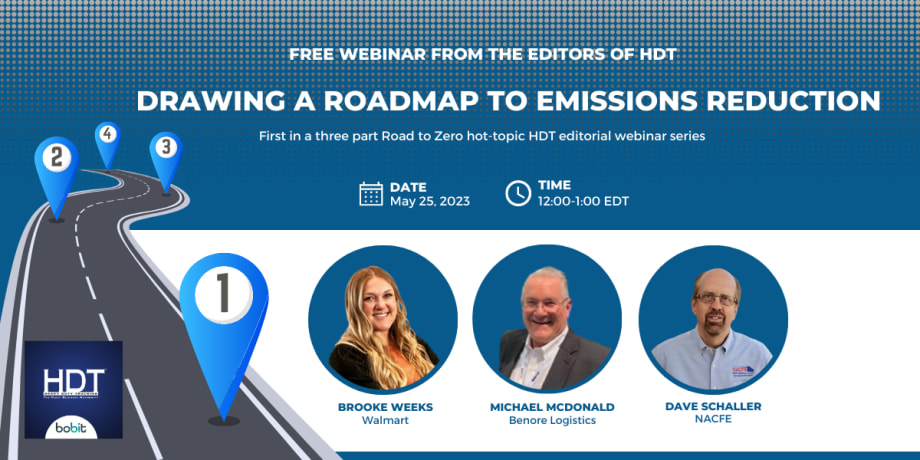
The May 25 webinar will explore real-world fleet strategies to lower emissions.
HDT Graphic
The push to decarbonize transportation can be intimidating for fleet managers who operate heavy- and medium-duty trucks. Regulators are pushing battery-electric and fuel-cell-electric technology that’s still in its infancy, and we’re seeing increasing popularity of renewable fuels and other alternatives for the internal combustion engine.
Starting May 25, the editors of Heavy Duty Trucking are producing a special three-part Road to Zero webinar series to provide real-world fleet insights into questions such as:
How will the industry reduce both tailpipe and greenhouse gas emissions?
What will that mean for diesel engines?
How can fleets afford this new technology?
Will batteries or fuel cells be the future?
What about charging and fueling infrastructure?
Can alternative fuels help bridge the gap?
How do I set sustainability goals and determine a strategy to get there?
Part 1:Drawing a Road Map to Emissions Reduction
The webinar series kicks off May 25, noon-1 p.m. EDT, exploring how fleets can get started on a path to lower emissions. How do fleets evaluate their operations, options, and resources? How can they start setting goals? How do they measure progress?
HDT Editor and Associate Publisher Deborah Lockridge will moderate a panel discussion with the following speakers:
Brooke Weeks, Senior Manager Transportation Engineering, Walmart
Weeks leads the transportation engineering team focusing on zero-emission vehicle development at Walmart’s private fleet. She’ll discuss the company’s sustainability goals and strategies and how they evaluate alternative-fuel and zero-emission trucks (and trailers), including natural gas, battery-electric, and hydrogen-fuel-cell.
Michael McDonald, Senior Director of Maintenance, Benore Logistics
This for-hire regional and drayage fleet is committed to sustainability and is “on an electrification and reduced carbon footprint journey.” When it took delivery of Peterbilt’s first battery-electric production Class 8 579EV, it was the first electric truck in the state.
Dave Schaller, Industry Engagement Director, North American Council for Freight Efficiency
NACFE will share insights from its recent “messy middle” report on a framework for powertrain decision-making, a thoughtful process to decide how and when to decarbonize through zero-emission trucks, alternative fuels, and working on efficiency to burn less fuel.
This special editorial hot-topic webinar series is made possible with the sponsorship of Mann + Hummel FleetDirect and Rush Truck Centers.
Mark your calendar for the second and third installments:
Part 2:Alternative Fuels and the Future of Internal Combustion Engines
June 20, noon EDT
The trucking industry can’t transition to zero-emission vehicles overnight. There is still plenty going on in the development of more efficient engines and alternative fuels such as renewable diesel, renewable natural gas, even hydrogen. Learn steps you can take now and in the near and medium term to move along an emissions-reduction path.
Part 3:Zero-Emission Trucks Today and Tomorrow
September 20, 2 p.m. EDT
Hear from fleets that have already been adopting electric trucks in their operations. Which applications make the most sense right now? How do you handle the challenges of charging? Maintenance? Range? Financing? Can you “future-proof” your EV journey? What role will hydrogen fuel cells play?
More Fuel Smarts

How Volvo Updated Its D13 for EPA 2027 [Watch]
Volvo’s updated D13 promises lower emissions without sacrificing performance or fuel economy. Take a closer look at what changed inside the engine in this HDT Spotlight video.
Read More →
Diesel Price Spike Shortens Payback for Natural Gas Trucks, Report Says
Energy Vision estimates fleets could recover the higher purchase price of an RNG-fueled Class 8 tractor in 1.3 to 2.8 years under current fuel-price scenarios.
Read More →
Calstart Becomes Catalyst Mobility, Reflecting Broader Focus
Calstart is now Catalyst Mobility, reflecting the nonprofit’s growing national role in clean transportation, including zero-emission trucks, infrastructure and incentive programs.
Read More →

Record Diesel Prices Squeeze Trucking Fleets
Average U.S. diesel prices have climbed to nearly $6 a gallon, surpassing the 2022 record as tight refinery capacity and Middle East disruptions keep fuel costs elevated.
Read More →
How Fuel Delivery Shapes Engine Performance
Fuel delivery depends on more than what happens at the injector. For fleet, maintenance and technical professionals, looking at the full path from pump to injector can provide useful context for understanding engine performance.
Read More →
East Coast Port Launches $45M Electric Truck Push
The Port Authority of New York and New Jersey announced millions in incentives for zero-emission drayage trucks, yard tractors, and new charging hubs near the port.
Read More →
California Bill Could Shed Light on Electric Truck Prices
Why do battery-electric Class 8 trucks remain so expensive? A California bill headed to Gov. Gavin Newsom would give fleets and state agencies more visibility into what manufacturers charge.
Read More →
Detroit Opens Orders for EPA 2027 Engines
Detroit isn’t starting from scratch to meet EPA 2027 diesel emissions standards. Its Gen 6 DD13 and DD15 engines keep much of today’s platform while updating the fuel and aftertreatment systems.
Read More →
Zero-Emission Truck Corridor Planned for West Coast
California, Oregon, Washington, British Columbia and Baja California are coordinating plans for truck charging and hydrogen fueling from Canada to Mexico.
Read More →
A Closer Look at Kenworth’s Electric T880E Vocational Truck [Video]
Learn more about Kenworth's T880E battery-electric vocational truck at the Paccar Technical Center, including its range, applications, upfitting considerations, and PTO options, in this HDT Spotlight video.
Read More →