





You Also May Like: Are You Setting Your Rate the Right Way?
Has the Freight Cycle Peaked?
High fuel prices and inflation are among the factors prompting analysts to say the freight pendulum is starting to swing back the other way.
May 17, 2022
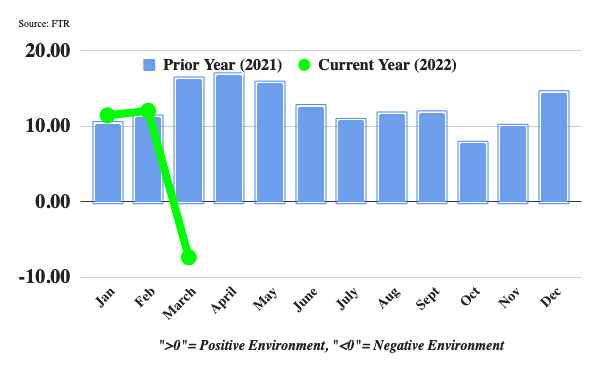
FTR's Trucking Condition Index took a major plunge in April.
Source: FTR
3 min to read
It appears the freight cycle is heading back down, with fuel prices, inflation, and global uncertainties putting a drag on both trucking and the economy.
FTR’s Trucking Conditions Index for March was negative for the first time since May 2020, caused by record diesel prices and, to a lesser extent, weaker freight rates.
The Index plunged to a reading of -7.38 from February’s positive 12.06 reading. The TCI tracks the changes representing five major conditions in the U.S. truck market: freight volumes, freight rates, fleet capacity, fuel prices, and financing costs.
Although the outlook for trucking conditions generally is for modestly positive conditions, FTR said, uncertainty is rising in several key areas, including fuel costs, capacity utilization, and rates.
“Given the unprecedented surge in diesel prices during early March, a negative reading for the Trucking Conditions Index was hardly surprising,” said Avery Vise, FTR’s vice president of trucking. “Fuel costs apparently will represent a big negative factor for May as well.”
The pendulum of the freight cycle is swinging back, said ACT Research in its latest freight forecast.
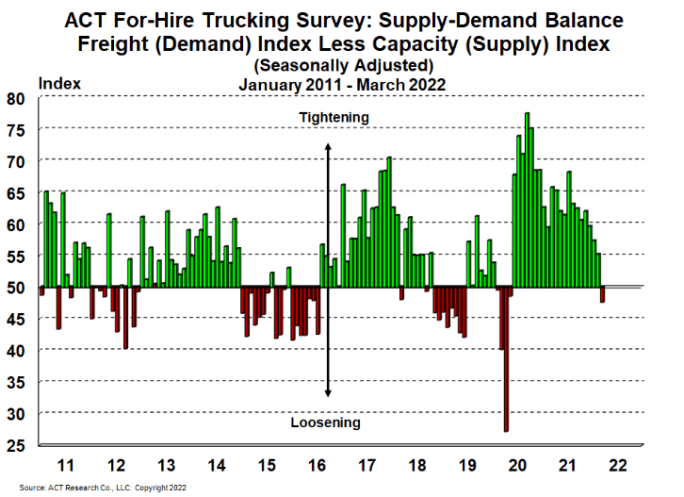
ACT's supply-deman balance survey loosened in March for the first time since 2020.
Source: ACT Research
“As recently as the start of the year, pricing power in the truckload market was firmly with fleets,” said Tim Denoyer, ACT senior analyst. “But once a pendulum gets going, it’s very hard to stop.”
ACT reported that the supply-demand balance in its for-hire survey turned loose this month for the first time since June 2020, “as the rebalancing, drawn-out by the pandemic, hit critical mass," Denoyer said.
The Driver Shortage and Spot Rates
“The driver shortage is over,” said ACT’s Denoyer. “The record drop in spot rates ex-fuel in the past few months has been magnified by Russia and Omicron, but still clearly says the market has shifted to a driver surplus. We’re not adding nearly as much equipment capacity as we typically would, which suggests a possibly shorter-than-normal downcycle.”
FTR’s Vise noted that a stronger supply of drivers is enabling a shift of activity back to the contract environment from spot, but overall freight volume so far has remained strong.
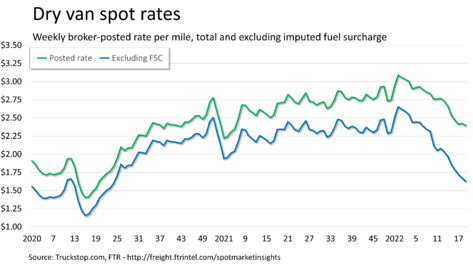
When you take out the fuel surcharge, dry van spot rates have been sliding most of the year.
Source: Truckstop.com
Spot rates for dry van and refrigerated freight have been sliding in the Truckstop.com system for most of 2022. As of its May 16 report, dry van spot rates are down about 69 cents from the record level posted at the end of 2021. Dry van rates were nearly 12% lower than the same 2021 week — but nearly 31% lower if the fuel surcharge is excluded. It’s a similar story with refrigerated spot rates, down nearly $1.33 since hitting a record at the end of 2021, 16% below the same 2021 week but about 33% lower excluding the fuel surcharge.
Contract rates, according to Uber Freight’s Transplace, remain elevated and have not yet followed the spot-market downward trend.
What About the Economy?
ACT’s Denoyer said while the freight sector is a leading indicator, “it’s mainly for the goods economy, rather than the larger service sector. Russia’s war has a tough-to-quantify but clearly adverse macro impact, and softer freight volumes are consistent with a slower economy.”
Vise pointed out that consumer spending is still robust even when adjusted for inflation, and industrial activity is growing.
In the near term, Vise said, “the larger uncertainties relate to potential external shocks — such as the pandemic-related lockdowns in China — and the fate of small carriers that are seeing weaker spot rates and soaring fuel costs. A flood of those drivers back to the security of working directly for larger carriers might accelerate a market normalization, although equipment availability could limit a downside on utilization and rates.”
Kenny Vieth, ACT president and senior analyst, said “the economy is walking a fine line in 2022,” with the effects of inflation, uncertainty about the war in Ukraine, and the impact of Chinese COVID lockdowns on global supply chains. Trucking industry profits tend to lag the freight cycle, so are likely to peak around the third quarter of 2022, he predicted.
“The road ahead looks treacherous, but it is not necessarily bad for carriers,” said FTR’s Vise.
More Fleet Management

Kodiak Lines Up Fleets for Driverless Trucking
An agreement for 75 trucks, a new Texas freight lane, and progress on safety validation move Kodiak closer to its planned driverless highway launch.
Read More →
ITS Logistics Settles Religious Harassment Case
The Nevada-based logistics firm agreed to pay more than $396,000 to settle a religious harassment charge involving an employee's Jewish identity.
Read More →
Your Trucks Are Busy. That Doesn’t Mean They’re Winning.
High utilization doesn’t always mean strong margins. Looking beyond the current load can help fleets make better dispatch decisions and get more value from each truck’s time.
Read More →
Why This Trucking Recovery Is Different
Freight demand remains sluggish, but rising costs and tougher enforcement have taken enough capacity out of the market to change the outlook for motor carriers.
Read More →
Platform Science Adds Dispatch and Safety Tools
Four additions to PS Fleet help fleets monitor loads, manage driver coaching, share truck locations and adjust video system settings.
Read More →
PrePass Intelligence Mines Fleet Bypass, Toll and Safety Data
PrePass Intelligence helps fleets measure bypass savings, flag potential toll overcharges, and spot suspicious transactions by combining data from separate systems.
Read More →
Motive Adds AI Agents for Fleet Operations
New tools automate follow-up on fleet data, from maintenance work orders to driver alerts, with two-way voice conversations planned for later this year.
Read More →
Can You Beat Our Trucking Trivia Challenge?
Test your truck knowledge with 19 trivia questions from Heavy Duty Trucking Exchange. Can you keep up with the fleet pros?
Read More →
BeyondTrucks Adds Rules Checks to Dispatch
New Compatibility Engine checks driver qualifications, equipment requirements and fleet policies before loads are dispatched.
Read More →
Diesel Prices Hijack Trucking’s Worry List
ATRI’s annual survey finds cautious optimism about freight, but diesel costs, litigation, and insurance continue to squeeze fleets. Drivers have different priorities on several issues.
Read More →