




Growth in Truck Freight, Rates to be Slight in 2020: FTR
Barring the unexpected, trucking can generally expect flat to moderate growth in demand and rates in 2020, with most of the growth in the second half of the year.

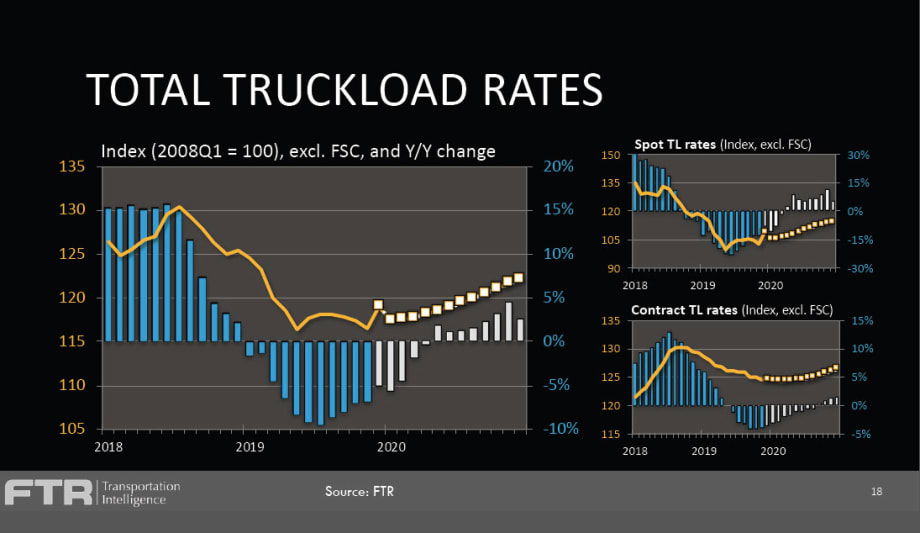
FTR's truckload rate forecast for 2020 is for slight growth.
Graph courtesy FTR
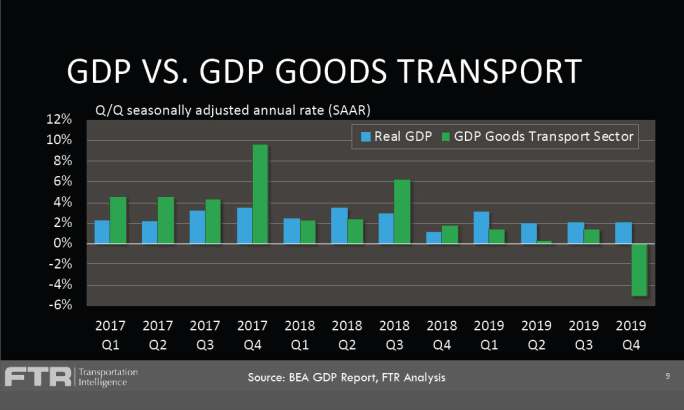
What FTR calls the Goods Transport Sector, the portions of GDP that affect truck freight, performed vastly differently from overall GDP in the last few quarters.
Graph courtesy FTR
Barring the unexpected, trucking can generally expect flat to moderate growth in demand and rates in 2020, with most of the growth in the second half of the year. That’s the takeaway from FTR Associates’ Outlook for Trucking webinar on Feb. 13.
Avery Vise, FTR vice president, trucking, noted that freight-related economic indicators are mixed:
Manufacturing: The ISM index in January rebounded from several months in the negative to basically flat, as orders for durable and core capital goods are basically flat.
Construction: Total construction spending has risen since June and was higher year over year in October and November, while housing starts in December were the highest since 2006.
Housing: Sales of new homes are highest since 2007 and existing home sales are the strongest in nearly two years, while mortgate rates are near all-time lows.
Consumer: Retail sales were at an all-time high in December
Inventories: The inventory-to-sales ratio finally dipped in November, but it had been stuck at its highest level since late 2016. However, Vise noted, e-commerce could be changing views on what this metric should be.
Employment: Payroll job growth has accelerated since mid 2019 and exceeds the average during the recovery, while unemployment is near a 50-year low and wage growth is solid.
Trade: Total U.S. trade in goods was down slightly in 2019, but trade is suffering from global issues, from the U.S. trade war with China to the Coronavirus outbreak. The U.S. Mexico-Canada Agreement, which replaces NAFTA, and the Phase One deal with China should help stabilize the environment, but what will happen with the virus is impossible to predict.
Trucking-Specific Indicators
Turning to more trucking-specific indicators, Vise said FTR’s overall forecast for truck loadings for 2020 is 0.7% growth over the course of the year. “That’s not very much, certainly not from the perspective of for-hire carriers, to stimulate rate growth.” Refrigerated freight will be the clear leader in freight volume this year, he said.
The rate environment so far is trending a little above flat for the year, Vise said. FTR projects the truckload market will see about a 0.4% increase in rates over the course of the year. “We’re in a negative environment now and will get stronger in the second half of the year.” The growth is mostly expected to come from the spot market, offsetting a continued slight decline in contract rates. Again, refrigerated freight is expected to outpace the rest of the industry given the expected growth in volume, and FTR is projecting a 2.5% increased in rates for the year – but flatbed and specialized rates will see a “mildly negative environment,” probably dropping, but by less than 1%.
Of course, demand is only part of the factor in rates; the other is capacity. There are a lot of ways to look at capacity, but Vise used for-hire trucking jobs as a proxy, because the majority of those jobs are drivers, and the majority of capacity. Movement is driven by driver supply. That number has been pretty much flat for the last five months, he said, down 0.4% from an all-time high last July. “Moving forward, we would not expect to see too much growth and possibly some modest losses,” he said.
Trucking Capacity Factors
Several trucking issues may affect capacity this year, Vise said.
Rapidly rising insurance costs, he said, have been a major factor in an above-trend number of carriers losing operating authority over the last five quarters. The latest operating costs survey from the American Transportation Research Institute, which covered costs in 2018, indicated insurance premiums as measured by marginal cost per mile rose 12% in 2018 over 2017, significantly outpacing other operating costs. “Anecdotally, we understand 2019 was much more painful,” Vise said. It’s particularly a problem for smaller carriers, which saw increases in the neighborhood of 50% from 2017 to 2018 when measured in marginal cost per mile, according to ATRI.
Other issues that could affect capacity, utilization, and productivity, and therefore rates, include the final transition to electronic logging devices under the ELD mandate that went into effect in December; and the new drug and alcohol clearinghouse that went into effect in January, along with a rise in the random test rate to 50%.
More Fleet Management

Why Private Fleets Are Taking More Freight
Private fleets are putting their own trucks on demanding customers and high-cost lanes as companies seek greater control over service, costs, and capacity.
Read More →
Color Match Smarter: Tools That Restore & Perform
For fleet managers and collision repair professionals keeping heavy-duty trucks on the road, getting the color right the first time isn't just about appearance — it's about efficiency, turnaround time, and bottom-line results. Discover how today's digital color tools are transforming the repair process from guesswork to precision.
Read More →
FMCSA Pauses Biennial-Update Enforcement Amid Motus Transition
Carriers whose updates were due on or after June 1 have more time, while FMCSA works to stabilize its new registration system and warns of phishing sites impersonating its new carrier registration system, Motus.
Read More →


2026 Blueprint for Countering Smarter Supply Chain Theft
Cargo theft is no longer just the cost of doing business. It's a multi-billion-dollar criminal enterprise exploiting vulnerabilities across your fleet, drivers, and supply chain.
Read More →
How Telematics Improves Visibility, Control, and Performance in Refrigerated Fleets
Explore how telematics help refrigerated fleets improve visibility, uptime, efficiency, compliance, and cargo protection across connected cold chain operations.
Read More →
What the U.S.-Canada Trade War Means for Trucking
Escalating U.S.-Canada tariffs could disrupt cross-border freight, reduce truck volumes, raise costs, and create new uncertainty for carriers on both sides of the border.
Read More →
What Are Trucking’s Top Concerns for 2026?
The American Transportation Research Institute wants to know what's worrying trucking fleet managers, drivers, and other stakeholders in its annual Industry Issues survey.
Read More →
American Trucking Associations Looks for a New Leader
ATA President and CEO Chris Spear abruptly left his job at the association on August 21, at a pivotal time for the trucking industry.
Read More →
Public Wi-Fi Cybersecurity Risks: How Truck Drivers and Fleets Can Protect Their Data
Public Wi-Fi can expose truck drivers and fleets to credential theft, malware, and other cyber threats. Here’s how to reduce the risk on the road.
Read More →
For Nicky Cupp, Fleet Innovation Starts With Frustration
HDT Truck Fleet Innovator Nicky Cupp turns everyday pain points at Fraley & Schilling into opportunities for better technology and smarter processes.
Read More →