




GHG Rule Review Pleases Trailer Makers, Concerns Some Stakeholders
The Trump administration’s announcement that it will revisit parts of the Phase 2 greenhouse gas/fuel economy rules were greeted with cautious optimism by the trailer makers who pushed for the review, but with concern by other parties.

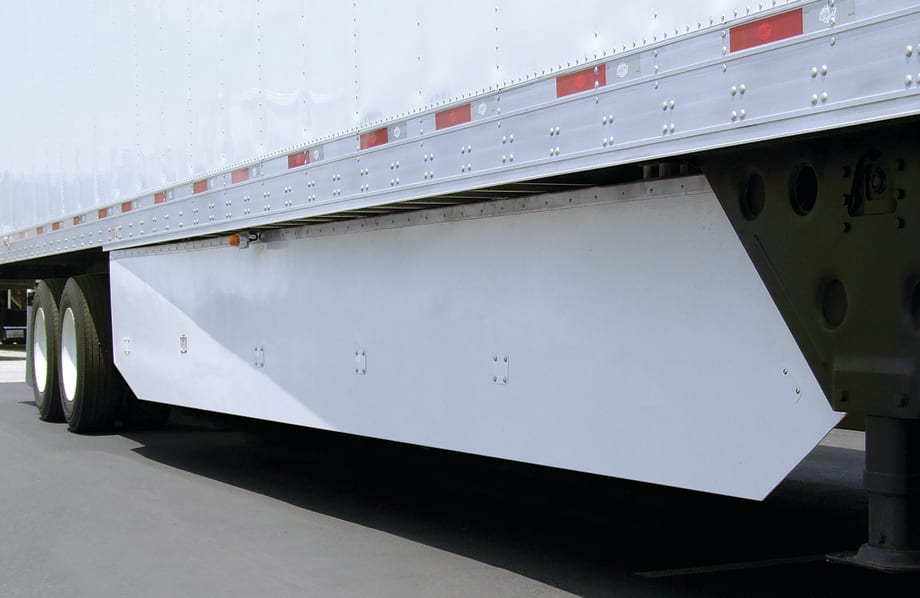
Trailer skirts like this one benefit some carriers, but not enough fleets so they should be mandated, contend trailer makers. Photo: Utility Trailer Mfg.
Trailer skirts like this one benefit some carriers, but not enough fleets so they should be mandated, contend trailer makers.Photo: Utility Trailer Mfg.
The Trump administration’s announcement that it will revisit parts of the Phase 2 greenhouse gas/fuel economy rules were greeted with cautious optimism by the trailer makers who pushed for the review, but with concern by other parties.
The Environmental Protection Agency announced Aug. 17 that it will revisit provisions of the Phase 2 Greenhouse Gas Emissions and Fuel Efficiency Standards, following concerns raised by stakeholders in the trailer and glider industry. The rules were issued jointly by the EPA and the National Highway Traffic Safety Administration in 2016 and are the first time trailers have been covered by a federal emissions regulation.
The Truck Trailer Manufacturers Association, which petitioned the agency to reconsider the rules, says it’s pleased with the agencies announcement, but it hopes the agencies will stay the implementation date while they complete their review.
The rules are still scheduled to begin with January 2018 trailer production, just a few short months away, the association noted in a press release.
“Most heavy-duty trailers are custom-ordered, and the required lead time for scheduling production means that trailer manufacturers are having to quote orders for 2018 delivery that will force customers to purchase equipment they do not want and that will not produce any fuel efficiencies in the customers’ operations," TTMA said.
“Moreover, much of this equipment is still not certified by EPA, so trailer manufacturers are not certain if they can incorporate the equipment into future orders and still comply with the regulations. This is disrupting the normal ordering process and is frustrating both customers and manufacturers.”
TTMA confirmed that on August 17, it received letters from both EPA and NHTSA stating that they have reviewed its petitions for reconsideration of the new greenhouse gas regulations for heavy-duty trailers and agree that further rulemaking is needed.
However, the response also said the agencies had made no decision at this time regarding TTMA’s request for an administrative stay.
The association’s concerns fall into three main areas:
TTMA contends the EPA lacks authority to regulate trailers under the Clean Air Act, because they are not “motor vehicles.” TTMA points out that trailers are neither motorized nor self-propelled. “If Congress had intended for EPA to regulate trailers, it would have included trailers in the definition of a motor vehicle when it enacted the CAA.”
The group contends that for fleets that will benefit from aerodynamic trailer equipment, there is the voluntary EPA SmartWay program to help guide them toward options that will help those fleets save fuel, and that fuel cost “is already a compelling incentive for the owners and operators of heavy trailers to add this equipment where these benefits can be achieved.” But because the benefits of aerodynamics are only realized at certain speeds, TTMA contends that “most trailers are operated in such a way as to get little or no benefit from these design changes” required by the Phase 2 rules. It says EPA used unrealistic speed assumptions for trailer use when it calculated the supposed benefits of the new rules.
TTMA contends that the rules could actually have the opposite of the intended effect – that because the added weight of mandated GHG Phase 2 equipment would result in less cargo being able to be hauled, the regulations would actually result in more miles driven, more trucks on the roads, more greenhouse gases, and more accidents.
At trailer maker Great Dane, Rick Mullininx, executive vice president of engineering, said they are encouraged by the EPA's decision.
"Great Dane earnestly supports making trailers more fuel efficient, and we are actively involved in SuperTruck II to develop new fuel saving technology, but the current EPA regulation for trailers is flawed in that it takes a 'one size fits all' approach which in some cases offers no fuel savings and arguably increases fuel consumption, and even puts some fleets at a disadvantage," he explained.
The EPA's voluntary SmartWay program already helps drive fuel-saving technology based on market conditions, he noted. However, "Given this is only a review of the current regulation, Great Dane will proceed as planned with GHG2 compliance."
Not everyone’s happy
American Trucking Associations, however, is concerned about the move to revisit the rule, saying it could set the stage for California to impose a de facto national standard that's worse.
Noting that ATA worked closely with EPA on both Phase 1 and Phase 2 of the GHG rules, ATA President and CEO Chris Spear said in a statement, “ATA believes a single national standard, set by federal regulators, is preferable to at worst, a patchwork of state standards or at best, a de facto national standard that is set without the appropriate opportunity for the entire regulated community – many members of which are not based in California – to weigh in.”
Indeed, the California Air Resources Board, when asked for its take on the EPA’s move, said the agency “remains committed to achieving continued and additional reductions in greenhouse gas emission reductions from the medium- and heavy-duty transportation sector. CARB is accordingly developing a regulatory proposal to establish greenhouse gas emission standards for new medium- and heavy-duty engines and vehicles that will enable California to meet its unique greenhouse gas and petroleum usage reduction goals.”
ATA will continue to work closely with both EPA and NHTSA as they reopen and consider changes to the final rule” said Glen Kedzie, ATA vice president and energy and environmental counsel.
Mike Roeth, executive director of the North American Council for Freight Efficiency, which researches how fleets are improving fuel economy and freight efficiency, said research has found that “there are many actions fleets can profitably take to improve the efficiency of trailers pulled by heavy-duty tractors, such as aerodynamics for the front, side and rear, improved rolling resistance tires and tire pressure systems. And the rules are challenging manufacturers to improve their total cost of ownership as we are seeing many new products become available for these trailers."
The Environmental Defense Fund criticized the EPA's move, saying in a press release, “EPA and DOT’s plans to weaken the trailer standards are in capitulation to industry requests, ignoring the robust technical record confirming the cost effectiveness of pollution control technologies and efficiency standards for trailers, and the firm legal basis for these standards.”
The International Council on Clean Transportation, a San Francisco-based nonprofit that provides research and analysis to environmental regulators, points out that the EPA and NHTSA did not exactly pull the GHG phase 2 rules out of their hats.
“The agencies undertook a multi-year, comprehensive stakeholder engagement process in creating a regulatory package that will accelerate the development and deployment of cost-effective technologies,” said Ben Sharpe, a researcher in the ICCT's heavy-duty vehicle program, in response to our email. “Across all of the vehicle and equipment types — including trailers and gliders — we believe that the following elements are the key aspects of the standards.”
Attractive economics, with estimated payback times within typical industry expectations.
Long-term standards that allow the industry to have certainty in developing long-term product strategies. “This is particularly significant in the case of trailers, as the U.S. is the first country in the world to establish efficiency standards for trailers.”
International leadership in the heavy-duty vehicle regulatory space; several other governments around the world are deliberating similar efficiency policies.
Flexible provisions for demonstrating compliance, so companies can “continue to provide their customers with the vehicles and equipment that meet their specific operations needs, while driving efficiency technologies into the market.”
Minimized compliance burden. “Based on industry feedback, the standards are explicitly designed to minimize the compliance burden, while ensuring that there is sufficient testing and evaluation to give fleets and the larger stakeholder community confidence that the technologies promoted by the rule will yield the expected fuel savings and economics benefits.”
Updated 5:25 EDT 8/18/2017 to add Great Dane comments.
More Equipment

How Volvo Updated Its D13 for EPA 2027 [Watch]
Volvo’s updated D13 promises lower emissions without sacrificing performance or fuel economy. Take a closer look at what changed inside the engine in this HDT Spotlight video.
Read More →
Michelin Tire Improves Efficiency and Durability for Regional Fleets
The Michelin X Multi Energy D2 is a regional haul drive tire engineered to help fleets improve fuel efficiency, durability and traction in demanding stop-and-go operations.
Read More →
ZF Expands Commercial Vehicle Push in North America
ZF is expanding its North American commercial-vehicle presence with new transmission applications, electrification, trailer technology and autonomous-driving systems.
Read More →
Tesla Wants a Self-Driving Semi. Are Cameras Enough?
Could Tesla’s camera-only autonomous driving technology work on an 80,000-pound Semi? In this commentary, HDT's Deborah Lockridge takes a look at Tesla, Cybercab, and how autonomous trucks see the road.
Read More →
Kodiak: Driverless Long-Haul Truck Launch on Track for 2026
Kodiak AI says its driverless long-haul safety case is 93% complete and it remains on track to begin commercial operations by year-end 2026.
Read More →
What DOT’s Automated Vehicle Strategy Means for Trucking
The U.S. Department of Transportation issued a new automated-vehicle strategy that outlines plans for driverless-truck regulations, cross-state freight corridors, and federal safety standards.
Read More →
East Coast Port Launches $45M Electric Truck Push
The Port Authority of New York and New Jersey announced millions in incentives for zero-emission drayage trucks, yard tractors, and new charging hubs near the port.
Read More →
PlusAI Going Public to Fund Autonomous Truck Launch
A SPAC deal could provide PlusAI with up to $300 million as it works toward a 2027 commercial launch of factory-built autonomous trucks.
Read More →
NHTSA Moves to Rewrite Truck Fuel-Economy Rules
The National Highway Traffic Safety Administration says it lacks authority to regulate medium- and heavy-duty truck engines separately from complete vehicles, but the existing standards have not yet been eliminated.
Read More →
Detroit Opens Orders for EPA 2027 Engines
Detroit isn’t starting from scratch to meet EPA 2027 diesel emissions standards. Its Gen 6 DD13 and DD15 engines keep much of today’s platform while updating the fuel and aftertreatment systems.
Read More →