




GAO Takes on Highway Funding Questions
If you count all the money spent on highways in the last federal transportation program, each state got more than it put in to the Highway Trust Fund. That's because Congress had to make substantial cash infusions from the General Treasury into the trust fund, which did not have enough money to meet its obligations
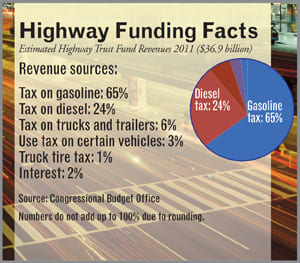
If you count all the money spent on highways in the last federal transportation program, each state got more than it put in to the Highway Trust Fund.
That's because Congress had to make substantial cash infusions from the General Treasury into the trust fund, which did not have enough money to meet its obligations.
If you count just the money collected for the trust fund, then 28 states paid more into the system than they got out, while 22 got more than they paid in.
But that is not a good way to account for highway spending, says the Government Accountability Office in a new report on the performance of the trust fund from 2005 to 2009, under the highway program known as SAFETEA-LU.
When distribution of highway funds is based on the predetermined outcome of returning funds to their attributed state of origin, more important factors such as performance and accountability take second place, GAO said in its report.
The message, said Rep. Nick Rahall, D-W.Va., the ranking member of the House Transportation and Infrastructure Committee, is that in drafting a new highway bill Congress should avoid "being consumed by the parochial 'donor' and 'donee' debate."
"Using rate of return as our rationale for how we spend our limited transportation dollars simply detracts from the nation focus when we ought to look at the larger picture and determine what investment best help create American jobs and grow our economy," he said in a statement.
In its report, which was requested by Rahall and his colleague on the T&I Committee, Peter DeFazio, D-Ore., GAO had several warnings for Congress besides the risk of state-by-state accounting.
It said that the infusion of general revenues, more than $28 billion between 2008 and 2010, into the Highway Trust Fund breaks the link between highway taxes and highway funding. It also complicates the rate-of-return analysis because it does not account for the states' general revenue contributions.
"For many surface transportation programs, goals are numerous and conflicting, and the federal role in achieving the goals is not clear," the agency said.
"Many of these programs have no relationship to the performance of either the transportation system or the grantees receiving federal funds and do not use the best tools and approaches to ensure effective investment decisions."
Another problem with focusing on rate-of-return is that it does not account for the long-term trend in highway funding: Highway Trust Fund receipts are declining, partly because the taxes have not been raised in 18 years and partly because vehicles are becoming more efficient and using less fuel.
More Drivers

When Language Stops the Truck: The Return of ELP Out-of-Service Orders
English language proficiency rules for commercial drivers aren’t new, but renewed out-of-service enforcement has raised the stakes. Here’s what carriers need to know before a driver reaches a roadside inspection.
Read More →
Samsara Launches Custom AI Agent Builder
Agent Studio lets fleets create AI tools for hours-of-service monitoring, reporting and driver support, including agents that communicate by phone.
Read More →
Trucker Path Expands Reserved Parking Network
Trucker Path has added close to 6,000 more truck parking spaces to its Trucker Path Reserved Parking Network with the addition of Safe Truck Parking.
Read More →
EEOC Sues Texas Trucking Company Over Driver Age Limits
The agency says Trancasa USA rejected applicants over 65 and applied tougher driving-record standards to those over 60.
Read More →
Nussbaum, Roehl Announce Second Driver Pay Increase This Year
This year has seen a swath of major truck driver pay increases as freight capacity has tightened.
Read More →
From One Generation to the Next: How Mentorship Builds Safer Truck Drivers
After three decades in trucking, Harold Perry shares what he's learned about driver safety, mentorship, and helping the next generation build confidence behind the wheel.
Read More →
Truck Drivers Need More Than Another Alert
Fleets have more visibility into truck health, safety events, and driver activity than ever. The next challenge is turning all that information into useful guidance for the person who has to decide what to do next.
Read More →
FMCSA Removes 110 Truck Driver Training Schools from Certified ELDT List
Federal regulators also are targeting more than 160 additional training providers and launching a nationwide audit of third-party CDL skills testers as part of a broader crackdown on trucking fraud.
Read More →
Hours of Service Pilot Programs: FMCSA Readies for 2027 Rollout
Two pilot programs could eventually reshape hours-of-service rules, giving truck drivers options to pause their 14-hour clock or use longer split sleeper rest periods.
Read More →
Medical Cards, English Proficiency Reshape Roadcheck Violations
Medical-card violations jumped to the top of the driver out-of-service list during CVSA’s 2026 International Roadcheck, while English-language proficiency violations appeared among the leading violations for the first time.
Read More →