




Fuso Begins Truck Platooning Tests in Japan
Daimler's Fuso subsidiary has begun platooning test operations outside of Tokyo as part of the Japanese government's plans to boost technology investment and deployment in the near future.
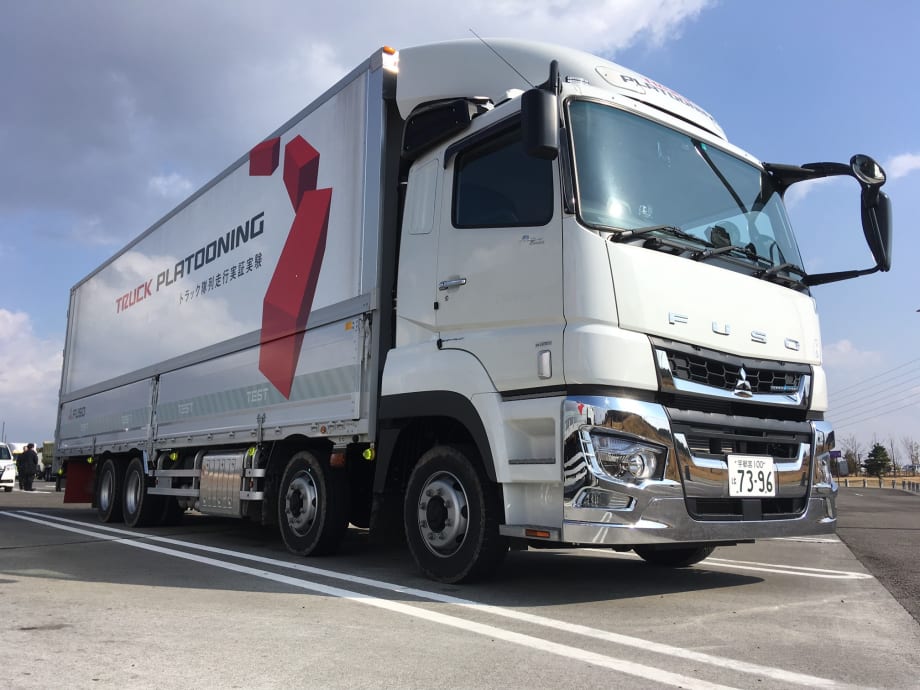
Daimler Trucks is testing Fuso Super Great heavy trucks in platooning runs with other truck brands on public roads outside Tokyo. Photo: Fuso
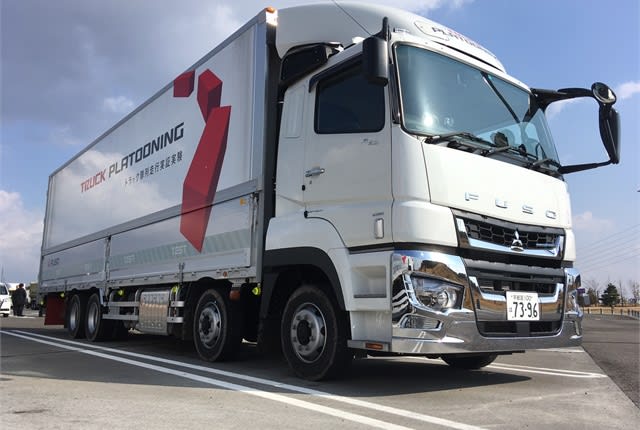
Daimler Trucks is testing Fuso Super Great heavy trucks in platooning runs with other truck brands on public roads outside Tokyo. Photo: Fuso
If there’s one traditionally tech-crazy country that’s largely been absent on the autonomous vehicle front to date, it’s Japan. But all of that may be about to change.
Daimler Trucks detailed its current vehicle-to-vehicle communications (V2V) efforts in The Land of the Rising Sun, including joint operation with other manufacturers' trucks on public roads around greater Tokyo.
After testing the electronic connection of trucks (truck platooning) in Europe and the US, Daimler Trucks said it is now also operating test runs of truck platoons in Japan with its Asian brand Fuso. During these tests, a heavy-duty Fuso Super Great truck model operates electronically connected to other trucks in a semi-autonomous control mode to maintain a platoon with trucks of other Japanese commercial vehicle manufacturers. The test drives are taking place Jan. 23-Feb. 1 on Shin-Tomei Expressway southwest of Tokyo and on Kita-Kano Expressway, north of the Japanese capital.
The Japanese ministry of economy, trade and industry, along with the ministry of land, infrastructure, transport and tourism, initiated the platooning test. The project is part of the Japanese government’s Future Strategy 2017, which aims to roll out innovations like the Internet of Things, big data and artificial intelligence across all industries. In the commercial vehicle sector, truck platooning will contribute to the reduction of fuel consumption and to lower CO2 emissions. In addition, truck platooning may help with Japan’s dramatic driver shortage issue.
Daimler Trucks has been doing pioneer work in autonomous, connected and electric driving with its truck brands Mercedes-Benz, Freightliner and Fuso. Throughout the globe, Daimler Trucks says it now has around 560,000 trucks to the Internet of Things, and says that is more than any other manufacturer.
For the digital connection of the Fuso Super Great during the platooning test, Daimler Trucks is combining the technological possibilities of connectivity with its experiences in the field of autonomous driving. The Wi-Fi-based V2V system interacts with driver-assistance systems, which are also used in Daimler-brands Mercedes-Benz and Freightliner. Some of those are Cooperative Adaptive Cruise Control, Lane Departure Assist and Active Brake Assist 4.
In 2014, Daimler Trucks launched the truck-concept Mercedes-Benz Future Truck 2025 with autonomous driving function. Its designated aim was to develop the autonomous driving technology for series production until 2025. The following year, Daimler introduced Highway Pilot in Germany. In 2016, Daimler took part in the Dutch government’s initiative European Truck Platooning Challenge with three electronically connected and semi-autonomous driving Mercedes-Benz Actros.
In the U.S., the Freightliner Inspiration Truck has been driving in a so-called pairing-configuration (two electronically connected trucks) on public roads in Nevada and Oregon, since 2017.
The Fuso Super Great is the first model of a Daimler-brand to drive in a platoon with other trucks in the key market Japan.
Martin Daum, who heads up Daimler AG's truck and bus operations, said, “Two years ago, we demonstrated with Mercedes-Benz trucks in Europe that platooning can be done and is highly advantageous. Right now, we keep developing the technology with Freightliner on public roads in the US. Japan is a key market for us that is on the lookout and promotes new technologies. We take part in the Japanese government’s initiative to push platooning further ahead in Asia and to remain in the lead in the development of this technology."
More Equipment

How Volvo Updated Its D13 for EPA 2027 [Watch]
Volvo’s updated D13 promises lower emissions without sacrificing performance or fuel economy. Take a closer look at what changed inside the engine in this HDT Spotlight video.
Read More →
Michelin Tire Improves Efficiency and Durability for Regional Fleets
The Michelin X Multi Energy D2 is a regional haul drive tire engineered to help fleets improve fuel efficiency, durability and traction in demanding stop-and-go operations.
Read More →
ZF Expands Commercial Vehicle Push in North America
ZF is expanding its North American commercial-vehicle presence with new transmission applications, electrification, trailer technology and autonomous-driving systems.
Read More →
Tesla Wants a Self-Driving Semi. Are Cameras Enough?
Could Tesla’s camera-only autonomous driving technology work on an 80,000-pound Semi? In this commentary, HDT's Deborah Lockridge takes a look at Tesla, Cybercab, and how autonomous trucks see the road.
Read More →
Kodiak: Driverless Long-Haul Truck Launch on Track for 2026
Kodiak AI says its driverless long-haul safety case is 93% complete and it remains on track to begin commercial operations by year-end 2026.
Read More →
What DOT’s Automated Vehicle Strategy Means for Trucking
The U.S. Department of Transportation issued a new automated-vehicle strategy that outlines plans for driverless-truck regulations, cross-state freight corridors, and federal safety standards.
Read More →
East Coast Port Launches $45M Electric Truck Push
The Port Authority of New York and New Jersey announced millions in incentives for zero-emission drayage trucks, yard tractors, and new charging hubs near the port.
Read More →
PlusAI Going Public to Fund Autonomous Truck Launch
A SPAC deal could provide PlusAI with up to $300 million as it works toward a 2027 commercial launch of factory-built autonomous trucks.
Read More →
NHTSA Moves to Rewrite Truck Fuel-Economy Rules
The National Highway Traffic Safety Administration says it lacks authority to regulate medium- and heavy-duty truck engines separately from complete vehicles, but the existing standards have not yet been eliminated.
Read More →
Detroit Opens Orders for EPA 2027 Engines
Detroit isn’t starting from scratch to meet EPA 2027 diesel emissions standards. Its Gen 6 DD13 and DD15 engines keep much of today’s platform while updating the fuel and aftertreatment systems.
Read More →