




Daimler Trucks Unveils Long-Term Plan for Autonomous-Driving Trucks
Daimler Trucks on Thursday shared its vision of the future of trucking trucks that can drive themselves, saying they could help solve the driver shortage problem -- but not by taking drivers out of trucks altogether. The autonomous truck project, called Mercedes-Benz Future Truck 2025, was demonstrated on a section of the A14 Autobahn.


Daimler Trucks' Future Truck 2025, disguised in black and white adhesive foil, obscuring the exterior contours. (PHOTO: Daimler Trucks)
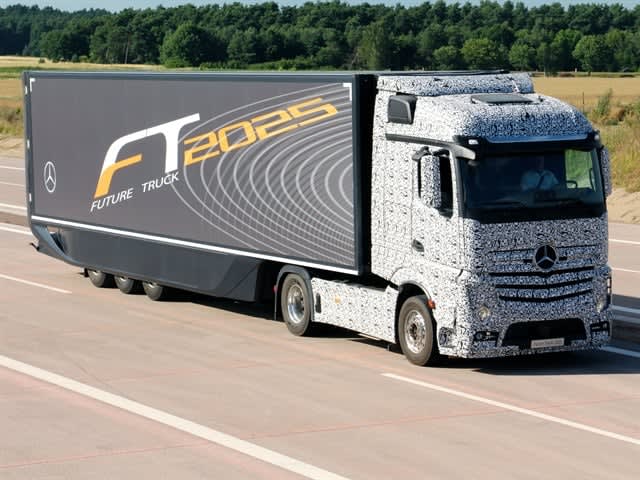
Daimler Trucks' Future Truck 2025, disguised in black and white adhesive foil, obscuring the exterior contours. (PHOTO: Daimler Trucks)
MAGDEBURG, GERMANY -- Daimler Trucks on Thursday shared its vision of the future of trucking trucks that can drive themselves.
The autonomous truck project, called Mercedes-Benz Future Truck 2025, was demonstrated to around 300 members of the trucking press, along with German government officials, market analysts and others from more than 30 nations. After listening to presentations, attendees watched a demonstration on a section of the A14 Autobahn, as the parent to truck makers Freightliner and Western Star showed off what it calls its Highway Pilot system.
It completed its first autonomous journey on the route, using a specially equipped Mercedes Actros tractor-trailer. A driver was inside the cab, but without hands or feet on the controls. The Future Truck drove itself in simulated real-world driving conditions.
“The truck is equipped with the extremely intelligent Highway Pilot assistance system, which enables it to drive completely autonomously at speeds of up to 85 kilometers per hour (52.8 mph),” said Wolfgang Bernhard, head of Daimler Trucks and Buses. “The Future Truck 2025 is our response to the major challenges and opportunities associated with road freight in the future.”
Bernhard said self-driving trucks not only could lead to more efficiency, but also to better safety and connectivity. This, he said, results “in a more sustainable transport system to the benefit of the economy, society and consumers.”
The goal of the event, according to Daimler, was to establish an ongoing dialogue with stakeholders about the conditions for transport in the future, in which it believes self-driving trucks will play a major role.
Bernhard conceded the ambitious project, which it hopes to implement by the year 2025, “raises a lot of questions that need to be answered,” such as legal and liability issues, among many others.
Daimler said current figures carry a clear message of the need for the Highway Pilot system. It pointed to a study showing a clear majority of road goods traffic as a proportion of total goods traffic in the six most populated European Union member nations. Truck transport volume in Europe is expected to grow dramatically over the next more than dozen years, and separate studies have shown much the same in the U.S. The EU study also found that, as in the U.S., investment in transportation infrastructure is regressive, with the transport business suffering from cost pressures and a shortage of drivers.
According to Daimler the Highway Pilot will “significantly upgrade the job profile of truck drivers” by not only freeing them from having to perform monotonous tasks, but also by giving them time for tasks currently handled by other workers at trucking companies, “making it possible for truckers to advance to new positions as transport managers, making truck driving a more attractive profession” and helping to reduce the shortage of truck drivers.
Future Truck 2025 builds on Daimler’s technological experience, with its Mercedes-Benz operation having already installed driver assistance in its trucks abroad, along with proximity cruise control, automatic braking, stability control and lane-keeping assistance systems. Future Truck includes Predictive Powertrain Control, which uses information about road topography and route characteristics to adjust the operation of the drivetrain in order to maximize fuel economy, according to Daimler.
The Highway Pilot uses a combination of radar sensors at the front and sides of the truck, a stereo camera behind the windshield, three-dimensional maps and V2V/V2I communication (vehicle to vehicle/vehicle to infrastructure), which is the exchange of information between the truck and other vehicles and with the roadway. This system, according to Daimler, allows the truck to automatically respond to any situation ahead on the highway.
Daimler expects additional and improved assistance systems in the coming years, which will communicate with one another and enable vehicles to operate without any driver involvement on highways and major roadways. However, they said, a driver would always be present in the truck, including driving it to and from major roadways manually.
Once on the highway, the driver simply activates the Highway Pilot, with the rig continuing to travel at the set speed, while the driver’s seat moves backwards and to the right, similar to sitting in an armchair at home.
Other benefits of Future Truck 2025, according to Daimler, will include or allow: optimal vehicle acceleration and braking to keep traffic moving at an optimal pace while reducing fuel consumption and truck emissions; more precise transport scheduling; taking up less roadway and creating fewer traffic tie-ups and lessening the risk of accidents.
Key to making Future Truck 2025 work are changes in laws and regulations, according to Daimler.
“If the legislative framework for autonomous driving can be created quickly, the launch of the Highway Pilot is conceivable by the middle of the next decade” said Bernhard. He pointed to recent EU regulatory changes, which he said he have already helped get the ball rolling, with hopes it would spur development and implementation in North America.
Daimler Trucks' autonomous truck project, called Mercedes-Benz Future Truck 2025, was demonstrated on a section of the A14 Autobahn near Magdeburg, Germany, in simulated real-world conditions. In this clip, the truck (disguised in black and white adhesive foil, obscuring the exterior contours) autonomously begins executing a passing maneuver in moving from the right to the left lane. (Video: Evan Lockridge)
More Drivers

From One Generation to the Next: How Mentorship Builds Safer Truck Drivers
After three decades in trucking, Harold Perry shares what he's learned about driver safety, mentorship, and helping the next generation build confidence behind the wheel.
Read More →
Truck Drivers Need More Than Another Alert
Fleets have more visibility into truck health, safety events, and driver activity than ever. The next challenge is turning all that information into useful guidance for the person who has to decide what to do next.
Read More →
FMCSA Removes 110 Truck Driver Training Schools from Certified ELDT List
Federal regulators also are targeting more than 160 additional training providers and launching a nationwide audit of third-party CDL skills testers as part of a broader crackdown on trucking fraud.
Read More →
Hours of Service Pilot Programs: FMCSA Readies for 2027 Rollout
Two pilot programs could eventually reshape hours-of-service rules, giving truck drivers options to pause their 14-hour clock or use longer split sleeper rest periods.
Read More →
Medical Cards, English Proficiency Reshape Roadcheck Violations
Medical-card violations jumped to the top of the driver out-of-service list during CVSA’s 2026 International Roadcheck, while English-language proficiency violations appeared among the leading violations for the first time.
Read More →
Driver Trust Can Make or Break the Success of Fleet Safety Technology
New Teletrac Navman research suggests that onboarding, transparency about driver data, and positive feedback can play a significant role in how commercial drivers respond to safety and coaching technology.
Read More →
EEOC Sues KLLM Over Alleged Sex Discrimination in Driver Training
KLLM is facing a federal sex-discrimination lawsuit over policies the EEOC alleges put female truck driver trainees at a disadvantage.
Read More →
FMCSA Moves to Codify English Language Requirements for Commercial Drivers
By changing regulations on English-language proficiency requirements for commercial drivers, rather than relying on a guidance memo, the FMCSA said future administrations won't be able to walk back the Trump administration's stricter enforcement with just a memo.
Read More →
Drivers Put Western Star Trucks to the Test at Star Nation Experience
Watch to get an inside look at the Western Star trucks, technology, and community behind the Star Nation Experience 2026!
Read More →
Trump Administration Looks to Put More Veterans Behind the Wheel
The Freedom Haulers program pulls together existing and expanded programs at several federal agencies to recruit veterans to drive commercial heavy-duty trucks and cut the red tape for them to get a CDL, training, and employment.
Read More →