




Daimler Unveils Highway Pilot Connect Truck Platooning
Daimler Trucks Monday unveiled the Highway Pilot Connect, a truck platooning system that has already been approved for use in a limited area in Germany, while its Highway Pilot autonomous driving system has been approved for use throughout the country.
by Staff
March 21, 2016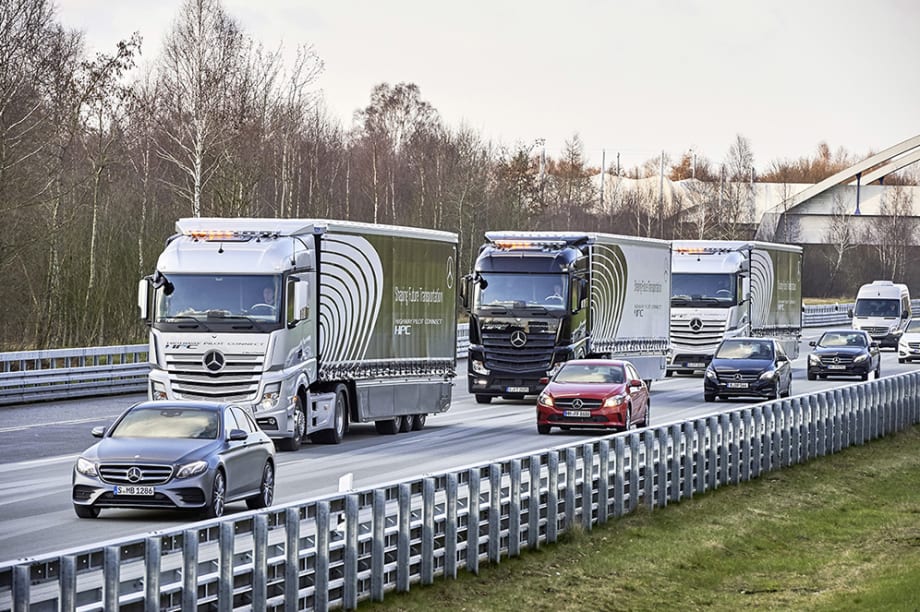
Daimler demonstrates a platoon of three trucks with Highway Pilot Connect. Photo: Daimler Trucks
4 min to read
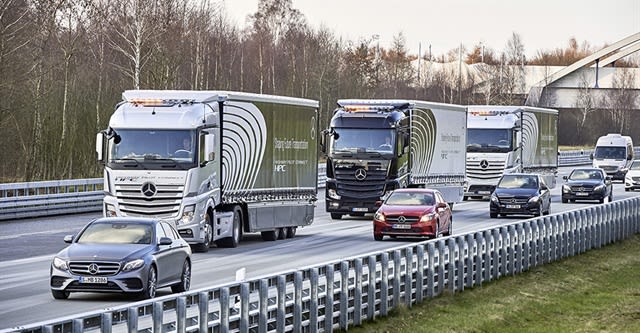
Daimler demonstrates a platoon of three trucks with Highway Pilot Connect.Photo: Daimler Trucks
DUSSELDORF, GERMANY — Daimler Trucks Monday unveiled the Highway Pilot Connect, a truck platooning system that has already been approved for use in a limited area in Germany, while its Highway Pilot autonomous driving system has been approved for use throughout the country.
The company said the new platooning system offers up to 7% lower fuel consumption and correspondingly lower CO2 emissions, plus only half of the previously required traffic space
Daimler originally unveiled the Highway Pilot in Germany in 2014 in a demonstration as part of its Future Truck 2025 initiative. They followed up in 2015 with the Freightliner Inspiration Truck in North America, and then put the Highway Pilot into a standard Mercedes-Benz Actros.
Highway Pilot Connect is the next step.
"We all know, platoons are not completely new.... but what we do today is not just more of the same ... it's not just another platoon," explained Sven Ennerst, who heads up Daimler Trucks' global development. "Our platoon today is something the world has never seen before... the reason is the trucks in our platoon are semi-autonomous trucks," running the latest version of the Highway Pilot system and the new Highway Pilot Connect.
The basis of Highway Pilot Connect is networking between vehicles and precise awareness of the surroundings, Daimler said. On the highway, the three semitrailer combinations form a platoon with each operating only 15 meters (just under 50 feet) apart.
Unlike other platooning systems, Daimler said, Highway Pilot Connect is unique in that it uses semi-autonomous trucks.
The Highway Pilot is now approved for use on public roads throughout Germany, while Highway Pilot Connect is approved for platoon driving within the federal state of Baden-Württemberg, for the complete A81 autobahn from Lake Constance to Würzburg. Only the greater Stuttgart area is excluded. Daimler has received an additional approval for the A52 in the greater Düsseldorf area. Further demonstration and test drives are possible with individually granted exceptional permission.
How it works
Highway Pilot Connect is an example of electronic vehicle-to-vehicle (V2V) networking. Compared to the Highway Pilot, Highway Pilot Connect has additional technical functions. The vehicles are equipped with both linear and lateral guidance systems. Although they are connected to each other as a platoon for a specific route, they can each be operated independently as autonomously driving trucks.
The fully automated lateral guidance provided by the Highway Pilot and Highway Pilot Connect allow automated driving through active steering intervention, which eases driver workload when convoy driving over monotonous long distances, says the company.
Networking between vehicles is made possible by an onboard telematics platform. This communicates using WLAN standard IEEE 802.11p, which is used only for automotive V2V applications. While the Highway Pilot drives semi-autonomously – i.e. with automated lateral and linear control – and is not networked with other vehicles, Highway Pilot Connect communicates with other trucks and the infrastructure. It uses a combination of a radio processor and a dual multiband HF transmitter/receiver. This means that information critical to safety, e.g. recognizing emergency braking when it occurs, can be transferred within 0.1 seconds.
The system also includes a three-dimensional digital map allowing the truck to always be fully aware of the road's course and topography. In addition the digital map and the information from multisensor fusion are used to determine the truck's own position.
In the Cab
Using a seat occupancy sensor plus seat belt buckle and hands-on detection, Highway Pilot Connect checks whether the driver is in his seat and able to intervene if necessary.
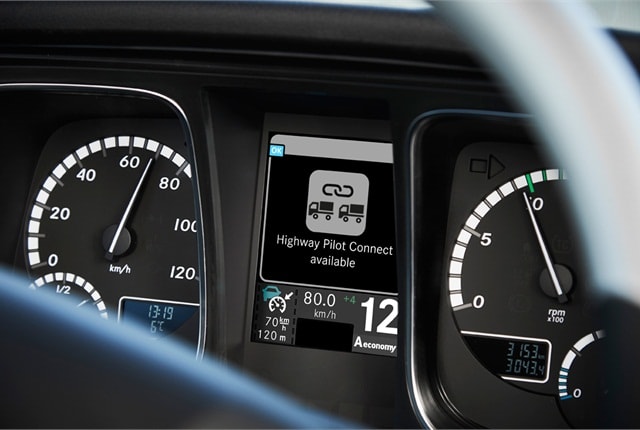
The dash display indicates Highway Pilot Connect is available.Photo: Daimler Trucks
The driver of a semitrailer combination uses the blue button provided to activate the Highway Pilot and to switch from manual to automated driving mode. The Highway Pilot sends out a signal: "Highway Pilot Connect available." If another truck wishes to join as a platoon, its driver presses a second light-blue button in the cockpit. His truck now automatically links up with the lead truck and reduces the distance between them to 15 meters.
The driver receives information about the status of the platoon and the traffic situation via an 8-inch monitor in the instrument panel. This displays route information as well as the vehicle's position within the platoon as a map graphic. In addition the individual drivers are always kept aware of the traffic situation. A camera in the lead vehicle records the driving situation ahead of the truck. Its images are transferred to all the vehicles in the convoy by WLAN, and shown on each monitor.
More vehicles can connect to the platoon as it forms. The maximum length of a platoon is not limited by the range of the transmission signals, but by the number of vehicles. As a stable connection must be assured at all times, and a "concertina" effect can occur from a certain platoon length onwards owing to braking and moving off within the convoy, which would give rise to tailbacks, it is not appropriate to link more than 10 vehicles, Daimler says.
Watch for a more comprehensive report from the event from Executive Editor David Cullen.
More Safety & Compliance

FMCSA Pauses Biennial-Update Enforcement Amid Motus Transition
Carriers whose updates were due on or after June 1 have more time, while FMCSA works to stabilize its new registration system and warns of phishing sites impersonating its new carrier registration system, Motus.
Read More →
ZF Expands Commercial Vehicle Push in North America
ZF is expanding its North American commercial-vehicle presence with new transmission applications, electrification, trailer technology and autonomous-driving systems.
Read More →
Truck Drivers Need More Than Another Alert
Fleets have more visibility into truck health, safety events, and driver activity than ever. The next challenge is turning all that information into useful guidance for the person who has to decide what to do next.
Read More →
Tesla Wants a Self-Driving Semi. Are Cameras Enough?
Could Tesla’s camera-only autonomous driving technology work on an 80,000-pound Semi? In this commentary, HDT's Deborah Lockridge takes a look at Tesla, Cybercab, and how autonomous trucks see the road.
Read More →
What DOT’s Automated Vehicle Strategy Means for Trucking
The U.S. Department of Transportation issued a new automated-vehicle strategy that outlines plans for driverless-truck regulations, cross-state freight corridors, and federal safety standards.
Read More →
NYC Expands Speed, Pedestrian Safety Tech Across Fleet
New York City is expanding intelligent speed assistance and pedestrian-alert systems across its municipal fleet, moving the technologies from pilot programs into vehicle procurement and retrofit requirements.
Read More →
FMCSA Removes 110 Truck Driver Training Schools from Certified ELDT List
Federal regulators also are targeting more than 160 additional training providers and launching a nationwide audit of third-party CDL skills testers as part of a broader crackdown on trucking fraud.
Read More →
Beyond DOT Compliance: What Makes a Trucking Fleet Truly Safe?
A trucking fleet can follow every rule and still make unsafe decisions. The real test comes when safety conflicts with freight, productivity, or cost.
Read More →
Hours of Service Pilot Programs: FMCSA Readies for 2027 Rollout
Two pilot programs could eventually reshape hours-of-service rules, giving truck drivers options to pause their 14-hour clock or use longer split sleeper rest periods.
Read More →
New Guide Offers Pet Safety Tips for Truck Drivers
Hundreds of thousands of pets travel in truck cabs. A new safety guide from Volvo Trucks and the Center for Pet Safety offers practical advice for truck drivers who bring dogs and cats along for the ride.
Read More →