





Related Video: A Quick Look at Freightliner's Autonomous Truck at Work
Hands-off on the Highway
There are still a few misconceptions about autonomous commercial vehicles. They are not driverless trucks, but trucks that help make drivers' lives a little easier and roadways safer through the use of advanced technology. Jim Park takes a ride in Daimler's Inspiration Truck.
May 7, 2015
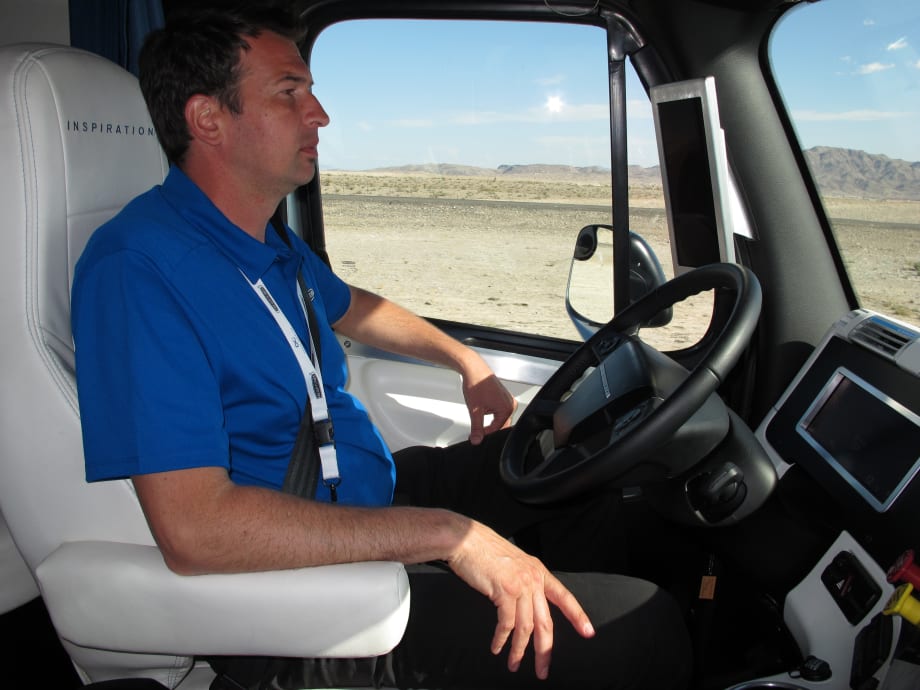
Driver Antonio Edgar, an electrical engineer in the vehicle test group, kept his hands in his lap while operating at highway speeds. Photo by Jim Park
6 min to read

Whether or not we will ever share the road with truly driverless trucks is a story for another day. But Daimler Trucks North America brought that possibility a little closer to reality with a full-blown test-drive of the technology that will be instrumental in making it happen.
Editors and reporters from all over the world rode in trucks that steered themselves along a busy highway, right alongside other trucks, motorcycles, cars and everything else that shares trucking's workspace. I'll bet none of those other drivers was even aware of the fact that the truck driver's hands were in his lap much of the time.
Daimler Trucks North America showcased the North American version of its autonomous commercial vehicle, called the Freightliner Inspiration Truck, at a global media event in Las Vegas, Nevada, the first state to permit the operation of autonomous trucks.
The technology that supports hands-free operation of the truck is still in its infancy, and so is the terminology we use to describe it. To be clear, the Inspiration Truck, and subsequent generations of the truck, will not be driverless trucks – they will not pull away from loading docks crammed with freight, navigate to the nearest Interstate and motor on through the hours and possibly days it takes to arrive at destination with no human onboard.
The Inspiration Truck has the capacity to be operated autonomously. The driver can safely release the steering wheel and take his or her feet away from the pedals while the truck maintains its speed and lane position without human intervention. At least for now, the regulations in Nevada require the driver to remain at the controls at all times (and to have a second driver in the passenger seat).
As Martin Zeilinger, head of Advanced Engineering at Daimler Trucks AG, explained, there are already a lot of automated safety features on today's trucks, such as antilock brakes, cruise control, even electronic stability control.
"The U.S. National Highway Traffic Safety Administration currently defines five levels of vehicle automation," he explained. Level 0 is no automation. In Level 1, "function specific" automation, certain functions such as ABS brakes are automated. At Level 2, you find combined-function automation where at least two primary controls can assist the driver, such as adaptive cruise control and integrated powertrain management (IPM), where the driver maintains steering control but the system is controlling throttle and brakes.
Level 3 is where we find limited self driving automation, where the driver can cede full control of safety-critical functions to the vehicle under certain conditions. The driver, however, must be able to take over at any time. Level 4 would be a full self-driving vehicle. Such a system would not allow driver control at any point during the trip other than entering navigation information.
"The Inspiration Truck is a prime example of a Level 3," Zeilinger said, "but there is still a lot of road ahead of us before Freightliner goes into production with Level 3 technology."

Al Pearson, director of Freightliner's vehicle test group, said Freightiner is not interested in pursuing Level 4. "The emphasis at DTNA is exploring Level 3 through the Freightliner Inspiration Truck," he says. "We not only want the driver to be in the truck, we want the truck to be the driver's partner."
While it may sound futuristic, much of the hard technology that makes limited autonomous control possible is already deployed in current production models like the Cascadia Evolution. These include the Detroit Assurance suite of safety systems (active brake assist, adaptive cruise control and optional lane departure warning) and lane departure warning systems. The lane keeping system on the Inspiration Truck builds on the current LDW technology using a stereo camera system to maintain trucks' lane position.
Combined, all the technology that makes limited self-control possible is called Highway Pilot.
On the road
While no one other than DTNA authorized drivers were allowed to operate the Innovation Truck, reporters were eager for rides in the trucks -- there are currently two of them on the road in North America.
Most of the group got a 20-minute ride, beginning at the Las Vegas Motor Speedway north of the city, just off of Interstate 15. The ride consisted of about 3 miles along Las Vegas Blvd, 4 miles along I-15. During both of those stretches, our driver, Antonio Edgar, an electrical engineer in the vehicle test group, kept his hands in his lap. He did negotiate the turns onto and off of the freeway, as well as maneuvering through the parking lot and side streets, but it was hands off the rest of the time.

This test drive was notable because it took place on a public highway, not a track or a closed course. Consequently, there were no opportunities for evasive maneuvers or stunt driving. It was actually a rather uneventful affair. However, it was rather windy during the drive, and I found it remarkable how well the truck maintained its lane position even in the stiff crosswinds. I had driven another truck over the same course an hour earlier and had to work to keep it between the lines.
The Innovation Truck was able to maintain lane position with much finer steering inputs than I could have made. The steering wheel pivoted back and forth constantly by four or five degrees, but the movement was barely noticeable in the cab. We didn't run into a situation where a lane change was required, but on a stretch of Las Vegas Blvd, an S-turn was required and the truck negotiated that without the aid of the driver. It was a very deliberate movement, first to the left, then straight; then to the right and then straight once again. The trailer tracked perfectly through the curves.
Clearly the technology is up to the task of maintaining good lane position and negotiating simple turns. We are told it can do more, and with the predictive cruise, adaptive cruise and active braking all looking out for everyone's safety, it's said to be a perfectly safe vehicle.
Among the obvious applications for such technology is platooning, where two, three or more trucks follow a lead truck in close proximity to gain the benefits of slipstreaming. Following at a distance of perhaps 25 feet at 65 mph would be frowned upon universally by safety departments, but with all the technology Highway Pilot brings to the game, it could be a serious -- and safe -- fuel saver. When the lead truck brakes, the following trucks can apply brakes in a faction of a second compared to a second or more in human reaction time.

The system is fairly simple on the surface. The camera recognizes lane markings and communicates through the computer controls with the steering gear. While Cascadia Evolution uses adaptive cruise control, the Inspiration Truck has ACC plus, which combines active cruise and distance control in combination with the ability to stop and go without driver intervention. It can control distance and speed from 0 mph to maximum rated speed, currently limited to 55 mph.
What we saw in Las Vegas could be the near-term future of freight transportation, provided all the necessary regulatory approvals eventually fall into place. The Innovation Truck and its immediate successors will not replace drivers. They are intended to relieve some of the drudgery and boredom of driving and in the process make it safer for everyone.
"The Innovation Truck never gets tired, it never gets distracted and it never takes its full attention off the task," says DTNA president and CEO, Martin Daum in opening remarks to the session.
However, there will be those who continue to think the way some pilots did when early versions of autopilot were first introduced.
"The perfect cockpit team consists of an autopilot, a pilot and a dog," goes an old aviation joke. The autopilot is there to fly the plane, the pilot is there to feed the dog, and the dog is there to bite the pilot if he touches anything."
Subscribe to Our Newsletter
More Drivers
How Fraley & Schilling Improved Logbook Compliance by Over 50%
Fraley & Schilling needed a way to close a compliance workflow gap in its ELD system without adding more work from driver training, reminders, and back-office follow-ups. It found the answer in a custom driver app.
Read More →
Volvo Goes Gaming
Volvo has roared into American Truck Simulator with two new flagship trucks.
Read More →
What the Best Fleets to Drive For Teach About Driver Retention
Survey fatigue, AI-powered routing, owner-operator expectations, and the decline of social media all emerged as themes from this year's Best Fleets to Drive For program.
Read More →
Driver Retention Lessons From the Best Fleets to Drive For
What separates trucking's best workplaces from the rest? Jane Jazrawy shares the biggest lessons from this year's Best Fleets to Drive For program on driver retention, communication, AI, and workforce trends on the HDT Talks Trucking podcast.
Read More →
Farewell, CDL: Why I'm Giving Up My Commercial Driver's License
After more than 20 years as a CDL holder, HDT Executive Editor Jack Roberts is letting his commercial license expire. Not because he wants to — but because trucking's nuclear verdict crisis has made the risks of public-road test drives too great for editors, manufacturers, and everyone involved.
Read More →
How Top Trucking Fleets Improve Driver Retention [Video]
What do healthy snacks, optimized routing, and just picking up the phone have in common? They're all strategies the Best Fleets to Drive For are using to retain truck drivers.
Read More →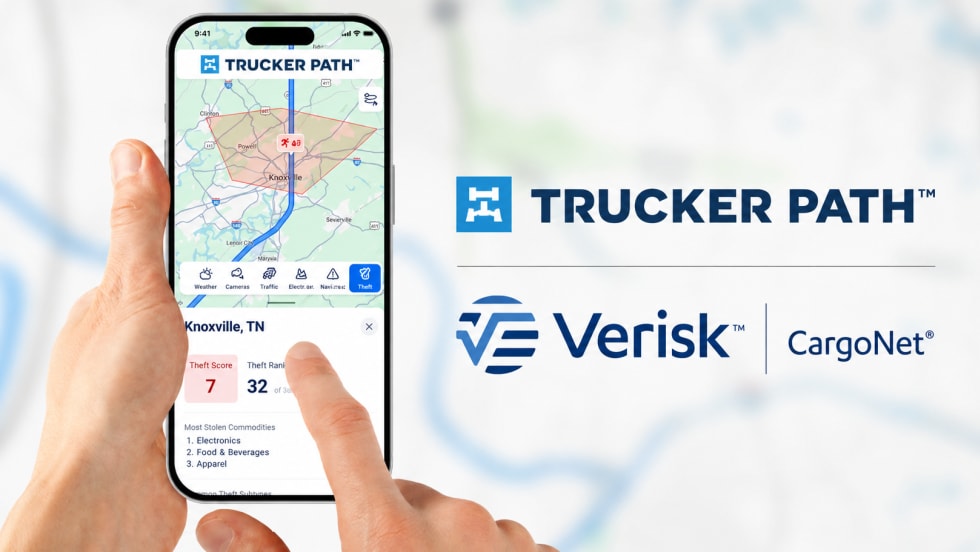
Trucker Path Adds Verisk CargoNet Theft Data to Navigation Platform
Trucker Path’s new cargo theft risk overlays give drivers and fleets visibility into high-risk areas, stolen commodity trends, and theft hotspots.
Read More →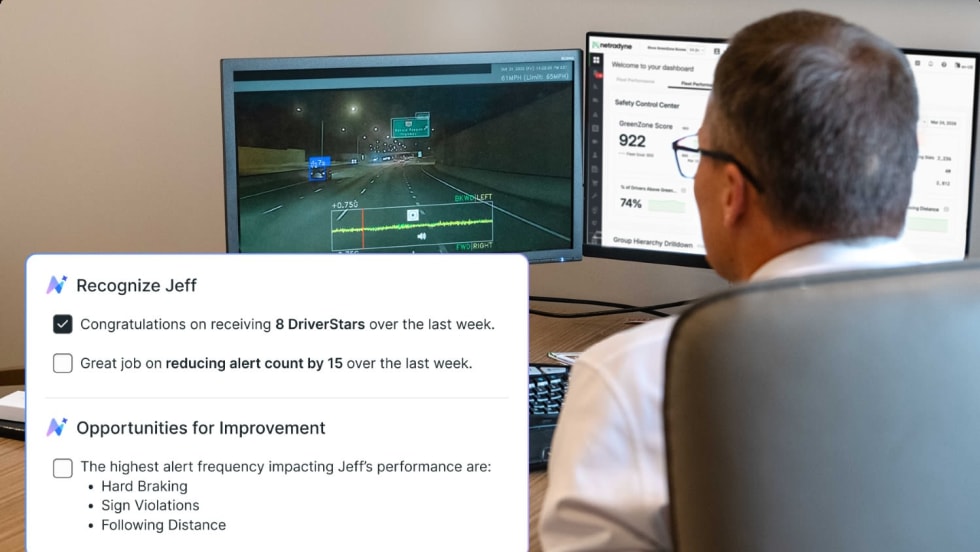
Netradyne Intelligence Uses New AI Agents to Automate Response to In-Cab Camera Data
The company called the next-generation in-cab camera safety platform "a fundamental shift from systems that report on what happened to systems that actively drive what should happen next."
Read More →
Why Truck Detention Keeps Costing Fleets Time and Money
A 2024 ATRI study found detention affects nearly 40% of truckload stops and costs the industry more than $15 billion annually. Despite the toll on drivers, fleets, and supply chains, the problem remains stubbornly persistent.
Read More →
Prime Inc. to Open $7.9M Flagship Used-Truck Dealership
A new driver-focused facility to sell Prime Inc's used trucks and trailers will be the first purpose-built location in the company's history.
Read More →