





Also of Interest: Rethinking Driver Pay
Fuel, Maintenance, Drivers Push Operational Costs Higher
The total marginal cost of trucking grew by 12.7% in 2021 to $1.855 per mile, the highest on record, according to the American Transportation Research Institute.
August 11, 2022
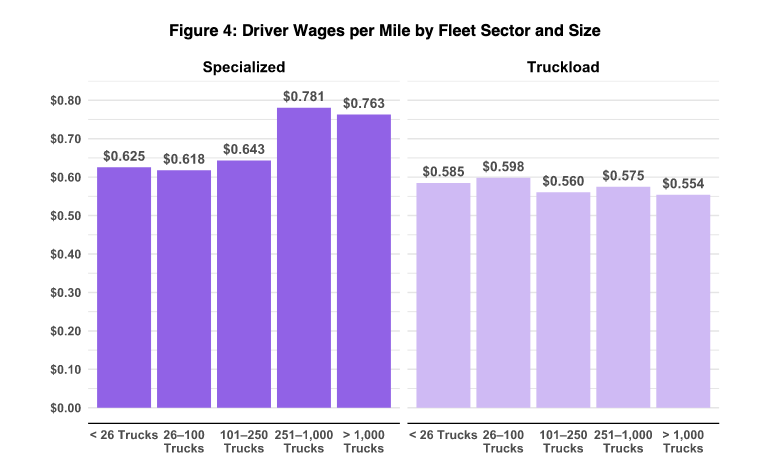
Though almost all fleet size groups had higher average driver wages in 2021 than in 2020, the larger fleets increased driver wages by a greater amount. (LTL carriers are not included in this report’s fleet size breakdowns because their fleet sizes rarely fall below 250 tractor-trailers.)
Source: ATRI
3 min to read
The total marginal cost of trucking grew by 12.7% in 2021 to $1.855 per mile, the highest on record, according to the American Transportation Research Institute’s 2022 update to An Analysis of the Operational Costs of Trucking.
Leading contributors to this increase were:
Fuel (35.4% higher than in 2020)
Repair and maintenance (18.2% higher than in 2020)
Driver wages (10.8% higher than in 2020).
On a cost-per-hour basis, costs increased to $74.65.
Even when fuel costs are removed, the marginal costs of trucking per mile increased by 10 cents between 2020 and 2021, from $1.338 to $1.438.
Truck and trailer lease or purchase costs set another record high in 2021. The same was true of repair and maintenance costs, which had the largest-ever annual spike as carriers faced unfavorable equipment markets. Within ATRI’s data set, insurance premium costs declined only slightly in 2021 – by a mere tenth of a cent, and tire costs declined by just two tenths of a cent.
A record number of motor carriers contributed their 2021 financial data for this year’s research. The “Ops Costs” report, which reflects 2021 numbers, provides detailed breakdowns of numerous line-item costs by fleet size and sector, allowing for tailored benchmarking.
2021 Trends in Trucking Operating Costs
The trucking industry experienced many new, atypical market conditions in 2021 and their effects can clearly be seen in the Ops Costs data, according to an ATRI news release.
Overall, fleets with 100 or fewer trucks spent 4.9 cents more per mile than fleets with more than 100 trucks — closing the 2020 gap with larger fleets by 70%. While larger fleets spent less than smaller fleets on insurance premiums per mile, the advantage was offset by higher out-of-pocket incident costs per mile for large fleets.
In response to the truck driver shortage, total driver compensation at $0.809 per mile was 10% higher than in 2020.
Faced with challenges throughout the supply chain, carriers emphasized greater efficiency. Empty or “deadhead” mileage decreased to 14.8%, and average truck fuel economy increased to 6.65 mpg.
Respondents’ average truck-tractor age was 5.7 years old — the highest in over a decade. At the same time, the average number of miles driven annually per truck fell by almost 11% to 79,808. The average annual miles driven per truck has been trending downward over the past decade, but this decline accelerated during the COVID-19 pandemic.
This year’s report includes several new efficiency metrics, such as annualized driver turnover, average dwell time at shipper facilities, and revenue per truck. The financial health of trucking remained strong throughout 2021 despite spiking costs, with an average operating margin in most sectors at 10%.
ATRI’s Ops Costs report focuses on for-hire motor carriers. In 2021 for-hire carriers held 52.6% percent of the total trucking market share, while private carriers had a 43% market share. ATRI respondents included a higher percentage of less-than-truckload carriers than the U.S. trucking industry as a whole, 55% vs. 29%.
More Fleet Management

Sponsored•September 16, 2026
Color Match Smarter: Tools That Restore & Perform
For fleet managers and collision repair professionals keeping heavy-duty trucks on the road, getting the color right the first time isn't just about appearance — it's about efficiency, turnaround time, and bottom-line results. Discover how today's digital color tools are transforming the repair process from guesswork to precision.
Read More →
FMCSA Pauses Biennial-Update Enforcement Amid Motus Transition
Carriers whose updates were due on or after June 1 have more time, while FMCSA works to stabilize its new registration system and warns of phishing sites impersonating its new carrier registration system, Motus.
Read More →
Sponsored•September 14, 2026
2026 Blueprint for Countering Smarter Supply Chain Theft
Cargo theft is no longer just the cost of doing business. It's a multi-billion-dollar criminal enterprise exploiting vulnerabilities across your fleet, drivers, and supply chain.
Read More →


Sponsored•September 1, 2026
How Telematics Improves Visibility, Control, and Performance in Refrigerated Fleets
Explore how telematics help refrigerated fleets improve visibility, uptime, efficiency, compliance, and cargo protection across connected cold chain operations.
Read More →
What the U.S.-Canada Trade War Means for Trucking
Escalating U.S.-Canada tariffs could disrupt cross-border freight, reduce truck volumes, raise costs, and create new uncertainty for carriers on both sides of the border.
Read More →
What Are Trucking’s Top Concerns for 2026?
The American Transportation Research Institute wants to know what's worrying trucking fleet managers, drivers, and other stakeholders in its annual Industry Issues survey.
Read More →
American Trucking Associations Looks for a New Leader
ATA President and CEO Chris Spear abruptly left his job at the association on August 21, at a pivotal time for the trucking industry.
Read More →
Public Wi-Fi Cybersecurity Risks: How Truck Drivers and Fleets Can Protect Their Data
Public Wi-Fi can expose truck drivers and fleets to credential theft, malware, and other cyber threats. Here’s how to reduce the risk on the road.
Read More →
For Nicky Cupp, Fleet Innovation Starts With Frustration
HDT Truck Fleet Innovator Nicky Cupp turns everyday pain points at Fraley & Schilling into opportunities for better technology and smarter processes.
Read More →
Adam Buttgenbach’s Approach to Electric Trucks: Start With Where They Fit
HDT Truck Fleet Innovator Adam Buttgenbach helped PepsiCo build one of North America’s largest EV fleets by focusing on where electric trucks make operational sense.
Read More →