




Related: HDT's COVID-19 Resource Page for the Latest on the Outbreak
FTR: COVID-19 Crisis to Take Toll on Trucking, Economy
The U.S. economy was rocked today by shocking numbers of 3.3 million people filing unemployment claims for the first time, but the worst is still to come for trucking.
by James Menzies
March 27, 2020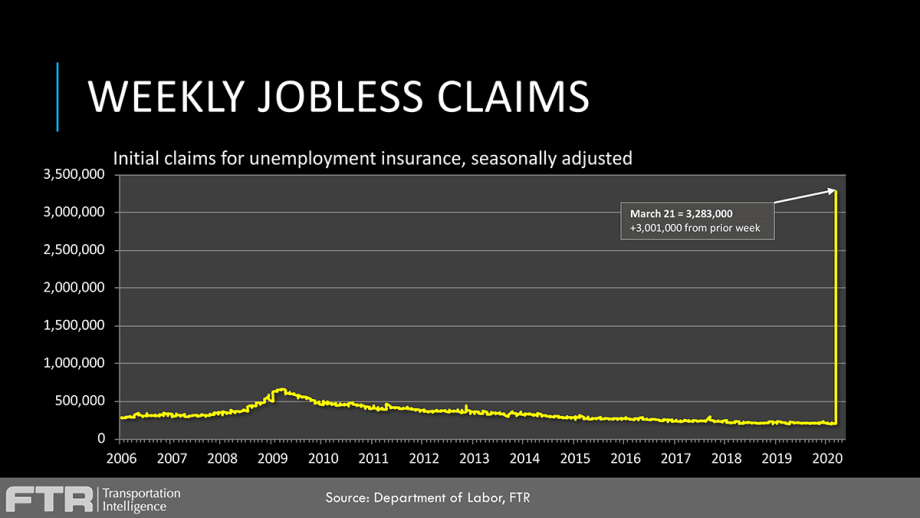
A total of 3.3 million people recently filed unemployment claims for the first time, compared to the Great Recession, when the U.S. unemployment claims peaked around 500,000.
Source: FTR, U.S. Department of Labor
5 min to read
The U.S. economy was rocked by a record number of 3.3 million people filing unemployment claims for the first time in the week ended March 21, but the worst is still to come for trucking.
“To put it in perspective, we were seeing somewhere in the neighborhood of 180,000 to 250,000 at any given point in time,” Eric Starks, CEO of industry forecaster FTR, said on a webinar March 26, the same day those figures were announced, to discuss how the trucking industry will be impacted by the COVID-19 pandemic. “When we hit the peak in the Great Recession, we were north of 500,000, but we’ve never seen anything like this.”
FTR recently cut its economic forecast, predicting U.S. real GDP will drop 11% in the second quarter.
“This has a huge impact on the marketplace and the transport system specifically,” Starks warned, adding the GDP goods transport sector, which is a measure of GDP factors specific to freight, could fall by 24% in the second quarter. “This is huge. There is no getting around this. There are significant impacts in the system as we move into the second quarter.”
Industrial output is also expected to take it on the chin, falling nearly 15% in the second quarter, as factories are temporarily locked up to deal with the virus.
Starks said FTR doesn’t expect to see a noticeable rebound until the fourth quarter, and freight won’t return to the peak levels seen in 2019 until mid-2021.
“We are talking somewhere between a year, to a year-and-a-half recovery just to get back to the levels we were at in the first quarter of 2019,” Starks said. “We are going to be having a very difficult time as we move through the summer. What we don’t know is, how long does the virus stick around? All indications we see right now say this is not a quick turn.”
What’s in Store for Trucking Providers?
“Trucking is going through something it has never experienced before,” said Avery Vise, FTR’s vice president of trucking, likening the situation to a catastrophic hurricane, but one that is nationwide in scope and with no set end date.
So far, there have been some benefits to trucking. Refrigerated load availability spiked, and spot market rates for dry van and reefer loads moved sharply higher over the past couple weeks. But non-essential freight has already felt an impact, with flatbed and specialized load availability on the decline.
Vise predicted the retail restocking efforts driving a spike in dry van and reefer freight “could go away quickly.”
“The spot market itself may stay elevated for a while, but clearly overall freight volumes are going to begin to fade,” Vise warned, calling for overall truck loadings to decrease 4% this year. (In comparison, FTR's pre-crisis prediction was for a modest 1.3% gain.)
Flatbed, bulk, and dump segments will be hit hardest, with loadings expected to decrease from 6-9%, barring an infrastructure bill that would kickstart construction. Refrigerated loads, however, should finish the year up slightly compared to 2019, FTR predicts.
Capacity utilization is likely to slide as drivers exit the industry. As available mileage dwindles and government supports workers with substantial payments, some drivers may opt to stay home, Vise noted.
“There will be people who will make more money on unemployment than at their jobs, especially in the near-term.”
Carrier bankruptcies are likely to continue, but “we think the loss of freight demand will outpace the loss of capacity,” Vise said.
Underlying issues driving an increase in carrier bankruptcies before the crisis – such as rising insurance costs – are not likely to abate, putting further pressure on weak performers. FTR doesn’t expect the U.S. government bailout to significantly impact the freight picture, though it could mean consumers are in better shape to resume spending when the crisis passes.
“This is a rescue plan, not a stimulus plan,” Vise pointed out.
FTR’s forecast assumes consumer spending will drop for a period of time.
“When we look at what happened with the latest data out this morning, and seeing over 2 million people applying for (unemployment) benefits, that suggests there is additional downside pressure on our numbers in the second quarter,” Starks said. If companies are able to keep their workforces in place, the economy should rebound more quickly when the virus is contained.
The Effect on Equipment Demand
FTR has reduced its equipment demand forecast to recession levels. It’s anticipating North American Class 8 production of 150,000 units this year, and predicts the second quarter will kick off the worst three months of Class 8 production seen since the Great Recession.
Its trailer production forecast has similarly been cut to 155,000 units, explained Don Ake, FTR’s vice-president, commercial vehicles. The medium-duty market is not immune to the downturn, either.
Higher cancellations can make matters worse for truck manufacturers.
“We are looking for elevated cancellations in March, and we would expect order levels in the truck and trailer markets to be below 10,000 units at least for the next several months,” Ake said, noting fleets began showing “anxiety” about the impact of the virus through their ordering activity as early as late February.
OEMs may also struggle to get plants back up and running, following temporary closures over the past couple weeks, Ake cautioned.
“Two things are going to hurt them in the second quarter: a lack of orders to build, and also a disruption to society that’s going on,” Ake said, noting it may be difficult to get employees back on the job. “Another factor that comes into play is how well the supplier base can snap back. We’re not just talking about the U.S. supplier base, we’re talking worldwide. We have heard reports it’s been very difficult for a few weeks to get any supplies out of India.”
FTR has created a free online resource page for information on the COVID-19 virus and its impact on the transportation and freight markets.
James Menzies is the editor of Today's Trucking, where this article originally appeared, and was used with permission from Newcom Media as part of a cooperative editorial agreement.
More Fleet Management

Sponsored•September 16, 2026
Color Match Smarter: Tools That Restore & Perform
For fleet managers and collision repair professionals keeping heavy-duty trucks on the road, getting the color right the first time isn't just about appearance — it's about efficiency, turnaround time, and bottom-line results. Discover how today's digital color tools are transforming the repair process from guesswork to precision.
Read More →
FMCSA Pauses Biennial-Update Enforcement Amid Motus Transition
Carriers whose updates were due on or after June 1 have more time, while FMCSA works to stabilize its new registration system and warns of phishing sites impersonating its new carrier registration system, Motus.
Read More →
Sponsored•September 14, 2026
2026 Blueprint for Countering Smarter Supply Chain Theft
Cargo theft is no longer just the cost of doing business. It's a multi-billion-dollar criminal enterprise exploiting vulnerabilities across your fleet, drivers, and supply chain.
Read More →


Sponsored•September 1, 2026
How Telematics Improves Visibility, Control, and Performance in Refrigerated Fleets
Explore how telematics help refrigerated fleets improve visibility, uptime, efficiency, compliance, and cargo protection across connected cold chain operations.
Read More →
What the U.S.-Canada Trade War Means for Trucking
Escalating U.S.-Canada tariffs could disrupt cross-border freight, reduce truck volumes, raise costs, and create new uncertainty for carriers on both sides of the border.
Read More →
What Are Trucking’s Top Concerns for 2026?
The American Transportation Research Institute wants to know what's worrying trucking fleet managers, drivers, and other stakeholders in its annual Industry Issues survey.
Read More →
American Trucking Associations Looks for a New Leader
ATA President and CEO Chris Spear abruptly left his job at the association on August 21, at a pivotal time for the trucking industry.
Read More →
Public Wi-Fi Cybersecurity Risks: How Truck Drivers and Fleets Can Protect Their Data
Public Wi-Fi can expose truck drivers and fleets to credential theft, malware, and other cyber threats. Here’s how to reduce the risk on the road.
Read More →
For Nicky Cupp, Fleet Innovation Starts With Frustration
HDT Truck Fleet Innovator Nicky Cupp turns everyday pain points at Fraley & Schilling into opportunities for better technology and smarter processes.
Read More →
Adam Buttgenbach’s Approach to Electric Trucks: Start With Where They Fit
HDT Truck Fleet Innovator Adam Buttgenbach helped PepsiCo build one of North America’s largest EV fleets by focusing on where electric trucks make operational sense.
Read More →