




Freight Shipments, Expenditures Hit Highest Levels of 2016 but Will it Continue?
Freight shipments and expenditures edged up in June after three months of lackluster performance, hitting their highest levels of the year, according to the Cass Freight Index – but it remains unclear if this is part of a larger trend.

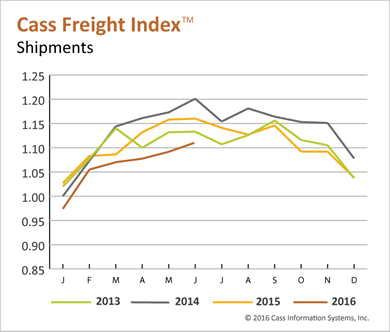

Freight shipments and expenditures edged up in June after three months of lackluster performance, hitting their highest levels of the year, according to the Cass Freight Index – but it remains unclear whether this is part of a larger trend.
The June freight shipments index climbed 1.7% from the month before, but it is still 4.3% below last year’s level and 7.6% lower than in June 2014.
Rosalyn Wilson, supply chain industry analyst and founder/president of the consulting practice FreightMatters, who provides analysis for the report, says stores are already stocking school supplies, which accounts for some of the increase.
She notes that after particularly slow traffic in April and May, the Association of American Railroads reports that carload shipments rose 29.3% and intermodal shipments jumped 23.4% in June. Also, The American Trucking Associations reported that May truck tonnage was up 2.7%. However, figures released just hours before the Cass Index showed a 1.5% decline in ATA's tonnage in June, while May’s figures was revised higher showing a 2.9% gain.
In addition, the freight-matching service provider DAT reported that spot market loads increased 28% in June, “indicating that truck tonnage should be up in June also,” Wilson said – but that didn’t happen, at least with ATA numbers.
“June’s shipments are in step with patterns that have been observed in the past few years, but are still well below the volume in the last two years," she said. "July usually sees a dip in the number of freight shipments, but the first part of July [this year] seems to be fairly robust."
Total freight expenditures reported by Cass jumped 3.9% in June from May, the second largest increase this year, but it's 8.8% below the level of June 2015.
Wison said the increase can be attributed to growth in shipments.
“DAT reported that both volumes and rates were up for most spot market moves. Abundant available truck capacity has provided strong competition for rail intermodal, holding down rates for both,” she said. “With the relatively slow and bumpy freight market so far in 2016, rates should stay flat with expenditure changes tied closely to the volume of freight shipments.”
If all of this leaves you feeling a bit confused, you’re not the only one, with Wilson calling the first half of the year’s economic performance “perplexing.”
“Consumer spending has been growing, although the effect on freight is small, as most of this increase has been in the service sector. Inventories are mostly unchanged at uncomfortably high levels, but the inventory-to-sales ratio fell in April for the first time in over a year,” she said.
Wilson also noted exports and imports are down, residential and commercial construction has been slowing, and consumer spending on goods is weak.
“That said, the manufacturing sector is awakening with a 3.9% growth in production, 2.3% increase in new orders and an 11.7% growth in order backlog," she said. The Federal Reserve recently decided against another interest rate hike, citing ‘considerable uncertainty’ in the U.S. economic outlook and ‘vulnerabilities’ from abroad.
The bottom line, according to Wilson, is that while the economy in the second quarter was stronger than the first, “the mixed signals in the air make the third quarter uncertain.”
Data within the Cass Freight Index includes all domestic freight modes and is derived from $25 billion in freight transactions processed by Cass Information Systems annually on behalf of its client base of hundreds of large shippers, accordign to the company, while annual freight volume per organization ranges from $1 million to over $1 billion.
More Fleet Management

Color Match Smarter: Tools That Restore & Perform
For fleet managers and collision repair professionals keeping heavy-duty trucks on the road, getting the color right the first time isn't just about appearance — it's about efficiency, turnaround time, and bottom-line results. Discover how today's digital color tools are transforming the repair process from guesswork to precision.
Read More →
FMCSA Pauses Biennial-Update Enforcement Amid Motus Transition
Carriers whose updates were due on or after June 1 have more time, while FMCSA works to stabilize its new registration system and warns of phishing sites impersonating its new carrier registration system, Motus.
Read More →
2026 Blueprint for Countering Smarter Supply Chain Theft
Cargo theft is no longer just the cost of doing business. It's a multi-billion-dollar criminal enterprise exploiting vulnerabilities across your fleet, drivers, and supply chain.
Read More →


How Telematics Improves Visibility, Control, and Performance in Refrigerated Fleets
Explore how telematics help refrigerated fleets improve visibility, uptime, efficiency, compliance, and cargo protection across connected cold chain operations.
Read More →
What the U.S.-Canada Trade War Means for Trucking
Escalating U.S.-Canada tariffs could disrupt cross-border freight, reduce truck volumes, raise costs, and create new uncertainty for carriers on both sides of the border.
Read More →
What Are Trucking’s Top Concerns for 2026?
The American Transportation Research Institute wants to know what's worrying trucking fleet managers, drivers, and other stakeholders in its annual Industry Issues survey.
Read More →
American Trucking Associations Looks for a New Leader
ATA President and CEO Chris Spear abruptly left his job at the association on August 21, at a pivotal time for the trucking industry.
Read More →
Public Wi-Fi Cybersecurity Risks: How Truck Drivers and Fleets Can Protect Their Data
Public Wi-Fi can expose truck drivers and fleets to credential theft, malware, and other cyber threats. Here’s how to reduce the risk on the road.
Read More →
For Nicky Cupp, Fleet Innovation Starts With Frustration
HDT Truck Fleet Innovator Nicky Cupp turns everyday pain points at Fraley & Schilling into opportunities for better technology and smarter processes.
Read More →
Adam Buttgenbach’s Approach to Electric Trucks: Start With Where They Fit
HDT Truck Fleet Innovator Adam Buttgenbach helped PepsiCo build one of North America’s largest EV fleets by focusing on where electric trucks make operational sense.
Read More →