




Freight-Matching Tech Firm Next Trucking Expands After Capital Infusion
Next Trucking, a trucker-centric online marketplace that connects carriers with shippers, announced it will double its headcount this year thanks to growing demand for its services.
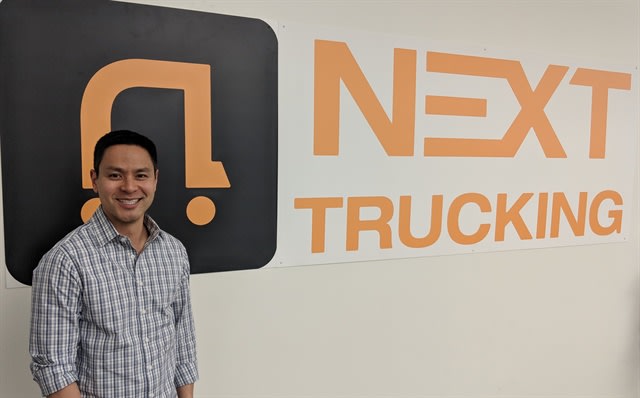
Jason Leu, Next Trucking's new vice president of product.Photo: Next Trucking
Next Trucking, a trucker-centric online marketplace that connects carriers with shippers, announced it will double its headcount this year thanks to growing demand for its services.
The company’s technology connects carriers with shippers based on routes, pricing, driver behavior, and other intelligent matching algorithms.
Following a February infusion of $21 million in funding led by Silicon Valley venture capital firm Sequoia Capital, the California-based company added six new roles to its executive management team. It’s now looking to fill more than 40 positions in engineering, product development, marketing and sales before the end of the year.
The expanded executive team includes:
Bryan Jolliff, vice president of sales
Jason Leu, vice president of product
Chris Lankford, vice president of engineering
Jennifer Chang, director of marketing
Shane Van Der Waag, director of drayage and intermodal
Andres Castañeda, director of talent recruitment
Leu and Lankford previously worked together at another startup for seven years. The company has also expanded its sales team, adding talent from C.H. Robinson, Werner, Schneider National, and CEVA Logistics, and its operations team with recruits from J.B. Hunt, Expeditors, Mattel, and APL. New hires in product and engineering come from leading Southern California tech companies and startups.
CEO and Co-founder Lidia Yan said the hiring spree is to support its aggressive growth strategy. “We are seeing record numbers of carriers and shippers continue to embrace our trucker-centric online marketplace instead of relying on outdated processes that no longer serve them. This has resulted in accelerated growth in all areas of our business.”
Yan got the idea for Next Trucking from working in her family business, one of the largest logistics companies in southern California for electronics. The app was launched two years before Uber decided to try to turn its expertise in ride-share apps to the freight world. At that time, Yan explained to HDT in an interview, “Our app allows truckers to dictate what they want. We realize that drivers spend a lot of time negotiating with brokers.”
Being from the industry, Yan said, “we understand drivers better than a true technology company.”
More Fleet Management

Color Match Smarter: Tools That Restore & Perform
For fleet managers and collision repair professionals keeping heavy-duty trucks on the road, getting the color right the first time isn't just about appearance — it's about efficiency, turnaround time, and bottom-line results. Discover how today's digital color tools are transforming the repair process from guesswork to precision.
Read More →
FMCSA Pauses Biennial-Update Enforcement Amid Motus Transition
Carriers whose updates were due on or after June 1 have more time, while FMCSA works to stabilize its new registration system and warns of phishing sites impersonating its new carrier registration system, Motus.
Read More →
2026 Blueprint for Countering Smarter Supply Chain Theft
Cargo theft is no longer just the cost of doing business. It's a multi-billion-dollar criminal enterprise exploiting vulnerabilities across your fleet, drivers, and supply chain.
Read More →


How Telematics Improves Visibility, Control, and Performance in Refrigerated Fleets
Explore how telematics help refrigerated fleets improve visibility, uptime, efficiency, compliance, and cargo protection across connected cold chain operations.
Read More →
What the U.S.-Canada Trade War Means for Trucking
Escalating U.S.-Canada tariffs could disrupt cross-border freight, reduce truck volumes, raise costs, and create new uncertainty for carriers on both sides of the border.
Read More →
What Are Trucking’s Top Concerns for 2026?
The American Transportation Research Institute wants to know what's worrying trucking fleet managers, drivers, and other stakeholders in its annual Industry Issues survey.
Read More →
American Trucking Associations Looks for a New Leader
ATA President and CEO Chris Spear abruptly left his job at the association on August 21, at a pivotal time for the trucking industry.
Read More →
Public Wi-Fi Cybersecurity Risks: How Truck Drivers and Fleets Can Protect Their Data
Public Wi-Fi can expose truck drivers and fleets to credential theft, malware, and other cyber threats. Here’s how to reduce the risk on the road.
Read More →
For Nicky Cupp, Fleet Innovation Starts With Frustration
HDT Truck Fleet Innovator Nicky Cupp turns everyday pain points at Fraley & Schilling into opportunities for better technology and smarter processes.
Read More →
Adam Buttgenbach’s Approach to Electric Trucks: Start With Where They Fit
HDT Truck Fleet Innovator Adam Buttgenbach helped PepsiCo build one of North America’s largest EV fleets by focusing on where electric trucks make operational sense.
Read More →