





Related: The Many Trucks of CES 2019
Ford Testing Last-Mile Delivery with Postmates
Ford announced it is working with Postmates, an on-demand delivery platform, to evaluate how customers interact with autonomous delivery vehicles and other last-mile issues.
January 11, 2019
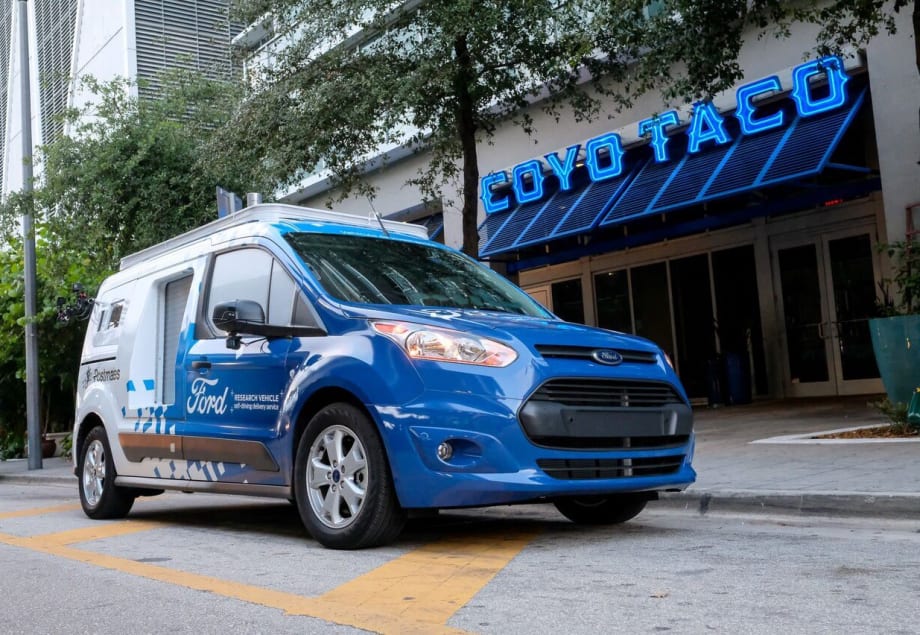
Ford says Transit Connect vehicles in a pilot program in Miami are equipped to look like they are operating autonomously in order to research how customers interact with self-driving delivery vehicles.
Photo: Ford
2 min to read
At the CES electronics show in Las Vegas, Ford showcased a new autonomous delivery version of its Transit Connect van it is developing with Postmates, an on-demand delivery platform, to operate a self-driving delivery service.
Ford said a Postmates pilot program is currently underway in Miami and Miami Beach with more than 70 businesses participating, including local favorites such as Coyo Taco. Residents in the area, when they order tacos — or almost anything, really — through Postmates, may be given the option to have the items delivered by a self-driving research vehicle.
For the pilot program, Ford designed a Transit Connect with a locker system to secure the food and allow it to serve multiple customers on one delivery route, which was on display at the company’s booth at CES. When the Postmates Transit Connect arrives at a restaurant to pick up a delivery, a restaurant employee types an access code into the screen. One of the lockers will automatically open so the food can be placed inside. Each locker has two cup holders so customers don’t have to worry about losing half their beverage in transit.
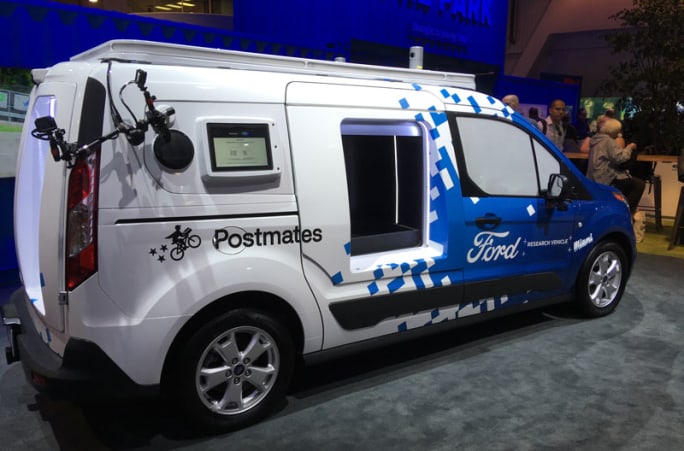
The Ford-Postmate research vehicle on display at CES.
Photo by Jim Park
Additionally, Ford said, since services like Postmates must deliver an assortment of products, from sushi restaurants to hardware stores, the rear and passenger-side lockers on the specially developed Transit Connect are different sizes to allow testing of the best vehicle configuration. Ultimately, Ford says, it is using the pilot program to test how businesses and consumers interact with a self-driving vehicle.
In keeping with that mission, Ford said the research vehicles for its business pilots are designed to appear as self-driving – however, they are manually driven by an experienced driver.
When the vehicle arrives at its destination, the customer receives a text notification indicating the delivery is ready for pickup.
Upon meeting the vehicle at the curb, consumers enter an access code into the touch screen and the appropriate locker will open. Audio prompts direct the interaction and lights will illuminate the designated locker.
Ford says the research vehicle is modified specifically to test a variety of interfaces — the touch screen, the locker system, the external audio system— to inform the design of purpose-built self-driving vehicles that are scheduled to arrive in 2021.
More Equipment

How Volvo Updated Its D13 for EPA 2027 [Watch]
Volvo’s updated D13 promises lower emissions without sacrificing performance or fuel economy. Take a closer look at what changed inside the engine in this HDT Spotlight video.
Read More →
Michelin Tire Improves Efficiency and Durability for Regional Fleets
The Michelin X Multi Energy D2 is a regional haul drive tire engineered to help fleets improve fuel efficiency, durability and traction in demanding stop-and-go operations.
Read More →
ZF Expands Commercial Vehicle Push in North America
ZF is expanding its North American commercial-vehicle presence with new transmission applications, electrification, trailer technology and autonomous-driving systems.
Read More →
Tesla Wants a Self-Driving Semi. Are Cameras Enough?
Could Tesla’s camera-only autonomous driving technology work on an 80,000-pound Semi? In this commentary, HDT's Deborah Lockridge takes a look at Tesla, Cybercab, and how autonomous trucks see the road.
Read More →
Kodiak: Driverless Long-Haul Truck Launch on Track for 2026
Kodiak AI says its driverless long-haul safety case is 93% complete and it remains on track to begin commercial operations by year-end 2026.
Read More →
What DOT’s Automated Vehicle Strategy Means for Trucking
The U.S. Department of Transportation issued a new automated-vehicle strategy that outlines plans for driverless-truck regulations, cross-state freight corridors, and federal safety standards.
Read More →
East Coast Port Launches $45M Electric Truck Push
The Port Authority of New York and New Jersey announced millions in incentives for zero-emission drayage trucks, yard tractors, and new charging hubs near the port.
Read More →
PlusAI Going Public to Fund Autonomous Truck Launch
A SPAC deal could provide PlusAI with up to $300 million as it works toward a 2027 commercial launch of factory-built autonomous trucks.
Read More →
NHTSA Moves to Rewrite Truck Fuel-Economy Rules
The National Highway Traffic Safety Administration says it lacks authority to regulate medium- and heavy-duty truck engines separately from complete vehicles, but the existing standards have not yet been eliminated.
Read More →
Detroit Opens Orders for EPA 2027 Engines
Detroit isn’t starting from scratch to meet EPA 2027 diesel emissions standards. Its Gen 6 DD13 and DD15 engines keep much of today’s platform while updating the fuel and aftertreatment systems.
Read More →