





Related: FMCSA to Tap Louisiana's Gautreaux as Deputy Administrator
FMCSA’s Gautreaux Sees Innovation Driving Safety Forward
At the start of her first full year helping to lead the Federal Motor Carrier Safety Administration, Deputy Administrator Cathy Gautreaux praised the agency for its recent accomplishments and laid out its priorities going forward.
January 11, 2018
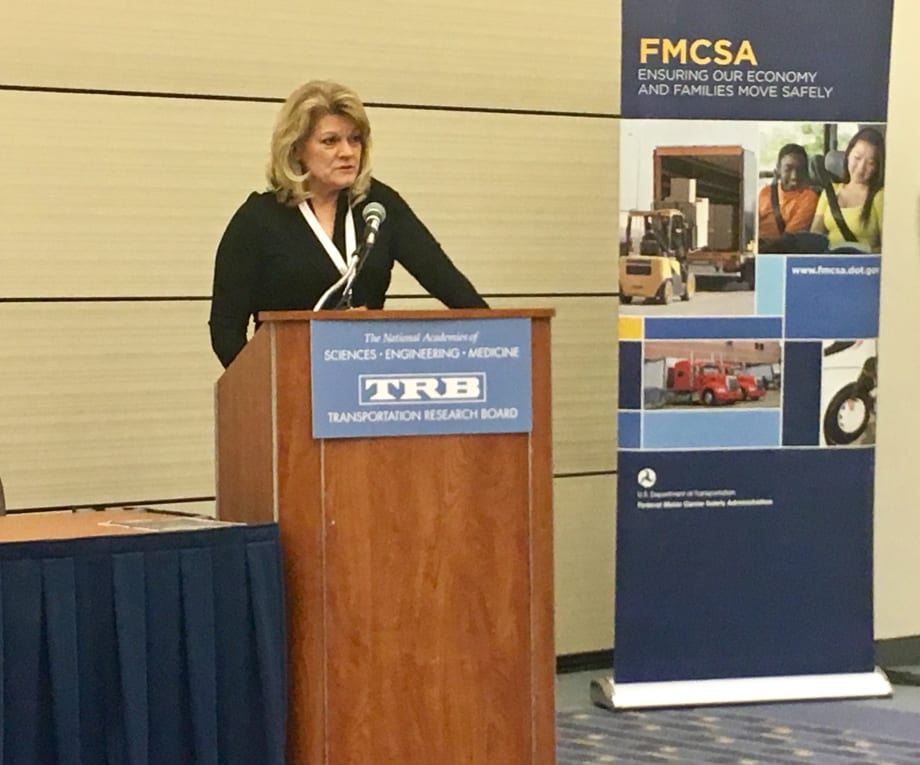
FMCSA Deputy Administrator Cathy Gautreaux tells TRB audience in Washington DC that the agency will keep seeking to reduce regulations without negatively impacting safety. Photo: David Cullen
5 min to read
FMCSA Deputy Administrator Cathy Gautreaux tells TRB audience in Washington DC that the agency will keep seeking to reduce regulations without negatively impacting safety.Photo: David Cullen
WASHINGTON, DC -- At the start of her first full year helping to lead the Federal Motor Carrier Safety Administration, Deputy Administrator Cathy Gautreaux praised the agency for its recent accomplishments and laid out its priorities going forward.
“These are exciting and important times for our agency. I am honored to have been selected to provide leadership, and look forward to helping to advance FMCSA’s priorities and goals,” Gautreaux said Jan. 9 at the top of her keynoter at the FMCSA Analysis, Research, and Technology Forum held here at the 97th Annual Meeting of the Transportation Research Board.
Looking back at last year, Gautreaux, who took over as the agency’s number-two official in November, said it was “a good year for us, thanks to the efforts of the 1,100 men and women of FMCSA and our partners. We couldn’t do our work without you.”
She said a notable success is the rise seen in the use of safety belts by truck and bus drivers, which increased to 86% in 2016 – up from 65% in 2007. Gautreaux also pointed to the agency’s efforts in 2017 to improve crash data collection, which she said are chief among FMCSA’s research activities and priorities this year.
Turning to the various Congressional mandates imposed on the agency by the FAST Act highway bill (signed into law in December 2015), she reported that the agency completed several FAST Act-required projects in 2017, including the Post-Accident Report Review and the Correlation Study, and noted that “recommendations have been published and the agency is currently working to implement improvements.”
Looking out to the new year now unfolding, Gautreaux called this “an exciting moment to work in the transportation sector. With rapid advances in technology and a rare bipartisan consensus developing about infrastructure, we are primed to do great things.”
Gautreaux said Secretary of Transportation Elaine Chao has outlined the department’s top three priorities going forward as keeping safety foremost in mind,s a commitment that “we will address our country’s crumbling infrastructure,” and, thirdly, engaging in helping “prepare for the future by encouraging innovation.”
She said Chao’s third point is especially important “because transportation is on the verge of one of the most transformational eras in history. I have witnessed the evolution of the industry from economic to safety regulation over the last 32 years,” Gautreaux noted, alluding to the economic deregulation of trucking that began with the Motor Carrier Act of 1980 and the present era in which the agency remains focused on reducing highway crashes involving large trucks and buses.
“Technology is the next frontier,” she continued. “We are on the cusp of revolutionary changes in the way we move both people and freight, and I am excited for what the future holds. That’s why I am looking forward to the several projects we are working on that are related to driver-assisted technologies. I expect the work on these projects to move forward this year and in 2019."
Gautreaux listed those projects as including:
Research and testing to accelerate the deployment of automatic emergency braking systems
A joint project with the National Highway Traffic Safety Administration to develop cybersecurity best practices for automated commercial motor vehicles
Specific research on sensor and braking performance
“I also want to say a word about the Electronic Logging Device [rule] implementation,” she said. “A great deal of work with our enforcement partners went into ensuring that the rollout of the ELD rule was a success.”
Gautreaux credited the agency’s efforts to train participating law-enforcement agencies in the Commercial Vehicle Safety Alliance with “making sure everyone felt comfortable and prepared to enforce the new requirement that drivers use this technology – which will reduce incidence of driver fatigue and save lives, without impeding commerce.”
And while she indicated being all for regulations, such as the ELD rule, that can be seen as improving safety and is “excited about all the technological and other tools to achieve FMCSA’s mission,” she also contended that “all too often progress is hampered, not by a lack of will or lack of resources, but by the many regulatory hurdles that must be cleared.
“The private sector is ready and eager to invest in infrastructure, experiment with advanced technologies, and grow their businesses in the process,” she continued. “But regulatory or permitting barriers can delay projects without providing concrete benefits to safety, the environment, or other concerns.”
Gautreaux stated that “without compromising safety or a change in our mission, we at FMCSA must look for ways to reduce regulatory burdens on industry whenever and wherever possible.”
Yet she was unequivocal in calling for increased efforts to improve highway safety. “Unfortunately, after many years of improvement, highway fatalities have started to creep upwards, she said. “The large-truck occupant fatalities showed an 8.6% increase from 2015 to 2016, which shows that we have much work to do to decrease those rates.”
Gautreax summed up by calling “21st century transportation technology a bright part of our future that will make us the envy of the world. Working together in partnership with our public and private sector partners to do so as safely as possible is paramount to our mission. We all have roles to play to make this vision a reality. I look forward to working with our partners as we advance these goals and priorities.”
After her formal remarks, Gautreax spoke briefly with HDT about the ELD rule’s rollout last month. “It’s been a pleasant surprise that the ELD implementation has gone as smoothly as it has [since Dec. 18]. But that’s not to say all the work is done. There will always be those who drag their feet [on a new rule]. But credit goes to FMCSA, going back to before my time here started, had a plan [for the rollout] and they worked closely with stakeholders to effectively execute it.”
More Fleet Management

Sponsored•September 16, 2026
Color Match Smarter: Tools That Restore & Perform
For fleet managers and collision repair professionals keeping heavy-duty trucks on the road, getting the color right the first time isn't just about appearance — it's about efficiency, turnaround time, and bottom-line results. Discover how today's digital color tools are transforming the repair process from guesswork to precision.
Read More →
FMCSA Pauses Biennial-Update Enforcement Amid Motus Transition
Carriers whose updates were due on or after June 1 have more time, while FMCSA works to stabilize its new registration system and warns of phishing sites impersonating its new carrier registration system, Motus.
Read More →
Sponsored•September 14, 2026
2026 Blueprint for Countering Smarter Supply Chain Theft
Cargo theft is no longer just the cost of doing business. It's a multi-billion-dollar criminal enterprise exploiting vulnerabilities across your fleet, drivers, and supply chain.
Read More →


Sponsored•September 1, 2026
How Telematics Improves Visibility, Control, and Performance in Refrigerated Fleets
Explore how telematics help refrigerated fleets improve visibility, uptime, efficiency, compliance, and cargo protection across connected cold chain operations.
Read More →
What the U.S.-Canada Trade War Means for Trucking
Escalating U.S.-Canada tariffs could disrupt cross-border freight, reduce truck volumes, raise costs, and create new uncertainty for carriers on both sides of the border.
Read More →
What Are Trucking’s Top Concerns for 2026?
The American Transportation Research Institute wants to know what's worrying trucking fleet managers, drivers, and other stakeholders in its annual Industry Issues survey.
Read More →
American Trucking Associations Looks for a New Leader
ATA President and CEO Chris Spear abruptly left his job at the association on August 21, at a pivotal time for the trucking industry.
Read More →
Public Wi-Fi Cybersecurity Risks: How Truck Drivers and Fleets Can Protect Their Data
Public Wi-Fi can expose truck drivers and fleets to credential theft, malware, and other cyber threats. Here’s how to reduce the risk on the road.
Read More →
For Nicky Cupp, Fleet Innovation Starts With Frustration
HDT Truck Fleet Innovator Nicky Cupp turns everyday pain points at Fraley & Schilling into opportunities for better technology and smarter processes.
Read More →
Adam Buttgenbach’s Approach to Electric Trucks: Start With Where They Fit
HDT Truck Fleet Innovator Adam Buttgenbach helped PepsiCo build one of North America’s largest EV fleets by focusing on where electric trucks make operational sense.
Read More →