





Hours of Service Timeline: The Long, Convoluted History of Truck Driver Rules
FMCSA Wants Comments on Meal and Rest Break Waivers
Although it determined previously that federal regulations regarding commercial motor vehicle drivers pre-empted state meal and rest break rules, the Federal Motor Carrier Safety Administration is now considering several petitions for waivers.
December 29, 2023
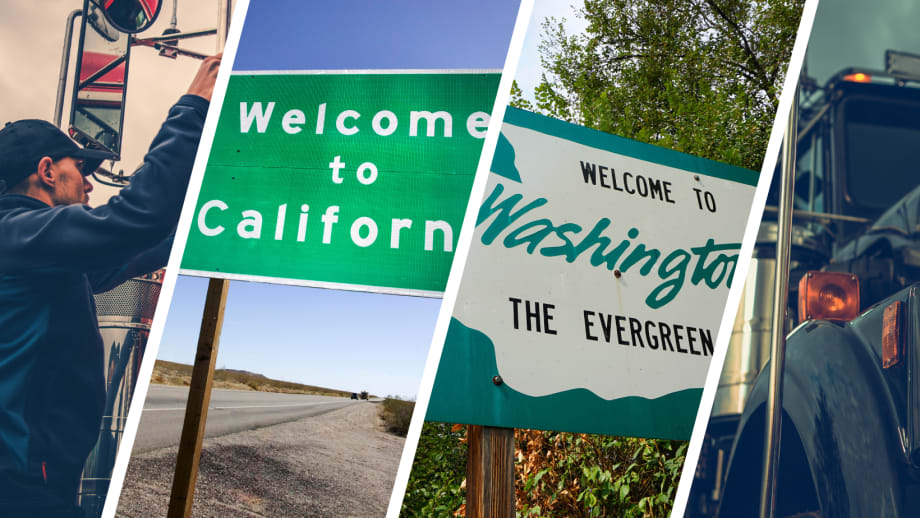
Will motor carriers with drivers in Washington and California have to deal with dueling driver work rules?
Credit:
HDT/Canva graphic
2 min to read
The Federal Motor Carrier Safety Administration is asking for comments on petitions requesting waivers of the agency's 2018 and 2020 decisions that said federal hours of service rules pre-empted state meal and rest break rules in California and Washington state.
In August, the FMCSA stunned the industry by saying it would consider such petitions.
Before the agency decided in 2018 and 2020 that the state meal and rest break rules were preempted by federal regulations, trucking companies often faced class action lawsuits seeking millions of dollars in penalties for violations of the state rules.
California and Washington Rest Break and Meal Rules
California requires employers to provide non-exempt employees a 30-minute meal break if they work more than 5 hours in a day, and employees who work a shift of 10 hours or more are entitled to a second 30-minute meal break.
Washington says employers must provide employees a meal period of at least 30 minutes that starts after the second hour and before the fifth hour of the shift, as well as 10-minute rest period for each four hours of working time.
In its 2018 decision, the DOT said California’s meal and rest break law was incompatible with federal regulations and caused a disruption in interstate commerce. It found that confusing and conflicting requirements at the state and federal level were overly burdensome for drivers and reduced productivity, increasing costs for consumers.
While most trucking groups agreed with the 2018 decision, the International Brotherhood of Teamsters blasted it, saying, “FMCSA’s suggestion that California’s meal and rest break rules negatively impact highway safety is ludicrous.”
What FMCSA Wants to Know
Waiver petitions were filed by:
The International Brotherhood of Teamsters.
The Truck Safety Coalition, Citizens for Reliable and Safe Highways and Parents Against Tired Truckers.
William B. Trescott.
The State of California.
FMCSA is asking for comments on any issues raised in the petitions for waivers, and on the following issues:
Whether and to what extent enforcement of a state's meal and rest break laws with respect to intrastate commercial vehicle drivers has impacted the health and safety of drivers.
Whether enforcement of state meal and rest break laws as applied to interstate commercial drivers will make truck parking shortage worse, and whether any such effect will burden interstate commerce or create additional dangers to drivers and the public.
Whether enforcement of a state's meal and rest break laws will dissuade carriers from operating in that state.
Whether enforcement of a state's meal and rest break laws will weaken or otherwise impact the resiliency of the national supply chain.
Comments must be received on or before Feb. 26, 2024.
More Safety & Compliance

From One Generation to the Next: How Mentorship Builds Safer Truck Drivers
After three decades in trucking, Harold Perry shares what he's learned about driver safety, mentorship, and helping the next generation build confidence behind the wheel.
Read More →
FMCSA Pauses Biennial-Update Enforcement Amid Motus Transition
Carriers whose updates were due on or after June 1 have more time, while FMCSA works to stabilize its new registration system and warns of phishing sites impersonating its new carrier registration system, Motus.
Read More →
ZF Expands Commercial Vehicle Push in North America
ZF is expanding its North American commercial-vehicle presence with new transmission applications, electrification, trailer technology and autonomous-driving systems.
Read More →
Truck Drivers Need More Than Another Alert
Fleets have more visibility into truck health, safety events, and driver activity than ever. The next challenge is turning all that information into useful guidance for the person who has to decide what to do next.
Read More →
Tesla Wants a Self-Driving Semi. Are Cameras Enough?
Could Tesla’s camera-only autonomous driving technology work on an 80,000-pound Semi? In this commentary, HDT's Deborah Lockridge takes a look at Tesla, Cybercab, and how autonomous trucks see the road.
Read More →
What DOT’s Automated Vehicle Strategy Means for Trucking
The U.S. Department of Transportation issued a new automated-vehicle strategy that outlines plans for driverless-truck regulations, cross-state freight corridors, and federal safety standards.
Read More →
NYC Expands Speed, Pedestrian Safety Tech Across Fleet
New York City is expanding intelligent speed assistance and pedestrian-alert systems across its municipal fleet, moving the technologies from pilot programs into vehicle procurement and retrofit requirements.
Read More →
FMCSA Removes 110 Truck Driver Training Schools from Certified ELDT List
Federal regulators also are targeting more than 160 additional training providers and launching a nationwide audit of third-party CDL skills testers as part of a broader crackdown on trucking fraud.
Read More →
Beyond DOT Compliance: What Makes a Trucking Fleet Truly Safe?
A trucking fleet can follow every rule and still make unsafe decisions. The real test comes when safety conflicts with freight, productivity, or cost.
Read More →
Hours of Service Pilot Programs: FMCSA Readies for 2027 Rollout
Two pilot programs could eventually reshape hours-of-service rules, giving truck drivers options to pause their 14-hour clock or use longer split sleeper rest periods.
Read More →