




FMCSA Proposes Entry-Level Driver Training Rule
Proposed national entry-level driver training requirements focus on a minimum amount of behind-the-wheel training.

Behind-the-wheel training is the focus of the proposal.
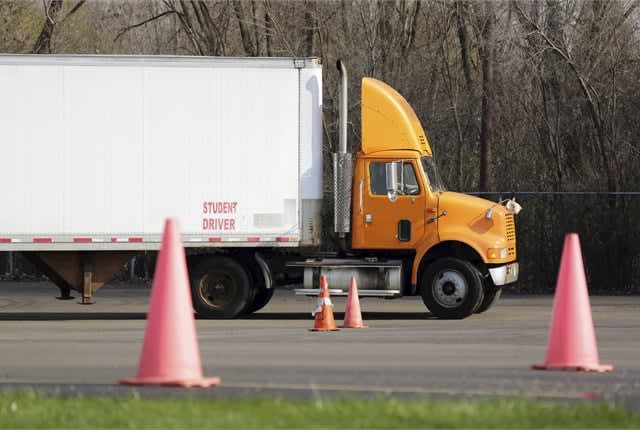
Behind-the-wheel training is the focus of the proposal.
The Federal Motor Carrier Safety Administration on March 4 unveiled a proposed rule on national training requirements for entry-level commercial truck and bus operators.
The Notice of Proposed Rulemaking (NPRM) reflects the recommendations of a negotiated rulemaking committee made up of FMCSA representatives and 25 stakeholders.
The American Trucking Associations quickly stated that it was “pleased to see” the new requirements have been proposed, but said it “takes issue with one of the required elements.”
Although it is still studying the proposed rule, the Owner Operator Independent Driver Association said it is generally receptive towards it.
A controversial initiative that has been in the works for years, the proposal is driven by a Congressional mandate imposed under the Moving Ahead for Progress in the 21st Century Act (MAP-21), the highway bill passed back in 2012.
The agency is seeking public comment as the next phase of its ELDT rulemaking.
Under the proposal, applicants seeking a “Class A” CDL – necessary for operating a combination tractor-trailer type vehicle weighing 26,001 pounds or more – would be required to obtain a minimum of 30 hours of behind-the-wheel training from an instructional program that meets FMCSA standards, including a minimum of 10 hours of operating the vehicle on a practice driving range.
Applicants seeking a “Class B” CDL – necessary for operating a heavy straight truck (such as a dump truck or box truck) or a school bus, city transit bus, or motorcoach – would be required to obtain a minimum of 15 hours of behind-the-wheel training, including a minimum of seven hours of practice range training.
There is no proposed minimum number of hours that driver trainees must spend on the classroom portions of any of the individual curricula.
“A diverse group of commercial motor vehicle stakeholders completed a tremendous amount of work, and that effort resulted in an unprecedented consensus,” said FMCSA Acting Administrator Scott Darling.
ATA President and CEO Bill Graves said the proposal “does a good job of outlining the knowledge and skills a new driver should have before heading out on the road." However, he stated that trucking's biggesty lobby is "concerned that an arbitrary requirement centered on behind- the-wheel training hours distracts from a more important focus on performance and safety outcomes.”
According to Graves, during the negotiated rulemaking process, ATA “repeatedly emphasized” that demonstrating the ability to safely operate was far more important than the number of hours of instruction or practice a new driver received.
“Some prospective drivers may demonstrate proficiency before reaching an arbitrary minimum hours requirement, but more concerning is the possibility that achieving this time threshold will erroneously convey competence and possession of the skills needed to safely drive,” Graves said.
ATA Chairman Pat Thomas, senior vice president, state government affairs for UPS, added that while the proposed rule “takes important strides toward ensuring that new truck drivers meet minimum training standards, we are hopeful that the final rule will be more focused on performance outcomes.”
OOIDA Executive Vice President Todd Spencer told HDT that "We are still reviewing the rule and will likely have some questions for clarification on some provisions.
“In general,” he continued, “we view the proposal positively and are encouraged to see the agency continue to make strides toward a final, solid rule."
Mandatory, comprehensive training in all 50 states, the District of Columbia, and all U.S. territories would apply to:
First-time CDL applicants;
Current CDL holders seeking a license upgrade (e.g., a Class B CDL holder seeking a Class A CDL) or an additional endorsement (necessary, e.g., to transport hazardous materials, operate a tank truck, school bus, or motorcoach, or pull double and/or triple trailers); and
Previously disqualified CDL holders seeking to reacquire a license.
These individuals would be subject to the proposed entry-level driver training requirements and must complete a course of instruction provided by an entity that:
Meets the minimum qualifications for training providers;
Covers the curriculum;
Is listed on FMCSA’s proposed Training Provider Registry; and
Submits electronically to FMCSA the training certificate for each individual who completes the training.
Under the proposal, military drivers, farmers, and firefighters would continue to remain generally exempt from the federal CDL requirements.
FMCSA’s Entry-Level Driver Training Advisory Committee (ELDTAC) met for six two-day negotiating sessions starting in February 2015 until reaching consensus in May 2015.
ELDTAC included FMCSA representatives and a cross-section of 25 representatives from motor carrier transportation, highway safety, driver training, state licensing, law enforcement, labor union, and insurance organizations.
“We are proud of the ELDT proposed rule because it is the product of the first negotiated rulemaking in the Agency’s history that resulted in an NPRM,” noted Darling in a March 4 blog post.
“The Entry-Level Driver Training Advisory Committee, a diverse group of our stakeholders, completed a tremendous amount of work, and that effort resulted in an unprecedented consensus,” he added.
Click here to view the NPRM. Members of the public will have the opportunity to review the NPRM and submit comments to the docket for 30 days following its publication in the Federal Register.
Click here for more information on entry-level driver training.
With reporting by David Cullen
More Drivers

When Language Stops the Truck: The Return of ELP Out-of-Service Orders
English language proficiency rules for commercial drivers aren’t new, but renewed out-of-service enforcement has raised the stakes. Here’s what carriers need to know before a driver reaches a roadside inspection.
Read More →
Samsara Launches Custom AI Agent Builder
Agent Studio lets fleets create AI tools for hours-of-service monitoring, reporting and driver support, including agents that communicate by phone.
Read More →
Trucker Path Expands Reserved Parking Network
Trucker Path has added close to 6,000 more truck parking spaces to its Trucker Path Reserved Parking Network with the addition of Safe Truck Parking.
Read More →
EEOC Sues Texas Trucking Company Over Driver Age Limits
The agency says Trancasa USA rejected applicants over 65 and applied tougher driving-record standards to those over 60.
Read More →
Nussbaum, Roehl Announce Second Driver Pay Increase This Year
This year has seen a swath of major truck driver pay increases as freight capacity has tightened.
Read More →
From One Generation to the Next: How Mentorship Builds Safer Truck Drivers
After three decades in trucking, Harold Perry shares what he's learned about driver safety, mentorship, and helping the next generation build confidence behind the wheel.
Read More →
Truck Drivers Need More Than Another Alert
Fleets have more visibility into truck health, safety events, and driver activity than ever. The next challenge is turning all that information into useful guidance for the person who has to decide what to do next.
Read More →
FMCSA Removes 110 Truck Driver Training Schools from Certified ELDT List
Federal regulators also are targeting more than 160 additional training providers and launching a nationwide audit of third-party CDL skills testers as part of a broader crackdown on trucking fraud.
Read More →
Hours of Service Pilot Programs: FMCSA Readies for 2027 Rollout
Two pilot programs could eventually reshape hours-of-service rules, giving truck drivers options to pause their 14-hour clock or use longer split sleeper rest periods.
Read More →
Medical Cards, English Proficiency Reshape Roadcheck Violations
Medical-card violations jumped to the top of the driver out-of-service list during CVSA’s 2026 International Roadcheck, while English-language proficiency violations appeared among the leading violations for the first time.
Read More →