





Survey: Young Women Will Consider Autonomous Trucking Careers
FMCSA Chief: Autonomous Trucks Mean 'Real and Broad Impacts on People's Livelihoods'
The Federal Motor Carrier Safety Administration isn’t sure when autonomous commercial trucks are coming, but its researchers are busily preparing for widespread use of the technology – including the potential impact on the workforce, the new acting administrator said.
March 11, 2021

Acting FMCSA Administrator Meera Joshi addressed the impacts of autonomout trucks on the workforce.
Photo: Screen capture during virtual FMCSA event, Deborah Lockridge
4 min to read
The Federal Motor Carrier Safety Administration isn’t sure when autonomous commercial trucks are coming, but its researchers are busily preparing for widespread use of the technology – including the potential impact on the workforce, the new acting administrator said.
FMCSA’s Office of Analysis, Research, and Technology addressed autonomous truck technology during a virtual version of its yearly update March 10.
In response to a question about how fully autonomous trucks would affect the workforce, Meera Joshi, the new deputy administrator of FMCSA and current acting administrator, said, “This is a real topic.”
Although no one knows for sure when autonomous trucks may become widely adopted, she noted, the perception of that timeline “differs depending on what perspective you’re looking at. If it’s your livelihood being threatened, it seems immediate; if you’re a developer frustrated [by the pace of advancement], it seems farther out.
“The truth is there’s a huge workforce that today travels all across the nation and performs the duties of a professional driver, and it’s been a mainstay of American employment for a long time. Automated vehicles will certainly make infroads into that workforce.”
It’s a hard question to answer empirically, Joshi said, as we just don’t yet have the data to be able to predict when or how significant that impact will be.
“It is certainly a priority of this administration, this DOT, and the Department of Labor, understanding that there are real and broad impacts to automation on peoples’ livelihoods.”
The administration needs to think about opportunities to where that workforce can be shifted, what training opportunities there are to allow displaced drivers to prepare for new careers, and what additional jobs may actually be created through automation, she explained.
“We can argue about the scope and the timeline, but we can’t argue that there will be a major shift in workforce. [We are working to] best prepare the workforce for this change regardless of the timeline and the size” of the disruption.
How Autonomous Trucks Affect Regulations
Luke Loy, senior engineer in FMCSA’s Office of Policy, said the agency started the process in 2017 of evaluating how autonomous vehicles will affect its safety and enforcement functions.
Autonomous trucks raise questions about regulations regarding areas such as driver licensing, hours of service, roadside inspections, cybersecurity, and more, he said. After researching the issue for the past few years, the agency drafted a notice of proposed rulemaking that would amend and revise certain regulations. That proposal has not been published yet, and the acting administrator’s is reviewing that draft. “I imagine some changes will be made, and hopefully that will go up to the secretary [of transportation’s] office for approval,” Loy said.
The office is focused on Level 4 and Level 5 autonomy as defined by the Society of Automotive Engineers, he explained, “only at those levels where the [automated driving system] controls all aspects of the driving tasks without intervention of a human driver. We primarily believe that Level 3 relies on the human for intervention, and that person would be considered the ‘driver,’ still subject to current driver regulations.”
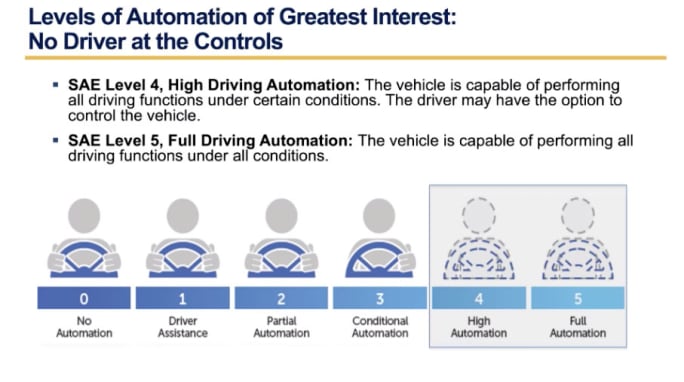
FMCSA is most concerned about how Level 4 and 5 autonomy will affect commercial vehicle safety regulations.
Photo: Screen capture during virtual FMCSA event, Deborah Lockridge
The Department of Transportation has in the past few years adopted evolving comprehensive plans regarding automated vehicles. The latest one was published for comment just before the change in administration, and the comment period closes on March 22. Loy seemed to indicate that he felt the new administration might have some different priorities so was unsure of the fate of this version of the plan.
ART is also doing some testing of its own regarding automated vehicle technology. It has outfitted a commercial coach with external cameras, radar, and lidar equipment.
“One of the things we’re looking at is we believe that during on-road usage of some of these Level 4 and 5 vehicles, we may run into situations where environmental degradation may affect the cleanliness or visibility of the cameras, which may affect the performance of the ADS technologies, due to bugs or dirt or rain or some other condition,” Loy explained. He suggested that pre-trip inspection protocols for SAE Level 4 and 5 vehicles might need to incorporate evaluation of this sensor equipment.
Ken Riddle, acting director of the Office of Research and Technology, highlighted some selected research projects his office is working on related to autonomous trucks. “How do you pull over and inspect a fully autonomous truck? How does it put out warning triangles? There are lots of challenges to overcome. We need to start thinking about those challenges now and how to overcome them.”
More Safety & Compliance

FMCSA Pauses Biennial-Update Enforcement Amid Motus Transition
Carriers whose updates were due on or after June 1 have more time, while FMCSA works to stabilize its new registration system and warns of phishing sites impersonating its new carrier registration system, Motus.
Read More →
ZF Expands Commercial Vehicle Push in North America
ZF is expanding its North American commercial-vehicle presence with new transmission applications, electrification, trailer technology and autonomous-driving systems.
Read More →
Truck Drivers Need More Than Another Alert
Fleets have more visibility into truck health, safety events, and driver activity than ever. The next challenge is turning all that information into useful guidance for the person who has to decide what to do next.
Read More →
Tesla Wants a Self-Driving Semi. Are Cameras Enough?
Could Tesla’s camera-only autonomous driving technology work on an 80,000-pound Semi? In this commentary, HDT's Deborah Lockridge takes a look at Tesla, Cybercab, and how autonomous trucks see the road.
Read More →
What DOT’s Automated Vehicle Strategy Means for Trucking
The U.S. Department of Transportation issued a new automated-vehicle strategy that outlines plans for driverless-truck regulations, cross-state freight corridors, and federal safety standards.
Read More →
NYC Expands Speed, Pedestrian Safety Tech Across Fleet
New York City is expanding intelligent speed assistance and pedestrian-alert systems across its municipal fleet, moving the technologies from pilot programs into vehicle procurement and retrofit requirements.
Read More →
FMCSA Removes 110 Truck Driver Training Schools from Certified ELDT List
Federal regulators also are targeting more than 160 additional training providers and launching a nationwide audit of third-party CDL skills testers as part of a broader crackdown on trucking fraud.
Read More →
Beyond DOT Compliance: What Makes a Trucking Fleet Truly Safe?
A trucking fleet can follow every rule and still make unsafe decisions. The real test comes when safety conflicts with freight, productivity, or cost.
Read More →
Hours of Service Pilot Programs: FMCSA Readies for 2027 Rollout
Two pilot programs could eventually reshape hours-of-service rules, giving truck drivers options to pause their 14-hour clock or use longer split sleeper rest periods.
Read More →
New Guide Offers Pet Safety Tips for Truck Drivers
Hundreds of thousands of pets travel in truck cabs. A new safety guide from Volvo Trucks and the Center for Pet Safety offers practical advice for truck drivers who bring dogs and cats along for the ride.
Read More →