




Ferro Farewell Focuses on Need to Spread Safety Burden
Anne Ferro’s departing message is that the cost of truck and bus safety needs to be distributed more evenly through the supply chain. Too much of the burden falls on drivers who are not paid for all the time they work, said Ferro in an exit interview Thursday with a number of reporters.


Photo: Oliver Patton
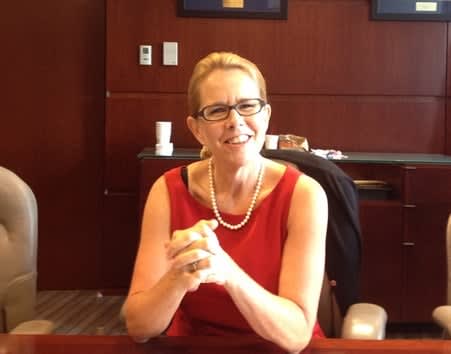
Photo: Oliver Patton
Corrected -- Anne Ferro’s departing message is that the cost of truck and bus safety needs to be distributed more evenly through the supply chain.
Too much of the burden falls on drivers who are not paid for all the time they work, said Ferro in an exit interview Thursday with a number of reporters.
Ferro will step down August 25 after five years as chief of the Federal Motor Carrier Safety Administration. She will become president and CEO of the American Association of Motor Vehicle Administrators when she leaves FMCSA.
She said that her experience late last year in a ride-along with owner-operator Leo Wilkins showed her how much safety responsibility falls on drivers and law enforcement while compliant carriers must bid against low-end competitors in a market dedicated to squeezing out costs.
“We need to move that safety calculus back into the supply chain and move the costs earlier among those influencing it,” she said.
It was a theme she returned to repeatedly.
“It is essential to recognize that professional drivers should be compensated for all time on duty. That’s integral to achieving the overall safety mission.”
This was in in reference to a provision in the pending Obama administration highway bill that would require carriers to pay drivers at least the federal minimum wage for time spent waiting to be loaded or unloaded. Ferro has been working on this issue since her Senate confirmation hearing in 2009.
Asked how she would measure the agency’s success when looking back five years from now, she started with the obvious metric – fewer fatal crashes – and then added, “vastly improved compensation for professional drivers, a higher bar for safety for those in the supply chain and incorporating safety into logistics management algorithms.”
The tension between the commercial pressure to deliver freight at the lowest possible cost and the imperative to do so safely is at the heart of the perpetual struggle over hours of service, Ferro said.
The agency is obliged by law to set constraints on carriers’ ability to meet their customers’ demands.
“In an economic system that continues to try to drive the last penny out of the supply chain, transportation and trucking in particular gets squeezed the hardest because it has the least leverage,” she said.
The trucking industry is fragmented and highly competitive, with a large group of small business operators – “A David facing the Goliath of supply chain shippers.”
“That tension will always bump up against an hours of service rule.”
She added that not everyone in the industry opposes the provisions of the rule that have sparked controversy in Congress.
American Trucking Associations has been pushing legislation that would suspend the 34-hour restart provision pending completion of a study of its impact.
The agency opposes this approach, preferring to keep the provision in place while the study proceeds.
“There are large numbers of drivers who would vastly prefer to see an hours of service structure that recognized their personal demands as professionals to get proper rest, and to work within a more manageable system,” Ferro said.
As the legislative fight over the restart continues, the agency is working on several studies of the issue, she said.
It has a contract with the National Academy of Sciences for a study that’s now under way, and it recently began the process of polling stakeholders for the questions they want answered in a second study. Another effort is targeting the impact of driver fatigue on small businesses.
The hours rule and others implemented during Ferro’s tenure have prompted some in the industry to blame Ferro for excessive regulation, even though others in the industry would like to see more regulation.
Ferro said she does not take the criticism personally.
“It’s not about me. It’s about the position and it’s about the agency’s role,” she said.
The FMCSA administrator “is not here to make friends,” she said. “The administrator is here to fulfill the letter of the law.”
Looking back, she would not have done anything differently, she said.
She added that she is not leaving the agency in response to a call from the board of the Owner-Operator Independent Drivers Association that she resign.
The opportunity from the American Association of Motor Vehicle Administrators came before “OOIDA called for my head,” she said.
One pending rule at the agency, a proposal to ban coercion of drivers by employers, shippers, receivers or brokers, is the first clear expansion of the FMCSA’s mandate deeper into the supply chain, Ferro said.
But the rule will not be a silver bullet, she added.
She encouraged carriers to use today’s market conditions, in which demand exceeds supply, to get better treatment for drivers.
“Shippers that are abusive should frankly be shut out,” she said. “I applaud any owner-operator or carrier who says to a shipper, ‘if you’re not going to pay detention time and tighten up on respect, we’re not taking your contract.'”
Ferro also said that the Department of Transportation and White House still are vetting the long-awaiting study of crash accountability in the CSA safety enforcement system. The final report is a few months away, she said.
Corrected 8/15/2014 9:45 a.m. EDT: The actual offer at AAMVA did not come before OOIDA's letter, although the opportunity did. The official offer came afterward.
More Fleet Management

How Telematics Improves Visibility, Control, and Performance in Refrigerated Fleets
Explore how telematics help refrigerated fleets improve visibility, uptime, efficiency, compliance, and cargo protection across connected cold chain operations.
Read More →
What the U.S.-Canada Trade War Means for Trucking
Escalating U.S.-Canada tariffs could disrupt cross-border freight, reduce truck volumes, raise costs, and create new uncertainty for carriers on both sides of the border.
Read More →
What Are Trucking’s Top Concerns for 2026?
The American Transportation Research Institute wants to know what's worrying trucking fleet managers, drivers, and other stakeholders in its annual Industry Issues survey.
Read More →

American Trucking Associations Looks for a New Leader
ATA President and CEO Chris Spear abruptly left his job at the association on August 21, at a pivotal time for the trucking industry.
Read More →
Public Wi-Fi Cybersecurity Risks: How Truck Drivers and Fleets Can Protect Their Data
Public Wi-Fi can expose truck drivers and fleets to credential theft, malware, and other cyber threats. Here’s how to reduce the risk on the road.
Read More →
For Nicky Cupp, Fleet Innovation Starts With Frustration
HDT Truck Fleet Innovator Nicky Cupp turns everyday pain points at Fraley & Schilling into opportunities for better technology and smarter processes.
Read More →
Adam Buttgenbach’s Approach to Electric Trucks: Start With Where They Fit
HDT Truck Fleet Innovator Adam Buttgenbach helped PepsiCo build one of North America’s largest EV fleets by focusing on where electric trucks make operational sense.
Read More →
Deen Albert: Let Automation Do the Math, People Make the Decisions
HDT Truck Fleet Innovator Deen Albert makes sure people are still at the heart of operations at Grand Island Express, even while adopting artificial intelligence tools. AI-assisted dispatch helped boost revenue 25% with the same number of trucks.
Read More →
Trimble’s New AI Agent Takes Aim at Fleet Back-Office Busywork
Arc Agent works across Trimble TMS products to automate repetitive tasks such as freight orders, maintenance, invoices, fuel costs and more.
Read More →
How HDT’s 2026 Truck Fleet Innovators Are Rethinking Fleet Operations
Meet five trucking leaders who are challenging assumptions, solving operational problems, and putting innovative ideas to work.
Read More →