




Ferro Presided Over Landmark Safety Rules
Anne Ferro, who will step down as chief of the Federal Motor Carrier Safety Administration next month, served as administrator during a period of great consequence for truck safety. Washington Editor Oliver Patton takes a look at what she has presided over in her almost five years in the post, as well as early industry reaction to her upcoming departure.

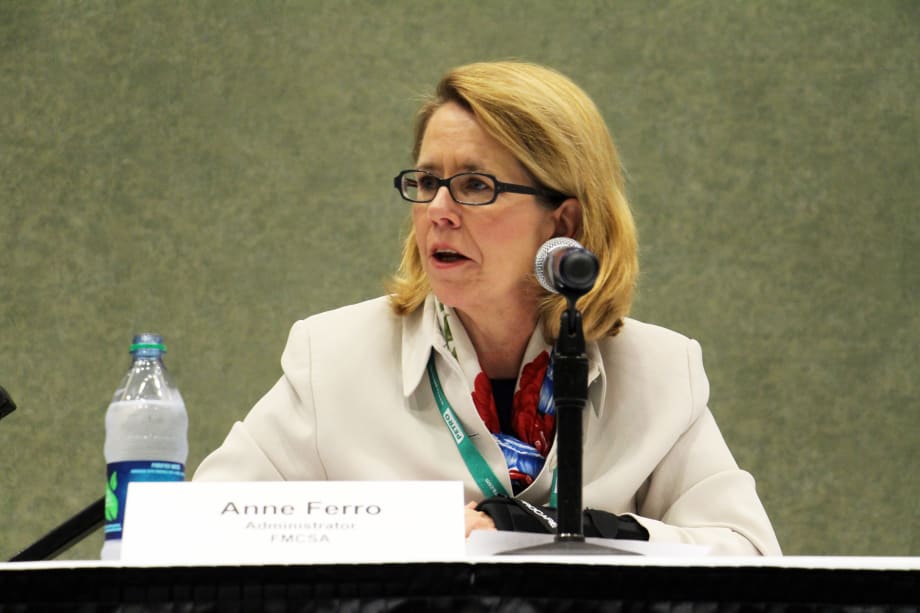
Outgoing FMCSA Administrator Anne Ferro at a listening session at the Mid-America Trucking Show earlier this year. Photo: Evan Lockridge
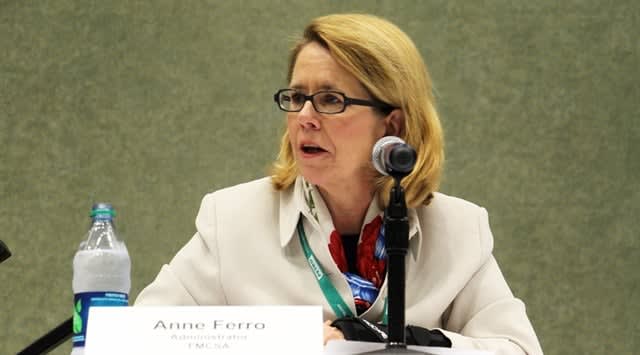
Outgoing FMCSA Administrator Anne Ferro at a listening session at the Mid-America Trucking Show earlier this year. Photo: Evan Lockridge
Anne Ferro, who will step down as chief of the Federal Motor Carrier Safety Administration next month, served as administrator during a period of great consequence for truck safety.
In her term of almost five years she presided over implementation of the landmark CSA safety enforcement program, substantial reform of the hours of service rule and the final stages of the electronic logging mandate, among many other initiatives.
Any of these regulations by itself would be a major event in an administrator’s career.
CSA (officially called Compliance, Safety Accountability), still a work in progress, has initiated a cultural change in industry safety. Hours of service, the fundamental work rule of the business, are extraordinarily sensitive. And when electronic logs are mandated, they will establish a new era of hours-of-service compliance.
All together, they amount to a significant body of work.
The job of FMCSA administrator is always a difficult balancing act, but it has been particularly so in a time of heightened rhetoric against government regulation while others are just as loud about wanting stricter controls.
Add to that the complexity and personal impact of CSA, hours of service and e-logs, and you get reactions such as those that accompanied news of Ferro’s resignation.
“Good riddance” and “none too soon” are typical of what’s being said, particularly by individual drivers.
Industry Reaction
But the chorus is not one-sided. A more positive perspective, for instance, comes from The Trucking Alliance, a small lobbying group representing a half-dozen carriers that are pushing for more safety regulations.
“Anne … has been a tireless advocate for the necessary structural changes required within the motor carrier community,” said Steve Williams, chairman of the Alliance and chairman and CEO of Maverick USA.
“Her commitment to study the efficacy of the hours of service rules, the implementation of the electronic logging device mandate and other initiatives, all of which are necessary to improve safety on our nation’s highways, will be her legacy,” Williams said.
Lane Kidd, managing director of the Alliance, said he hopes the Obama administration will nominate a replacement who “will turn up the volume even more in order to get the truck safety initiatives completed that Anne has been promoting.”
Another positive view came from Robert Voltmann, president and CEO of the Transportation Intermediaries Association.
TIA has strongly contested the agency’s handling of CSA safety data and Voltmann said the group has not always seen “eye to eye” with Ferro.
Yet, he added, “Ferro has been one of the most fair and open of FMCSA Administrators. [She] has always been receptive to the opinions of others. She has served our country well, and we wish her every success in her new role.”
He added: “TIA stands ready to continue to work with the agency and the Department [of Transportation] as we seek to find the right balance of safety and commerce, regulation and freedom to run small transportation businesses.”
American Trucking Associations, whose relations with Ferro have soured lately in the combat over the 34-hour provision of the new hours of service rule, simply acknowledged that Ferro has been a “passionate advocate” for her agency and wished her well.
Jim Johnston, president and CEO of the Owner-Operator Independent Drivers Association, said Ferro “is well known for having unprecedented personal outreach and engagement with truckers in all the years that we have worked with the agency.”
This expression comes just a month after the OOIDA board called for Ferro’s ouster, saying, “The agency needs to be headed by someone who will approach professional truck drivers with the respect and fair treatment that their important work and commitment to safety demand.”
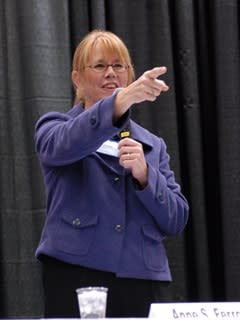
Ferro at an hours-of-service listening session at the Mid-America Trucking Show in 2010.
But, to illustrate the industry’s ambivalence about a strong regulator, shortly after the board’s shot a smaller group of OOIDA members said they support Ferro.
Ferro has made an extraordinary effort to reach out to the industry by conducting listening sessions at truck shows and truckstops, and answering calls on radio shows, they said.
“We believe these actions demonstrate the extra effort she puts forth to gain the knowledge she needs to make some very tough decisions,” they said.
“By actually mingling with the blue-collar people in the industry, she has fostered a unique safety culture in our industry. Never, before the introduction of [the] CSA program, has safety been on the lips of so many industry leaders and professional drivers.”
Ferro also has had her share of contention on Capitol Hill.
Rep. Richard Hanna, R-N.Y., challenged the agency’s commitment to zero fatalities as an ideology rather than a solution. Accidents are inevitable and there is no point in trying to drive the truck-related fatality rate down to zero, he said.
Zero deaths is "an unrealistic, impractical goal that burdens the industry and is philosophically based, not reality based.”
Ferro resisted this view and defended the agency’s approach. She said zero fatalities is not an ideology but an aspirational goal
“We really shouldn’t suggest that we can explain and justify the fatalities and serious injury crashes that happen today,” she said.
Left Unfinished
One important issue that remains outstanding as Ferro enters her last month in the job is the question of crash accountability.
Crash accountability has divided trucking since the agency began to deploy CSA four years ago. Under CSA, the agency aggregates crash data without reference to fault, based on the probability that some of the crashes will be the carrier’s fault.
This has given rise to the contention by both the agency and the safety advocacy community that past crashes are a predictor of future crash risk no matter who is at fault. But trucking interests believe it is illogical and wrong to include non-fault crashes in a system that measures safety performance.
The agency is many months overdue with an analysis that is looking at this issue, although it is possible that it will be done before Ferro leaves.
Another issue that Ferro will leave behind is the question of the impact of trucking’s business model on safety.
At her Senate confirmation hearing in 2009, Ferro said she considers it the administrator’s responsibility to talk about how uncompensated drivers’ time impacts safety.
“Uncompensated time, compensation by the mile or load, professional drivers classified as laborers – these are all aspects of a supply-chain model that rewards squeezing transportation costs out of the equation; factors that shift the cost onto the driving public and professional driver,” she said.
This concern led to a provision in the administration’s proposal for the next highway program that would require carriers to pay drivers at least the federal minimum wage for time waiting to be loaded or unloaded.
That provision is a long way from becoming law, but Ferro can be credited with getting the debate started.
Ferro will become president and CEO of the American Association of Motor Vehicle Administrators when she steps down in August.
This move brings her career to full circle. Immediately before she came to FMCSA she was president and CEO of the Maryland Motor Truck Association, and before that she was chief of the Maryland Motor Vehicle Administration.
There is no word yet on who the Obama administration will nominate to replace Ferro.
Her appointment was a departure from the traditional practice of naming a law enforcement professional to the post. She followed John Hill, a former officer in the Indiana State Police, and Annette Sandberg, former chief of the Washington State Patrol, at FMCSA.
More Safety & Compliance

FMCSA Pauses Biennial-Update Enforcement Amid Motus Transition
Carriers whose updates were due on or after June 1 have more time, while FMCSA works to stabilize its new registration system and warns of phishing sites impersonating its new carrier registration system, Motus.
Read More →
ZF Expands Commercial Vehicle Push in North America
ZF is expanding its North American commercial-vehicle presence with new transmission applications, electrification, trailer technology and autonomous-driving systems.
Read More →
Truck Drivers Need More Than Another Alert
Fleets have more visibility into truck health, safety events, and driver activity than ever. The next challenge is turning all that information into useful guidance for the person who has to decide what to do next.
Read More →
Tesla Wants a Self-Driving Semi. Are Cameras Enough?
Could Tesla’s camera-only autonomous driving technology work on an 80,000-pound Semi? In this commentary, HDT's Deborah Lockridge takes a look at Tesla, Cybercab, and how autonomous trucks see the road.
Read More →
What DOT’s Automated Vehicle Strategy Means for Trucking
The U.S. Department of Transportation issued a new automated-vehicle strategy that outlines plans for driverless-truck regulations, cross-state freight corridors, and federal safety standards.
Read More →
NYC Expands Speed, Pedestrian Safety Tech Across Fleet
New York City is expanding intelligent speed assistance and pedestrian-alert systems across its municipal fleet, moving the technologies from pilot programs into vehicle procurement and retrofit requirements.
Read More →
FMCSA Removes 110 Truck Driver Training Schools from Certified ELDT List
Federal regulators also are targeting more than 160 additional training providers and launching a nationwide audit of third-party CDL skills testers as part of a broader crackdown on trucking fraud.
Read More →
Beyond DOT Compliance: What Makes a Trucking Fleet Truly Safe?
A trucking fleet can follow every rule and still make unsafe decisions. The real test comes when safety conflicts with freight, productivity, or cost.
Read More →
Hours of Service Pilot Programs: FMCSA Readies for 2027 Rollout
Two pilot programs could eventually reshape hours-of-service rules, giving truck drivers options to pause their 14-hour clock or use longer split sleeper rest periods.
Read More →
New Guide Offers Pet Safety Tips for Truck Drivers
Hundreds of thousands of pets travel in truck cabs. A new safety guide from Volvo Trucks and the Center for Pet Safety offers practical advice for truck drivers who bring dogs and cats along for the ride.
Read More →