





Hydrogen: Truly Green Power
Learn about how hydrogen fuel cells work.
FCEV Drayage Trucks Prove Themselves in LA Port Demonstration Project
The ZANZEFF “Shore to Store” project proved fuel-cell electric trucks can match diesel performance to provide a zero-emissions alternative ready for commercial deployment.
September 22, 2022
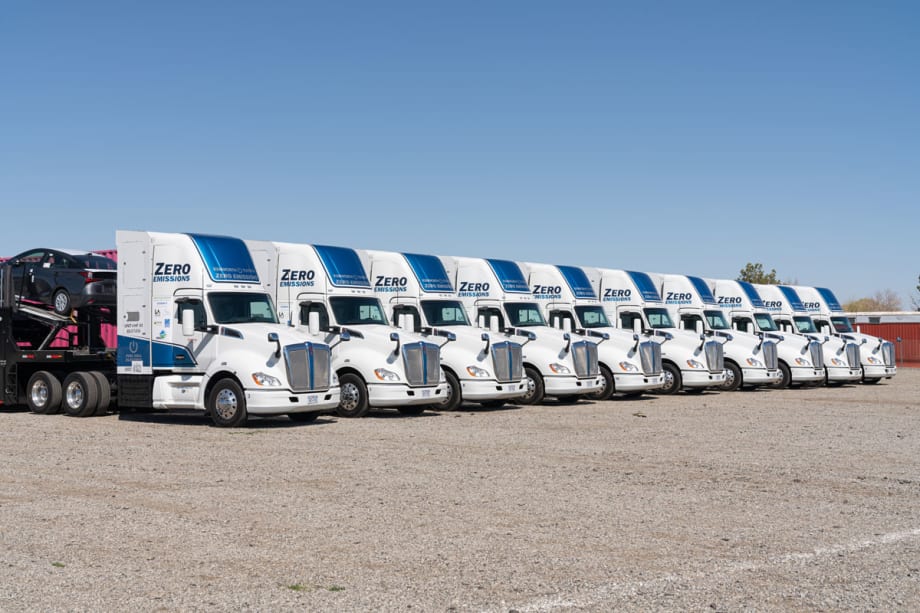
The fuel-cell electric trucks were operated by customers, including Toyota Logistics Services, Total Transportation Services Inc., and Southern Counties Express.
Photo: Toyota
4 min to read
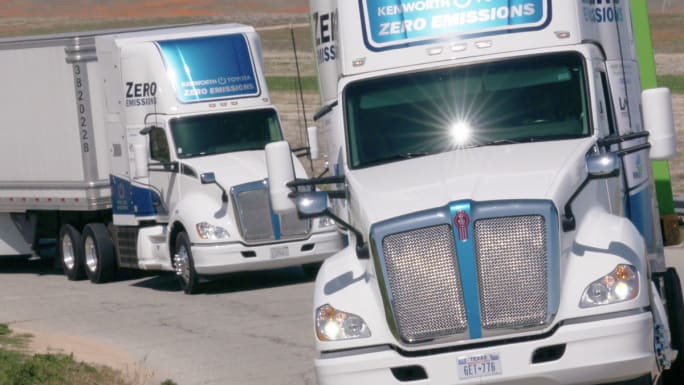
Kenworth and Toyota build 10 hydrogen-fuel-cell trucks for the "Shore to Store" project.
Photo: Toyota
A major hydrogen-fuel-cell-electric truck demonstration program has wrapped up in southern California with participants proclaiming it a success.
Toyota Motor North America and Kenworth Truck Co. announced they have proven the capabilities of their jointly designed heavy-duty, Class 8 fuel cell-electric trucks as a potential zero-emissions replacement for diesel-powered trucks. The companies have wrapped up their operations in the Zero- and Near-Zero Emissions Freight Facilities (ZANZEFF) “Shore to Store” project at the Port of Los Angeles, the Los Angeles basin, and the Inland Empire.
“Shore to Store” provided one of the largest real-world, proof-of-concept test cases to show the practical application of hydrogen-powered fuel cell technology at scale, noted the companies in an announcement. The primary goal was to nearly match the performance of diesel-powered drayage trucks while eliminating emissions.
Back in 2017, Toyota put its "Project Portal" Class 8 hydrogen fuel cell truck into testing, running regular drayage routes at ports in Southern California. In 2018 it announced an improved version of the fuel-cell-electric truck. In 2018, Kenworth showed off what it called the Zero Emissions Cargo Transport (ZECT) truck, a Class 8 hydrogen fuel cell electric vehicle, capable at that point of only about 100 miles of travel fully loaded. And in 2019, Toyota and Kenworth announced they would develop the 10 zero-emissions trucks for the ZANZEFF "Shore to Store" program.
The Toyota-Kenworth T680 FCEV truck was compared to a baseline 2017 diesel truck operating about 200 miles a day. The T680 FCEV has a range of about 300 miles when fully loaded to 82,000 lbs. With no downtime between shifts for charging and the short 15- to 20-minute fill time, the FCEVs could run multiple shifts a day and cover up to 400 or 500 miles.
Kenworth designed and built the Class 8 T680 FCEVs, while Toyota designed and built the powertrain’s fuel-cell electric power system, fueled with hydrogen. The trucks, code-named Ocean, reduced greenhouse gases by 74.66 metric tons of CO2 per truck annually compared to the baseline diesel engine.
Customer Experience
The 10 trucks for this project were operated by customers, including Toyota Logistics Services, Total Transportation Services Inc., and Southern Counties Express, serving their own real-world customers.
At Southern Counties Express, the Kenworth T680 FCEV was regularly in operation from Monday to Friday, and occasionally during weekends. It was used only on the morning shift, which usually starts at 5 a.m. and runs until 3 p.m., according to Ivan Hernandez, dispatch supervisor for the Rancho Dominguez, California-based fleet.
According to Hernandez, the T680 FCEV had two main runs. “The first was to and from the BNSF Railway yard in Commerce, California, then to a customer warehouse in Rancho Dominguez. The second was to and from the same customer’s warehouse to the terminals at the Ports of Los Angeles and Long Beach,” Hernandez noted. “We put in about 3,600 miles on the truck during the demonstration project.”
Southern Counties Express drivers reported the T680 FCEV is a lot quieter than a diesel. It has great torque, comfortable Kenworth cab, good visibility, and other driver-friendly features.
FCEV Trucks Ready for Wider Adoption
Though officially concluding their duties in the ZANZEFF project on Aug. 5, some of the FCEV trucks will remain in use as demonstration or working models, including one that will continue supporting Toyota operations in the lower LA Basin.
With the completion of this project, the door is now open for the technology to be adopted more widely for use in other heavy-duty applications, according to the announcement. The project was a result of close collaboration among project members, including Kenworth and Toyota, The Port of Los Angeles, Shell, and a grant from the California Air Resource Board.
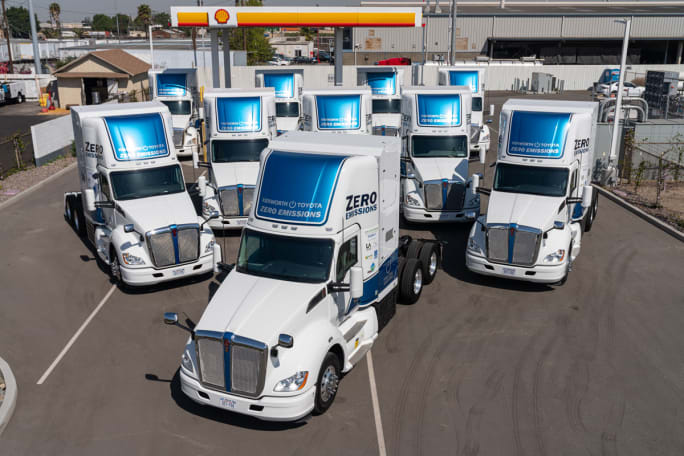
Shell contributed to the project by building a total of three hydrogen stations.
Photo: Toyota
Although the overall ZANZEFF project is anticipated to conclude later this year, the recently concluded “Shore to Store” projected funded under ZANZEFF was proposed by the Port of Los Angeles with support from Toyota, Kenworth and Shell. It was funded with a $41 million grant awarded by the California Air Resources Board.
Shell contributed to the project by building a total of three hydrogen stations (two ZANZEFF and one additional in the operating region), the first public provider in California to fuel heavy-duty trucks. With the set routes for the trucks’ drayage operations, the stations were regularly used, providing quick refueling.
The Port of Los Angeles, the busiest container port in North America, hopes to transition drayage fleets to zero-emission powertrains by 2035 and recently announced the Clean Truck Fund to help support this transition.
Toyota plans to produce fuel-cell powertrain modules in Kentucky starting in 2023.
More Fuel Smarts

How Volvo Updated Its D13 for EPA 2027 [Watch]
Volvo’s updated D13 promises lower emissions without sacrificing performance or fuel economy. Take a closer look at what changed inside the engine in this HDT Spotlight video.
Read More →
Diesel Price Spike Shortens Payback for Natural Gas Trucks, Report Says
Energy Vision estimates fleets could recover the higher purchase price of an RNG-fueled Class 8 tractor in 1.3 to 2.8 years under current fuel-price scenarios.
Read More →
Calstart Becomes Catalyst Mobility, Reflecting Broader Focus
Calstart is now Catalyst Mobility, reflecting the nonprofit’s growing national role in clean transportation, including zero-emission trucks, infrastructure and incentive programs.
Read More →

Record Diesel Prices Squeeze Trucking Fleets
Average U.S. diesel prices have climbed to nearly $6 a gallon, surpassing the 2022 record as tight refinery capacity and Middle East disruptions keep fuel costs elevated.
Read More →
Sponsored•September 9, 2026
How Fuel Delivery Shapes Engine Performance
Fuel delivery depends on more than what happens at the injector. For fleet, maintenance and technical professionals, looking at the full path from pump to injector can provide useful context for understanding engine performance.
Read More →
East Coast Port Launches $45M Electric Truck Push
The Port Authority of New York and New Jersey announced millions in incentives for zero-emission drayage trucks, yard tractors, and new charging hubs near the port.
Read More →
California Bill Could Shed Light on Electric Truck Prices
Why do battery-electric Class 8 trucks remain so expensive? A California bill headed to Gov. Gavin Newsom would give fleets and state agencies more visibility into what manufacturers charge.
Read More →
Detroit Opens Orders for EPA 2027 Engines
Detroit isn’t starting from scratch to meet EPA 2027 diesel emissions standards. Its Gen 6 DD13 and DD15 engines keep much of today’s platform while updating the fuel and aftertreatment systems.
Read More →
Zero-Emission Truck Corridor Planned for West Coast
California, Oregon, Washington, British Columbia and Baja California are coordinating plans for truck charging and hydrogen fueling from Canada to Mexico.
Read More →
A Closer Look at Kenworth’s Electric T880E Vocational Truck [Video]
Learn more about Kenworth's T880E battery-electric vocational truck at the Paccar Technical Center, including its range, applications, upfitting considerations, and PTO options, in this HDT Spotlight video.
Read More →