




Faster Truck Development Cycles Help Muddy the Definition of Production
What does it mean for a medium- or heavy-duty commercial truck to be “in production”? It’s a question that has come up more and more as startup truck makers developing new electric and hydrogen fuel cell vehicles enter the market, so the North American Council for Freight Efficiency has put out a report attempting to formulate an answer.

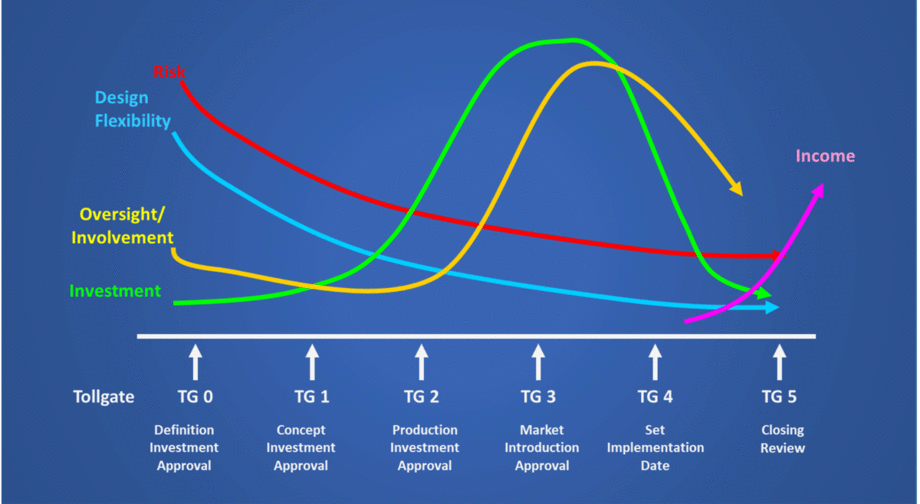
Getting designs from idea to production where the vehicles meet both regulatory and market expectations for safety, durability, functionality and cost requires time.
Graph: NACFE
What does it mean for a medium- or heavy-duty commercial truck to be “in production”? It’s a question that has come up more and more as startup truck makers developing new electric and hydrogen fuel cell vehicles enter the market, so the North American Council for Freight Efficiency has put out a report attempting to formulate an answer.
There is no one definition for production beyond being a point in time where a new product comes off of a production line and is commercially provided to an end use customer, NACFE notes. It can mean different things to different OEMs, customers, regulators, media and the public.
It is relatively easy to create “show” trucks for public events and low-volume prototypes for limited track and road testing, taking six weeks to six months. Commercial production trucks, however, can take years – four to six years is common, NACFE said.
NACFE outlined four main conclusions in its report:
Many definitions exist for a statement by truck builders that they are in production, causing confusion with stakeholders.
Product development is an investment in a new product that reduces collective risk over time through testing and decision-making.
There are dramatically differing situations for established versus new OEM entrants, including such items as established development processes, revenue needs, variation of product offerings, and risk acceptance levels.
Fleet expectations for cost of operation, performance, reliability and durability, etc. will not change – and in fact be more demanding.
Confusion abounds
The report notes the wide variety of definitions the authors have seen for being in production:
The first vehicle off of a low-rate production tooling, with few options available – or the first vehicle off of a high-rate production tooling, with many options available.
The first commercially sold vehicle, but with limited trained field support and limited parts availability – or the first commercially sold vehicle, with substantial trained field support and robust parts availability.
Low-rate production line at factory while the factory is ramping up assembly training and supply chain – or full-rate production line at factory, with factory staff trained and the supply chain fully operational.
First commercially leased vehicle, with intent to retrieve and replace vehicle with later version – or the first commercially leased vehicle with full service life
First vehicle to be ordered via the production ordering process. But it might require frequent software updates and recalls – or may have a stable software configuration and no recalls
First vehicle in customer commercial use – but they may experience low uptime, or a company might not consider it full production until a vehicle is in commercial use with high uptime.
Shortening development cycles
One of the factors at work here is shortening development cycles.
Getting designs from idea to production where the vehicles meet both regulatory and market expectations for safety, durability, functionality and cost requires time, NACFE notes. “OEMs consistently focus on reducing time to market, but shortcutting processes can have ramifications seen in expensive and embarrassing product recalls and legal settlements with regulators and others.”
“The definition of production is going to be different for each company based on the risk they and fleet buyers are willing to accept,” said Rick Mihelic, NACFE director of future technologies studies and the lead on the report, in a conference call with reporters.
Historically, said NACFE Executive Director Mike Roeth, the development process is a lengthy one. “With advances in computer analysis, this time can be shortened. But it can’t be shortened to the point where it adds a lot of risk to the customer.”
Helping to drive some of the acceleration we’re seeing in development cycles and different definitions of “production” are new entrants into the industry.
“There’s a lot of research on how new entrants in any market, not just trucking, do need to be aggressive and challenging in order to meet their investment goals and so forth,” Roeth said. “I also would say when a traditional long-term manufacturer, over time, they’ve had [bad] experiences with product launches in the past, it can create a too conservative approach sometimes to product development.”
Another change is that fleet validation of new trucks has become a much more publicly touted process. Recent announcements have highlighted Werner Enterprises putting a Peterbilt electric truck into testing, and Daimler’s Innovation Fleet has electric Freightliners in the hands of NFI and Penske in California.
“The benefit of those upstart new companies is they’ve brought more attention to innovation in the public realm, and so the older traditional companies are having to show what they’re doing so they don’t look like they’re falling behind,” Mihelic said.
He also pointed out that there’s increasing collaboration and partnerships between startups and traditional OEs and component suppliers. “A couple years ago, the newcomers were saying the traditional OEMs were too slow, and the traditional OEMs would say the newcomers don’t know what they’re doing and it’ll take longer than they think. Now you’re seeing with partnerships there are some benefits to what the traditional OEMs were doing, and traditional OEMs are seeing some benefits to some of the faster approaches of the newcomers, so you’re getting this amalgamation of the best of both worlds. It should get innovation faster to the marketplace – but also when it gets there, they will be more reliable.”
The report, which NACFE is classifying as a “thought leadership paper,” can be downloaded at https://nacfe.org/defining-production/
More Equipment

How Volvo Updated Its D13 for EPA 2027 [Watch]
Volvo’s updated D13 promises lower emissions without sacrificing performance or fuel economy. Take a closer look at what changed inside the engine in this HDT Spotlight video.
Read More →
Michelin Tire Improves Efficiency and Durability for Regional Fleets
The Michelin X Multi Energy D2 is a regional haul drive tire engineered to help fleets improve fuel efficiency, durability and traction in demanding stop-and-go operations.
Read More →
ZF Expands Commercial Vehicle Push in North America
ZF is expanding its North American commercial-vehicle presence with new transmission applications, electrification, trailer technology and autonomous-driving systems.
Read More →
Tesla Wants a Self-Driving Semi. Are Cameras Enough?
Could Tesla’s camera-only autonomous driving technology work on an 80,000-pound Semi? In this commentary, HDT's Deborah Lockridge takes a look at Tesla, Cybercab, and how autonomous trucks see the road.
Read More →
Kodiak: Driverless Long-Haul Truck Launch on Track for 2026
Kodiak AI says its driverless long-haul safety case is 93% complete and it remains on track to begin commercial operations by year-end 2026.
Read More →
What DOT’s Automated Vehicle Strategy Means for Trucking
The U.S. Department of Transportation issued a new automated-vehicle strategy that outlines plans for driverless-truck regulations, cross-state freight corridors, and federal safety standards.
Read More →
East Coast Port Launches $45M Electric Truck Push
The Port Authority of New York and New Jersey announced millions in incentives for zero-emission drayage trucks, yard tractors, and new charging hubs near the port.
Read More →
PlusAI Going Public to Fund Autonomous Truck Launch
A SPAC deal could provide PlusAI with up to $300 million as it works toward a 2027 commercial launch of factory-built autonomous trucks.
Read More →
NHTSA Moves to Rewrite Truck Fuel-Economy Rules
The National Highway Traffic Safety Administration says it lacks authority to regulate medium- and heavy-duty truck engines separately from complete vehicles, but the existing standards have not yet been eliminated.
Read More →
Detroit Opens Orders for EPA 2027 Engines
Detroit isn’t starting from scratch to meet EPA 2027 diesel emissions standards. Its Gen 6 DD13 and DD15 engines keep much of today’s platform while updating the fuel and aftertreatment systems.
Read More →