




Existing Intelligent Transportation Technologies Could Eliminate Almost All Traffic Accidents
Nearly every traffic accident caused by driver error -- up to 90 percent of all crashes -- could be eliminated if existing intelligent transportation technologies were implemented in our vehicles and roads, say experts at IEEE, the world's largest technical professional association
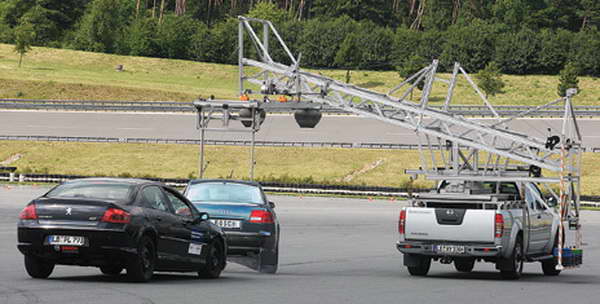
Courting danger: On a Bosch test track, the black demo car approaches the dummy car too quickly, alerting the radar system, which applies the brakes in time to prevent or at least soften the crash. Photo: Bosch.
Nearly every traffic accident caused by driver error -- up to 90 percent of all crashes -- could be eliminated if existing intelligent transportation technologies were implemented in our vehicles and roads, say experts at IEEE, the world's largest technical professional association.
These include electronics and computing technologies such as in-vehicle machine vision and sensors to detect drowsy drivers, lane departure warning systems, and vehicle-to-vehicle and vehicle-to-infrastructure communications for safety applications. However, costs of such technologies need to fall so the average consumer can afford such vehicle safety features.
"Today's advanced embedded systems, sensors, microprocessors and control technologies have made our vehicles and roads significantly safer, but integrating them into our vehicles and roads has been a slow process," said Dr. Azim Eskandarian, IEEE member and director of the Center for Intelligent Systems Research at The George Washington University. "However, within 10 years, as technology costs continue to fall and implementation of these technologies increases, we could see significant improvements in vehicle safety, efficiency, and energy conservation -- especially in developing parts of the world where high-end cars are not yet affordable by the general public."
Dr. Eskandarian says other challenges include market acceptance and potential liability concerns surrounding technologies that take total or partial control of the vehicle, such as collision avoidance and driver assistance programs like automatic braking. However, these technologies may follow the path of driver- and passenger-side airbags and anti-lock braking systems or electronic stability control. These were initially offered as optional features but today are considered proven and often standard safety measures in nearly all vehicles.
Advanced research on safety technologies is going far beyond individual vehicles. For example, Teruo Higashino, IEEE Senior Member and professor of information networking at Osaka University in Japan, has focused recently on applying wireless networking technology for vehicle-to-vehicle communication to help detect dangerous vehicles on the road -- such as a car approaching a blind intersection -- and warn nearby drivers, helping dramatically reduce accidents. Many of these ground-breaking innovations, including vehicle-to-vehicle communication, were discussed at the recently held IEEE ITS Conference in Washington D.C.
Driverless Vehicles
Dr. Alberto Broggi, President of the IEEE Intelligent Transportation Systems Society and professor at the Universita di Parma in Italy, says intelligent transportation technologies on the horizon, including autonomously-driven vehicles, will forever change our concept of car use.
Broggi recently coordinated the successful 8,000-mile journey of a driverless van from Italy to China.
"These types of self-driven vehicles will be ready for use in non-urban environments within five to eight years," said Broggi. "The same technology will also apply to agricultural equipment, including self-driven tractors and combines that will maximize land use, increase crop output and decrease injuries."
Another expected benefit of intelligent transportation technologies is reduced fuel consumption and emissions. IEEE Senior Member Matt Barth, at the Center for Environmental Research and Technology at University of California-Riverside, predicts that fuel use and vehicle emissions can be reduced by 20 to 30 percent worldwide over the next five years using environmentally-friendly ITS technology such as "eco-routing." This vehicle GPS system capability will allow drivers to select destination routes according to fuel efficiency.
"Many governments are establishing new emissions and fuel efficiency standards for vehicle manufacturers to meet in the next ten years," Barth said. "The integration of ECO-ITS technologies - such as eco-routing into our vehicles - will be an important evolution in further reducing carbon emissions, achieving greater fuel efficiency, and strengthening energy independence."
Kyongsu Yi, IEEE member and director of the Vehicle Dynamics and Control Laboratory at SeoulNational University in South Korea, said the application of intelligent transportation technologies varies by setting. "There's much more of a focus on traffic management systems for pedestrian protection in countries in Europe and Asia where cities were traditionally designed around a relatively small and defined city center," Yi said. "In contrast, in the United States where there are more sprawling open spaces, the emphasis is on vehicle safety systems to prevent roll-overs or collisions with other fast-moving vehicles."
Additional IEEE resources and multimedia content on intelligent transportation systems include:
IEEE Spectrum article on a recent affordable innovation in long-distance car radar - long distance car radar
IEEE Spectrum article on Ford's Curve Control Technology - Advanced Cars
Video from U.S. Department of Transportation on vehicle-to-vehicle communication safety systems - www.its.dot.gov/library/media/v2v_video.htm
ITS World Congress, focusing on "Keeping the Economy Moving" - www.itsworldcongress.org
Learn more: www.ieee.org.
More Safety & Compliance
A Camera Isn't a Safety Program. Here's What Brokers Are Screening for Now
Footage alone may not be enough to pass broker vetting processes. Here's what counts as a defensible safety program now.
Read More →
Marijuana and Trucking’s Drug-Testing Dilemma
Marijuana is getting stronger, laws are changing, and drug tests still can’t reliably establish impairment. What does that mean for truck drivers and the fleets that employ them?
Read More →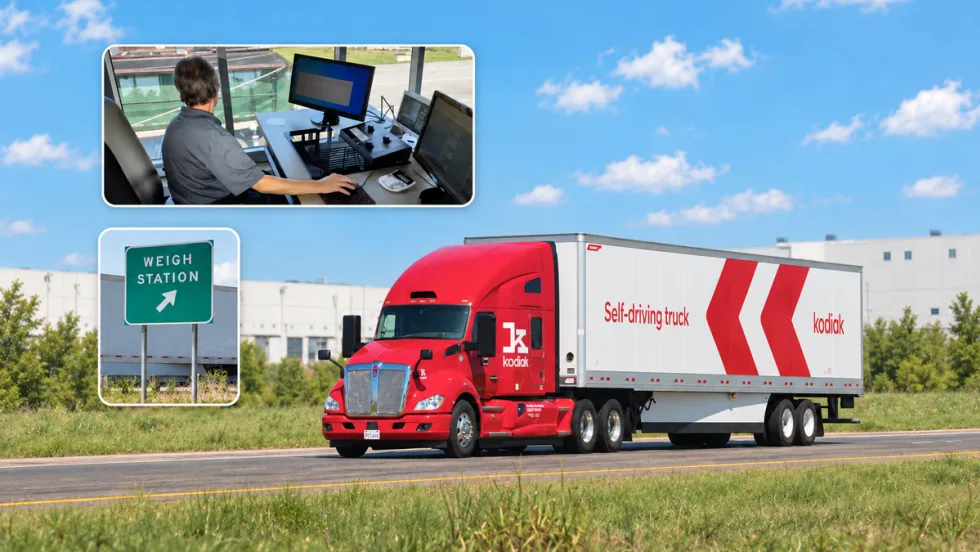
PrePass, Kodiak Connect Driverless Trucks to Roadside Enforcement
The system will allow enforcement agencies to verify Enhanced Inspection information and decide whether Kodiak’s autonomous trucks can bypass roadside screening sites.
Read More →

From One Generation to the Next: How Mentorship Builds Safer Truck Drivers
After three decades in trucking, Harold Perry shares what he's learned about driver safety, mentorship, and helping the next generation build confidence behind the wheel.
Read More →
FMCSA Pauses Biennial-Update Enforcement Amid Motus Transition
Carriers whose updates were due on or after June 1 have more time, while FMCSA works to stabilize its new registration system and warns of phishing sites impersonating its new carrier registration system, Motus.
Read More →
ZF Expands Commercial Vehicle Push in North America
ZF is expanding its North American commercial-vehicle presence with new transmission applications, electrification, trailer technology and autonomous-driving systems.
Read More →
Truck Drivers Need More Than Another Alert
Fleets have more visibility into truck health, safety events, and driver activity than ever. The next challenge is turning all that information into useful guidance for the person who has to decide what to do next.
Read More →
Tesla Wants a Self-Driving Semi. Are Cameras Enough?
Could Tesla’s camera-only autonomous driving technology work on an 80,000-pound Semi? In this commentary, HDT's Deborah Lockridge takes a look at Tesla, Cybercab, and how autonomous trucks see the road.
Read More →
What DOT’s Automated Vehicle Strategy Means for Trucking
The U.S. Department of Transportation issued a new automated-vehicle strategy that outlines plans for driverless-truck regulations, cross-state freight corridors, and federal safety standards.
Read More →
NYC Expands Speed, Pedestrian Safety Tech Across Fleet
New York City is expanding intelligent speed assistance and pedestrian-alert systems across its municipal fleet, moving the technologies from pilot programs into vehicle procurement and retrofit requirements.
Read More →