




EPA Proposal to Exempt Gliders from GHG Regs Draws Criticism in Hearing
Opponents of the Environmental Protection Agency’s proposal to roll back the glider kit portion of its greenhouse gas emissions regulations testified Monday that the agency is ignoring its own research and that excepting gliders will put truck and engine makers at a significant competitive disadvantage.

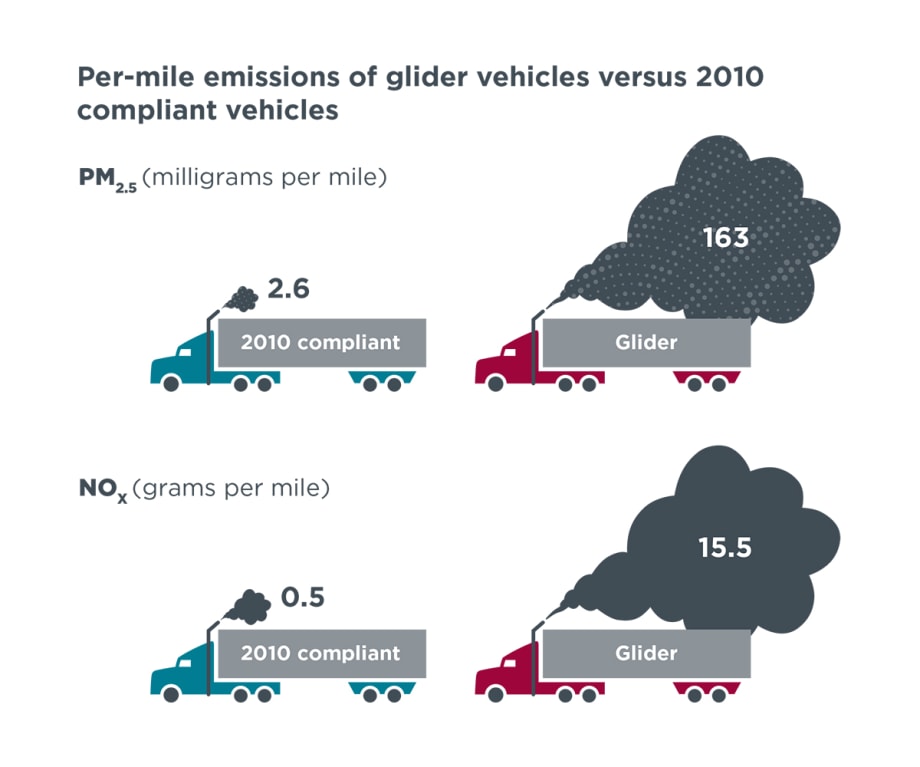
This ICCT graphic shows per-mile emissions of glider vehicles vs. EPA-2010 trucks. Results derived from testing conducted by EPA's National Vehicle & Fuel Emissions Laboratory. Results reflect a 95% weighting of highway activity and 5% weighting of transient activity for a test vehicle with a combined weight of 60,000 pounds.
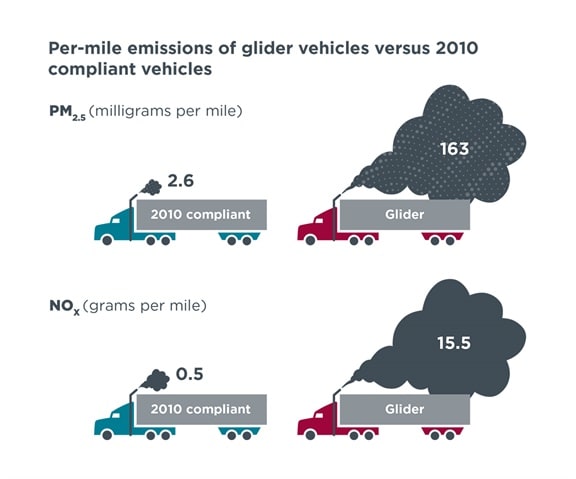
This ICCT graphic shows per-mile emissions of glider vehicles vs. EPA-2010 trucks. Results derived from testing conducted by EPA's National Vehicle & Fuel Emissions Laboratory. Results reflect a 95% weighting of highway activity and 5% weighting of transient activity for a test vehicle with a combined weight of 60,000 pounds.
Opponents of the Environmental Protection Agency’s proposal to roll back the glider kit portion of its greenhouse gas emissions regulations testified Monday that the agency is ignoring its own research and that excepting gliders will put truck and engine makers at a significant competitive disadvantage.
A public hearing in Washington, D.C., Monday, was scheduled to gather comment on the EPA’s recent proposed rulemaking to eliminate provisions affecting glider kits within the Phase 2 Greenhouse Gas Emissions and Fuel Efficiency Standards, which start to take effect in January.
The Phase 2 rules as written would allow glider kits only for their original purpose, which was seen as reclaiming powertrains from wrecked trucks and reusing them in new bodies and chassis. But the EPA announced earlier this fall a proposal to drop the glider kit portion of the regulation.
Rachel Muncrief, the heavy-duty program director for the International Council on Clean Transportation and a participant in Monday's hearing, called them “zombie trucks,” writing in a recent blog post, “Scott Pruitt’s EPA is bringing the oldest and dirtiest diesel engines back from the dead—but disguising them in a shiny new host body. How? In the form of the innocuous-sounding glider truck.”
More than 60 people signed up to testify at the hearing. Not just environmental groups, but also representatives from the trucking industry, including speakers from Volvo, the Engine Manufacturers Association, the American Trucking Associations, and the Heavy Duty Fuel Efficiency Leadership Group.
The EPA’s proposal to undo the glider kit portion of the GHG regs “would undermine investments made in the industry, encourage the use of older, less efficient technologies, and increase smog-forming pollution that harms public health,” said Pat Quinn, executive director of the Heavy Duty Fuel Efficiency Leadership Group. This “informal alliance” of companies involved in trucking, including Cummins, Eaton, FedEx, PepsiCo, Wabash National and Waste Management, supports the development of national fuel efficiency and greenhouse gas emission regulations for heavy-duty vehicles.
“Truck and engine manufacturers over the past 10 years have made enormous investments in sophisticated emission control technologies to comply with current emissions standards,” Quinn said. “If EPA’s proposed repeal of emission requirements for gliders has the anticipated effect of expanding glider production, truck and engine manufacturers will face a significant competitive disadvantage.”
Dueling data
Quinn was one of a number of speakers citing EPA’s own data. That data, he said, “suggests that gliders have become much more common since 2010, when the agency’s latest heavy duty NOx standard took effect, with ‘significantly over’ 10,000 vehicles in 2015. The agency’s data also indicate that ‘nearly all engines for recent glider production’ are MY 1998-2002 that are not equipped with exhaust gas re-circulation (EGR), which lowers NOx emissions. The re-use of these older powertrains in glider kits also produces elevated levels of PM emissions that significantly exceed current standards and currently certified OEM products. Based upon recent EPA data, glider vehicle NOx levels are four to 40 times higher than current powertrains and PM levels are 50 to 450 times higher.”
Dave Cooke, senior vehicles analyst for the Union of Concerned Scientists, also spoke at the hearing. In a blog post published before the hearing, he discussed the research being used in this rulemaking process.
He criticized research submitted by Fitzgerald Trucks, the glider kit manufacturer reportedly behind the push to take glider kits out of the rule. “The tests were paid for by Fitzgerald and conducted using Fitzgerald’s equipment in Fitzgerald’s facilities,” Cooke said. “The results of the tests were incomplete and indicated that the work was sub-standard.” Among the shortcomings, he said, were that researchers did not use industry standard testing procedures; did not take samples of soot during testing but only “visually inspected” test probes; and did not test under “cold start” conditions when engines put out the most pollution.
Meanwhile, he said, higher quality data was recently published from EPA testing.
“According to the test results, it appears that these engines actually exceed the legal limits they were initially designed for. This means that the “special programming” of the engine Fitzgerald claims to do to the engines may result in greater fuel economy, but it means greater pollution, too,” Cooke writes.
More concerns
Quinn of the Heavy Duty Fuel Efficiency Leadership Group also emphasized the importance of national regulations, saying the group was concerned that repealing the glider provisions “could lead to an inconsistent patchwork of federal and state requirements, producing uncertainty for truck and engine manufacturers and fleets.”
California, of course, would be the most likely state to implement its own rules, and if so, it could be followed by others. Indeed, the California Air Resources Board spoke at the hearing as well. “This illegal effort by EPA will open the floodgates to allow unlimited numbers of old and dirty trucks to pour onto our streets and highways masquerading as brand new clean trucks,” said Steve Cliff, CARB deputy executive officer.
“The proposed repeal would legitimize the actions of the glider industry, which … has been blatantly circumventing emission control requirements and undermining the vast majority of businesses that play by the rules and clean up their trucks.”
Cliff and others also said repealing the glider requirements would also be in violation of the federal Clean Air Act. Excluding glider vehicles from the definition of “new motor vehicle,” he said, is inconsistent with the fact that glider vehicles are being manufactured, marketed, and sold as “new” vehicles.
The Diesel Technology Forum, which promotes “clean diesel,” issued a statement on the occasion of the hearing, noting that “the greatest benefits for the environment and for trucking customers lie in the adoption of the new generation of clean diesel technology, which would be slowed if the current requirements regarding glider vehicles were changed.”
"Almost 3 million heavy-duty diesel commercial vehicles introduced in the U.S. from 2011 through 2016 are now on the road, powered by the latest generation clean diesel engines. These trucks have delivered important benefits in the form of cleaner air, fewer carbon dioxide emissions and dramatic fuel savings," said Allen Schaeffer, DTF executive director. "Over a five-year period, the newest generation commercial vehicles have saved 4.2 billion gallons of diesel fuel, and reduced 43 million tons of carbon dioxide (CO2), 21 million tons of nitrogen oxides (NOx) and 1.2 million tons of particulate matter (PM)."
More Fuel Smarts

How Volvo Updated Its D13 for EPA 2027 [Watch]
Volvo’s updated D13 promises lower emissions without sacrificing performance or fuel economy. Take a closer look at what changed inside the engine in this HDT Spotlight video.
Read More →
Diesel Price Spike Shortens Payback for Natural Gas Trucks, Report Says
Energy Vision estimates fleets could recover the higher purchase price of an RNG-fueled Class 8 tractor in 1.3 to 2.8 years under current fuel-price scenarios.
Read More →
Calstart Becomes Catalyst Mobility, Reflecting Broader Focus
Calstart is now Catalyst Mobility, reflecting the nonprofit’s growing national role in clean transportation, including zero-emission trucks, infrastructure and incentive programs.
Read More →

Record Diesel Prices Squeeze Trucking Fleets
Average U.S. diesel prices have climbed to nearly $6 a gallon, surpassing the 2022 record as tight refinery capacity and Middle East disruptions keep fuel costs elevated.
Read More →
How Fuel Delivery Shapes Engine Performance
Fuel delivery depends on more than what happens at the injector. For fleet, maintenance and technical professionals, looking at the full path from pump to injector can provide useful context for understanding engine performance.
Read More →
East Coast Port Launches $45M Electric Truck Push
The Port Authority of New York and New Jersey announced millions in incentives for zero-emission drayage trucks, yard tractors, and new charging hubs near the port.
Read More →
California Bill Could Shed Light on Electric Truck Prices
Why do battery-electric Class 8 trucks remain so expensive? A California bill headed to Gov. Gavin Newsom would give fleets and state agencies more visibility into what manufacturers charge.
Read More →
Detroit Opens Orders for EPA 2027 Engines
Detroit isn’t starting from scratch to meet EPA 2027 diesel emissions standards. Its Gen 6 DD13 and DD15 engines keep much of today’s platform while updating the fuel and aftertreatment systems.
Read More →
Zero-Emission Truck Corridor Planned for West Coast
California, Oregon, Washington, British Columbia and Baja California are coordinating plans for truck charging and hydrogen fueling from Canada to Mexico.
Read More →
A Closer Look at Kenworth’s Electric T880E Vocational Truck [Video]
Learn more about Kenworth's T880E battery-electric vocational truck at the Paccar Technical Center, including its range, applications, upfitting considerations, and PTO options, in this HDT Spotlight video.
Read More →