





Transportation Secretary Promises to Go After 'Bad Actors' in Trucking
Emergency Rule Overhauls How States Issue Non-Domiciled CDLs
FMCSA’s interim final rule, effective immediately, significantly alters how states issue non-domiciled CDLs, following findings that thousands were improperly granted — particularly in California.
September 26, 2025
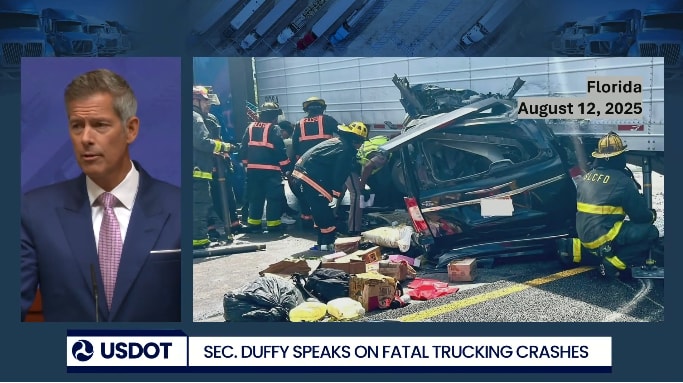
Transportation Secretary Sean P. Duffy announced stricter standards for CDLs for non domiciled drivers.
Source: Transportation Secretary Sean P. Duffy
7 min to read
The U.S. Department of Transportation announced an emergency interim final rule to strengthen federal oversight of how states issue non-domiciled commercial driver’s licenses.
It's a move that one transportation law firm said could affect 6% to 18% of the commercial driver workforce nationwide.
The rule comes in response to a nationwide review conducted by the Federal Motor Carrier Safety Administration into state licensing practices regarding non-domiciled CDLs.
Moving forward, non-citizens will not be eligible for a non-domiciled CDL unless they meet a much stricter set of rules. This will include having an employment-based visa and undergoing a mandatory federal immigration status check using the SAVE system.
FMCSA issued an Interim Final Rule that “significantly alters the process for state driver’s licensing agencies issuing commercial driving credentials to foreign-domiciled individuals,” noted Scopelitis Transportation Consulting in an email alert.
The rule takes effect immediately upon publication in the Federal Register, which could be as early as Monday, September 29.
According to an email from California law firm Hanson Bridgett LLP, the regulation not only restricts new CDL issuances but also appears to require state driver’s license agencies to reevaluate existing non-domiciled CDL holders to determine whether their licenses remain valid. That could trigger widespread ripple effects across trucking, logistics, and supply chains.
What is a Non-Domiciled CDL?
As the American Trucking Associations explained in a blog post reacting to the announcement, “a non-domiciled CDL is given to someone who is legally allowed to work in the U.S. but doesn’t permanently live in the state issuing the license — often foreign nationals working under temporary U.S. work authorization.
“These licenses can’t be issued to Mexican and Canadian drivers, since they’re already covered by agreements between our countries. But they must meet the same rigorous federal testing standards as all CDLs.
“The problem is that federal audits have shown that several states aren’t living up to those standards.”
Since the beginning of the 2025 calendar year, FMCSA has identified at least five fatal crashes involving non-domiciled CDL holders, according to a copy of the interim final rule.
At least two of these drivers were improperly issued a CDL, while others held CDLs that complied with the regulations in place at the time of issuance but would not be eligible for a non-domiciled CDL under the revised regulations.
Scopelitis: Trucking Fleets Should Review Hiring Practices
The rule revises the regulations that allow state driver licensing agencies to issue and renew non-domiciled commercial learner’s permits and CDLs to individuals domiciled in foreign jurisdictions.
It restricts the issuance and renewal of non-domiciled CLPs and CDLs to individuals who maintain lawful immigration status in specific employment-based non-immigrant categories: H-2A, H-2B, and E-2 visa holders.
No other immigration categories will be eligible for a non-domiciled CLP or CDL.
Scopelitis also noted that FMCSA is asking for comments on the rule within 60 days after its publication in the Federal Register.
“Motor carriers are advised to review their hiring practices to ensure alignment with the updated requirements,” said Scopelitis.
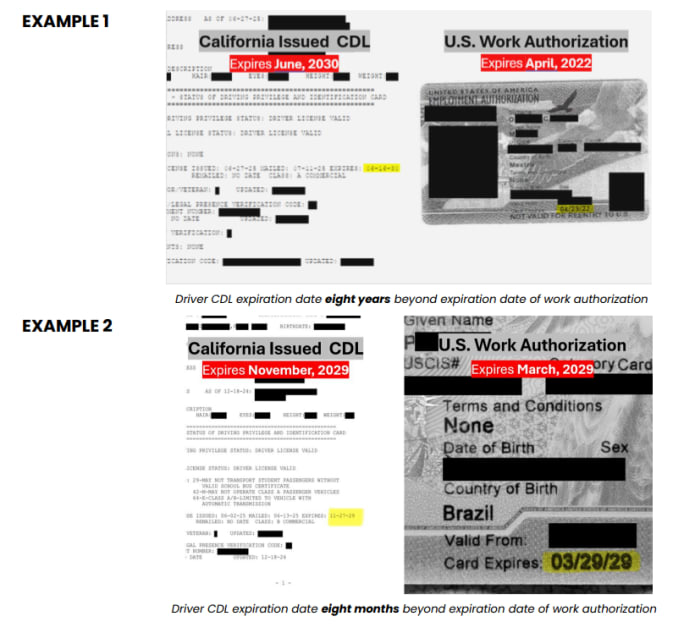
An FMCSA audit of state licensing practices found California has CDLs to non-domiciled drivers with expiration dates far past when their immigration or visa documents expire.
Source: FMCSA
DOT Targets California
FMCSA’s review found that due to weak oversight, insufficient training, and programming errors, a large number of non-domiciled CDLs were issued to:
Drivers who were ineligible.
Drivers whose licenses were valid long after their lawful presence in the U.S. expired.
According to a DOT news release, states where problems were found included California, Colorado, Pennsylvania, South Dakota, Texas, and Washington, with California the worst offender.
California has been under scrutiny regarding its CDL program since a highly publicized fatal August crash in Florida where a truck driver making an illegal U-turn.
The truck driver, Harjinger Singh, an Indian national, reportedly crossed the California border into the U.S. illegally in 2018 and has been in immigration proceedings ever since. Yet despite being in the country illegally, Singh held a California CDL.
According to Transportation Secretary Sean P. Duffy, the FMCSA review has found that in California alone, more than 25% of non-domiciled CDLs reviewed were improperly issued. Some licenses extended as many as four years beyond the expiration date of their lawful presence documentation.
In addition to the emergency rule, Duffy also announced direct enforcement action against California. The state must immediately:
Pause issuance of non-domiciled CDLs.
Identify all unexpired non-domiciled CDLs that fail to comply with FMCSA regulations.
Revoke and reissue all noncompliant non-domiciled CDLs if they comply with the new federal requirements.
California has 30 days to come into compliance, or FMCSA will withhold federal highway funds — starting at nearly $160 million in the first year and doubling in year two.
“California must get its act together immediately or I will not hesitate to pull millions in funding,” Duffy said in a news release. “To every other state around the country – find all improperly issued CDLs and revoke their licenses now. We owe it to the American people to ensure only lawful, qualified drivers are operating big rigs on our highways.”
California Gov. Gavin Newsom's press office responded to a post from Duffy on the social media platform X, saying that California CDL holders have a lower fatal crash rate than the national average.
It appears the Secretary of Transportation is having a challenging time understanding the road rules.
Unlike him, we’ll stick to the facts: California commercial driver’s license holders have a fatal crash rate nearly 40% LOWER than the national average.
And when you look at… https://t.co/374dffYxLF— Governor Newsom Press Office (@GovPressOffice) September 26, 2025
Trucking Groups Applaud Move on Non-Domiciled Driver Licenses
Both the American Trucking Associations and the Owner-Operator Independent Drivers Association brought up concerns to the federal government about non-domiciled CDLs earlier this year.
OOIDA started sounding the alarm on this issue back in March, when it testified before the House Committee on Transportation & Infrastructure on this and other issues.
In that hearing, OOIDA’s Lewie Pugh told the committee that FMCSA issued regulatory guidance in 2019 that created a loophole for states to issue more non-domiciled CDLs and that the association was "hearing growing concerns from our members and from truckers at large about the prevalence of drivers using these licenses."
In April, ATA President and CEO Chris Spear sent a letter to Secretary Duffy calling for an audit of non-domiciled CDL issuance.
Following the September 26 announcement, OOIDA issued a statement applauding Secretary Duffy for responding to the association’s concerns.
“For too long, loopholes in this program have allowed unqualified drivers onto America’s highways, creating unnecessary safety risks for professional drivers and the motoring public alike,” said OOIDA President Todd Spencer.
A September 26 statement from ATA President and CEO Chris Spear said, “"Rules only work when they are consistently enforced, and it's imperative that all state driver licensing agencies comply with federal regulations. We appreciate USDOT taking these steps to guarantee that happens, and we look forward to reviewing the rule in detail and providing specific feedback in our official comments."
More About the New Non-Domiciled CDL Rule
1. Limits individuals eligible for non-domiciled CDLs and commercial learners permits to foreign individuals in lawful status in the United States in certain employment-based, non-immigrant categories, certain individuals domiciled in a U.S. territory, and individuals domiciled in a state that is prohibited from issuing CLPs or CDLs because FMCSA has decertified the state’s CDL program.
2. Requires non-citizen applicants (except for lawful permanent residents) to provide an unexpired foreign passport and an unexpired Form I-94/94A (Arrival/Departure Record) indicating one of the specified employment-based nonimmigrant categories, specifically H2-B, H2-A, and E-2 visas, at every issuance, transfer, renewal, and upgrade action de-fined in the regulation.
3. Requires state drivers licensing agencies to query the Systematic Alien Verification for Entitlements system, known as SAVE, to verify the accuracy and legitimacy of provided documents and information. (The SAVE system is an online service by U.S. Citizenship and Immigration Services used by government agencies to confirm an applicant’s immigration status.)
4. Requires state licensing agencies to keep copies of the application documents for at least two years.
5. Requires the expiration date for any non-domiciled CLP or CDL to match the expiration date of the Form I-94/94A or to expire in one year, whichever is sooner.
6. Requires the applicant to be present in-person at each renewal.
7. Requires a state driver licensing agency to downgrade the non-domiciled CLP or CDL if the state becomes aware that the holder is no longer eligible to hold a non-domiciled CLP or CDL.
More Drivers

Truck Drivers Need More Than Another Alert
Fleets have more visibility into truck health, safety events, and driver activity than ever. The next challenge is turning all that information into useful guidance for the person who has to decide what to do next.
Read More →
FMCSA Removes 110 Truck Driver Training Schools from Certified ELDT List
Federal regulators also are targeting more than 160 additional training providers and launching a nationwide audit of third-party CDL skills testers as part of a broader crackdown on trucking fraud.
Read More →
Hours of Service Pilot Programs: FMCSA Readies for 2027 Rollout
Two pilot programs could eventually reshape hours-of-service rules, giving truck drivers options to pause their 14-hour clock or use longer split sleeper rest periods.
Read More →
Medical Cards, English Proficiency Reshape Roadcheck Violations
Medical-card violations jumped to the top of the driver out-of-service list during CVSA’s 2026 International Roadcheck, while English-language proficiency violations appeared among the leading violations for the first time.
Read More →
Driver Trust Can Make or Break the Success of Fleet Safety Technology
New Teletrac Navman research suggests that onboarding, transparency about driver data, and positive feedback can play a significant role in how commercial drivers respond to safety and coaching technology.
Read More →
EEOC Sues KLLM Over Alleged Sex Discrimination in Driver Training
KLLM is facing a federal sex-discrimination lawsuit over policies the EEOC alleges put female truck driver trainees at a disadvantage.
Read More →
FMCSA Moves to Codify English Language Requirements for Commercial Drivers
By changing regulations on English-language proficiency requirements for commercial drivers, rather than relying on a guidance memo, the FMCSA said future administrations won't be able to walk back the Trump administration's stricter enforcement with just a memo.
Read More →
Drivers Put Western Star Trucks to the Test at Star Nation Experience
Watch to get an inside look at the Western Star trucks, technology, and community behind the Star Nation Experience 2026!
Read More →
Trump Administration Looks to Put More Veterans Behind the Wheel
The Freedom Haulers program pulls together existing and expanded programs at several federal agencies to recruit veterans to drive commercial heavy-duty trucks and cut the red tape for them to get a CDL, training, and employment.
Read More →
Putting Mack’s Command Steer to the Test
A test drive of Mack’s Command Steer active steering system evaluates how it can make truck driving easier and less tiring.
Read More →