




Transportation Secretary Promises to Go After 'Bad Actors' in Trucking
DOT reinstates English language proficiency enforcement for commercial truck drivers; Secretary Duffy plans more safety reforms to help truckers.

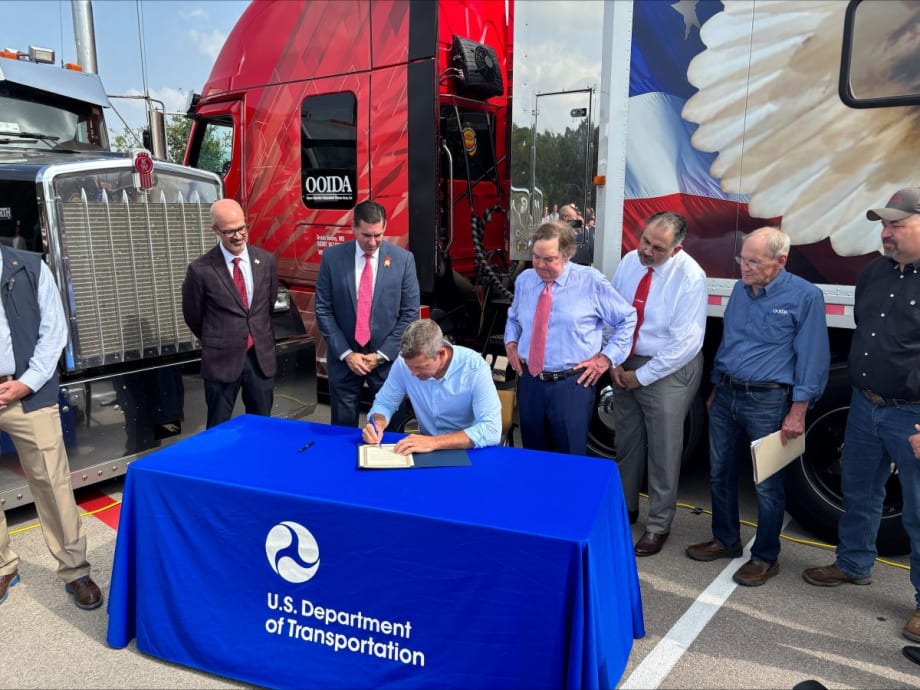
Transportation Secretary Sean Duffy signs official order on English language proficiency enforcement for truck drivers.
Photo: USDOT
Promising to end the “plague of bad actors” in trucking, Transportation Secretary Sean P. Duffy signed an order officially rescinding previous FMCSA guidance on enforcing requirements for English proficiency for drivers. At the same time, he promised more action from the DOT in areas such as truck parking and non-domiciled CDLs.
In an official signing at a trucking event in Austin, Texas, on May 20, Duffy said, “We’re going to replace it with stronger enforcement procedures.”
Under the new guidance, commercial motor vehicle drivers who fail to comply with the Federal Motor Carrier Safety Administration’s longstanding English-language proficiency requirements will be placed out of service.
This new guidance, which Duffy announced in April, is in response to President Trump’s Executive Order to strengthen highway safety by ensuring that all commercial drivers are properly qualified and proficient in English.
The English Proficiency Problem
According to existing federal regulations, to drive a commercial motor vehicle in interstate commerce, drivers must be able to speak and read English satisfactorily to:
Converse with the general public.
Understand traffic signs and signals.
Respond to official questions.
Make legible entries on reports and records.
However, in 2016, the Federal Motor Carrier Safety Administration put out guidance that violators were no longer to be placed out of service.
In 2015, Duffy said, before the guidance was changed, there were almost 100,000 violations of the English proficiency requirements. Of those, 1,000 were put out of service. In 2024, he said, there were only 10,000 violations, and no drivers were put out of service.
Duffy thanked the Commercial Vehicle Safety Alliance for its prompt cooperation in changing its out-of-service criteria to accommodate the change. Beginning June 25, English language proficiency violations will once again be included in the out-of-service criteria.
How Will Officers Determine Violations of the English Proficiency Rules?
In making the initial announcement last month, Duffy promised that there would be guidance forthcoming from the Federal Motor Carrier Safety Administration for commercial motor vehicle inspectors to ensure enforcement of the English language proficiency standard is applied consistently.
Brandon Wiseman of Trucksafe Consulting offered some analysis of a heavily redacted FMCSA memo outlining the enforcement guidance.
The new policy advises FMCSA personnel to initiate all roadside inspections in English. If the inspector’s initial contact with the driver indicates that the driver may not understand the inspector’s initial instructions, the inspector should conduct an English language proficiency assessment, which should consist of:
Driver interview
Highway traffic sign recognition assessment.
In a reversal from previous guidance, tools such as interpreters, I-Speak cards, cue cards, smartphone applications, and On-Call Telephone Interpretation Service should not be used during the driver interview.
The policy of placing drivers out-of-service or further disqualifying the driver should not apply to drivers performing operations in the U.S.-Mexico border commercial zone, but the drivers may still be cited for violations, said the trucking attorneys at Scopelitis, Garvin, Light, Hanson & Feary in an email alert.
Vague Guidance Could Mean Uneven Enforcement
What questions are supposed to be included in that interview and what's in that sign recognition assessment are redacted.
The Scopelitis alert said because the guidance is redacted, "the criteria for the assessment in Step 1 is very vague. Unless the FMCSA issues additional instructions, this could lead to uneven enforcement throughout the U.S."
Wiseman also commented on the redactions.
"In short, FMCSA’s renewed emphasis on ELP reflects a safety-first mindset, but the redacted guidance leaves some uncertainty," Wiseman said. For instance, one question it does not answer, he said, is "how drivers placed OOS for ELP violations can be rehabilitated and returned to work."
"For trucking companies, the reintroduction of OOS consequences could disrupt operations, especially without insight into the assessment’s specifics," Wiseman noted. "Drivers face increased scrutiny and potential downtime, underscoring the need for robust English training programs."
Will This Move the Needle on Highway Fatalities?
In response to a question from a reporter, Duffy said, “We have 40,000 deaths on American roads every year, and as much as we try, it’s really hard to move those numbers. Is this going to move those numbers by the thousands? No.
"But I think we have to think through, how can we take small steps and start to save lives and move that needle in the right direction, and I think this is one of those small things we can do to follow the law and make sure we keep our roads safe.”
Going Beyond Truck Driver English Requirements
Duffy announced that the DOT is also taking additional steps related to commercial driver qualifications.
Reviewing the security of commercial driver’s licenses. “This is a state-by-state issue, but we do have a role, and we are reviewing the security procedures around how CDLs are given throughout the states."
Reviewing non-domiciled CDLs.
Improving verification protocols for both domestic and international credentials to ensure only qualified drivers are behind the wheel on American roads.
Truck Driver Quality of Life
The executive order commanding the Department of Transportation to change the English-language enforcement also directed the DOT to take steps to improve the working lives of truckers.
That's a broad and vague order, but Duffy offered a few clues to the department's thinking so far.
“By the way, I’ve got to tell you, it’s one of the most vocal groups of people I’ve heard from in my time at DOT…. I hear from the truckers a lot, and this English language proficiency was one of the big ones.
“But they’ve also said the quality of life could be improved. And that means looking at critical needs like truck parking, which impacts the lives of truckers every day on the road.”
“There will be more to come on this, but you can be sure the DOT is committed to truckers and trucker safety,” Duffy said.
“From not enforcing English language proficiency requirements, to broker fraud, to non-domiciled CDLs, it kind of feels like the trucking industry has become the Wild West with a lot of bad actors who have been allowed to play in this space," he added.
“We’re going to end the plague of bad actors, and we are going to support and encourage … the great businesses, the great drivers, the great brokers that make this country work.”
With Duffy were John Esparza, president and CEO of the Texas Trucking Association, and Todd Spencer, president of the Owner Operator Independent Drivers Association, as well as state transportation officials.
The Significance of Texas for Duffy's Announcement
“This is an issue that has been long in the works,” Esparza said. “Something as an industry we’ve been in communication for years now.... The very basic premise behind what’s occurring today is safety. Imagine you cannot, if you’re on the enforcement side, you’re unable to communicate roadside.”
“When we talk about English proficiency, we are talking about the very first interaction that we’re having roadside," Esparza said.
"We share 1,250 miles of U.S./Mexican border here in Texas, out of 1,550 miles in the entire country. … If we’re not taking the lead, as partners with our TexDOT commission, our leadership here in the state, with enforcement, then we’re not going to get any work done.”
“When you talk about non-domiciled, when we talk about the instances of cabotage that are occurring out there; we’re going to work in every area that we can.”
'English Proficiency Isn't Optional'
“Out on the road, there’s no margin for error,” Spencer said. “The only thing separating safe trips from deadly ones can be a simple road sign.
“These signs aren’t suggestions. They’re warnings. They save lives — but only if they’re understood. … Truckers must be able to read road signs, communicate with law enforcement, and respond in emergencies. When that doesn’t happen, people get hurt — or worse.
“Complying with the language proficiency standards doesn’t mean you can recite an encyclopedia, but it should mean you comprehend routine safety messages,” Spencer said.
“Those can and should be taught in training schools and tested for. English proficiency isn’t optional. It’s essential.”
Updated 5/21/2025 to add comments from Scopelitis.
More Safety & Compliance

FMCSA Pauses Biennial-Update Enforcement Amid Motus Transition
Carriers whose updates were due on or after June 1 have more time, while FMCSA works to stabilize its new registration system and warns of phishing sites impersonating its new carrier registration system, Motus.
Read More →
ZF Expands Commercial Vehicle Push in North America
ZF is expanding its North American commercial-vehicle presence with new transmission applications, electrification, trailer technology and autonomous-driving systems.
Read More →
Truck Drivers Need More Than Another Alert
Fleets have more visibility into truck health, safety events, and driver activity than ever. The next challenge is turning all that information into useful guidance for the person who has to decide what to do next.
Read More →
Tesla Wants a Self-Driving Semi. Are Cameras Enough?
Could Tesla’s camera-only autonomous driving technology work on an 80,000-pound Semi? In this commentary, HDT's Deborah Lockridge takes a look at Tesla, Cybercab, and how autonomous trucks see the road.
Read More →
What DOT’s Automated Vehicle Strategy Means for Trucking
The U.S. Department of Transportation issued a new automated-vehicle strategy that outlines plans for driverless-truck regulations, cross-state freight corridors, and federal safety standards.
Read More →
NYC Expands Speed, Pedestrian Safety Tech Across Fleet
New York City is expanding intelligent speed assistance and pedestrian-alert systems across its municipal fleet, moving the technologies from pilot programs into vehicle procurement and retrofit requirements.
Read More →
FMCSA Removes 110 Truck Driver Training Schools from Certified ELDT List
Federal regulators also are targeting more than 160 additional training providers and launching a nationwide audit of third-party CDL skills testers as part of a broader crackdown on trucking fraud.
Read More →
Beyond DOT Compliance: What Makes a Trucking Fleet Truly Safe?
A trucking fleet can follow every rule and still make unsafe decisions. The real test comes when safety conflicts with freight, productivity, or cost.
Read More →
Hours of Service Pilot Programs: FMCSA Readies for 2027 Rollout
Two pilot programs could eventually reshape hours-of-service rules, giving truck drivers options to pause their 14-hour clock or use longer split sleeper rest periods.
Read More →
New Guide Offers Pet Safety Tips for Truck Drivers
Hundreds of thousands of pets travel in truck cabs. A new safety guide from Volvo Trucks and the Center for Pet Safety offers practical advice for truck drivers who bring dogs and cats along for the ride.
Read More →