



Series: Electrification Simplified, BAE-Style
Part 1: Eaton, BAE Systems Unveil Lightweight Electronic Powertrain
Part 2: BAE/Eaton's Class 7 demonstrator EV chassis: Keep it Simple
Part 3: Under the Hood of BAE's Electric Demo Truck
 MENU
MENU SEARCH
In Part 3 of his report on the new commercial EV powertrain being developed by Eaton and BAE Systems, Jim Park takes a deep dive look at the companies' fresh, lighter and more compact take on powering electric trucks.
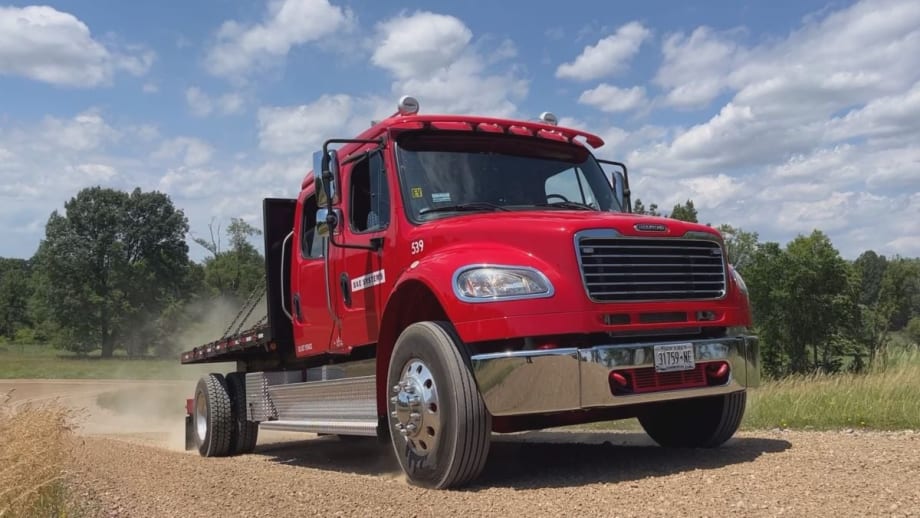
Out on the road course at the Eaton Proving Grounds in Marshall, Michigan, the demonstrator truck was quiet and torquey, with loads of get-up-and-go.
Photo: Jim Park
A typical EV chassis is festooned with orange cable, boxes with wires coming out of them, and tons of connectors, everywhere. But when I recently had a chance to explore a Class 7 demonstration electric-truck chassis from BAE and Eaton, it was stark naked by comparison.
And, as I noted in Part 1 of this series on the new Eaton-BAE Systems EV partnership, that's the point of their fresh take on how EV powertrains should be configured.
By integrating all the controllers and inverters, you minimize the number of boxes scattered around the chassis, and accordingly, reduce the amount of heavy, expensive orange high-voltage cable. As I said in Part 2 of this series, it's a concept that simply builds on the overall engineering simplicity that is already a hallmark of this interesting new partnership, which I learned about in a recent visit to Eaton's Proving Grounds in Marshall, Michigan.
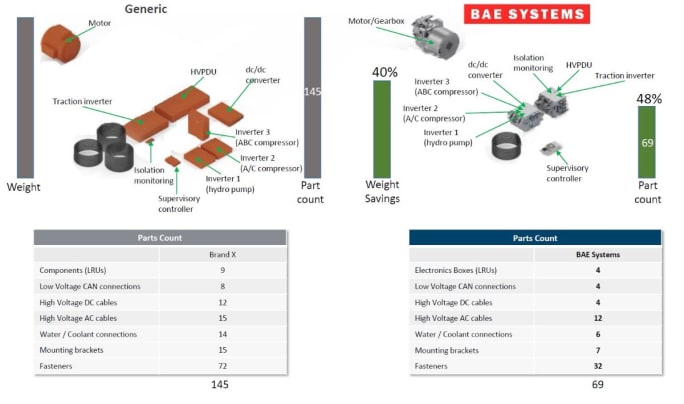
The parts count for a generic EV chassis compared with the parts count for the BAE chassis. BAE's version is 40% lighter than a current typical EV chassis and contains about half the parts, not to mention a fraction of the HV cable.
Graphic: BAE Systems
This is slightly over-simplified, but not by much. Under the hood of the BAE demo truck you'll find the accessory components, the DC/DC convertor with the modular invertors to drive the accessories, and the supervisory controller. There's also the cooling package for the thermal management system, fans, windshield washer bottle, air dryer, etc.
The batteries sit cross-wise under the frame beneath the cab. Midway down the frame on the right-hand side sits the high-voltage power distribution unit with the integrated traction invertor for the drive motor. This is where all the high-voltage cables come together. Just behind that, between the frame rails, sits the motor/gearbox assembly, the propshaft, and the drive axle.
"One thing I hope you notice is there are not many orange cables," said Derek Matthews, BAE's global partnership manager and senior business development manager, pointing to an area on the inboard side of the DC/DC convertor.
"This is the biggest confluence of orange cables on the trucks. You've got the batteries coming in. There's a charge port. And there's the inverter that drives the whole system — and that sits about 3 feet from the motor/gearbox assembly. There's just one wire going forward running everything up front."
To reduce energy losses and excess weight related to the accessory components, the air compressor, AC compressor and the pumps in the battery thermal management system, are all 750 volts. Matthews said there's significant savings in weight, cost and energy from using the higher voltage components.
It's electricity 101. If the loads are high enough, in the kW range, for every 1kW at 12V, that's 83 amps of current. Whereas at 600V, it’s less than 2A of current.
You'd need a really big copper cable to safely and reliably transmit hundreds of amps, or the losses due to resistance would consume a lot of valuable battery resources.
As well, the electric motor needed to make 2kW at 12V would be huge — and full of heavy, expensive copper.
"Between the losses in the wire, the larger wire, larger motors and larger controllers, it all adds up to reduced efficiency, increased weight and cost," Matthews explained.
"On top of all that, there's only one source of energy on an EV — the high-voltage batteries. If you had to do all that energy conversion, 600-800V down to 12/24V, you'd have additional conversion losses.
"If you want maximum efficiency and range from those expensive batteries, high-voltage accessories is the way to go," he added. "After 25 years of doing this, we've kind of figured out what things make sense to go together."
The batteries sit as far forward as possible on the truck. This shifts most of the weight to the steer axle. There are three battery modules for a total of 230 kWh capacity. Each battery weighs 580 kg (1,280 lbs.), Matthews said.
He told reporters the stripped chassis, sans body, weighs about 8,000 lbs. on the steer axle and 6,000 lbs. on the drive axle. Loaded to 33K GVW for the demo, with a body and dunnage, the axle weights were 11,700 for the steer and 21,700 for the drive axle.
"So, right around 33,000 lbs.," he said. "That's part of the advantage in not having so much stuff."
Eaton's 4-speed transmission isn't part of this project just for its good looks. Without the benefit of four gear ratios, you'd need a really big, really heavy motor to deliver the startability and energy efficient highway cruise speed BAE said this truck offers.
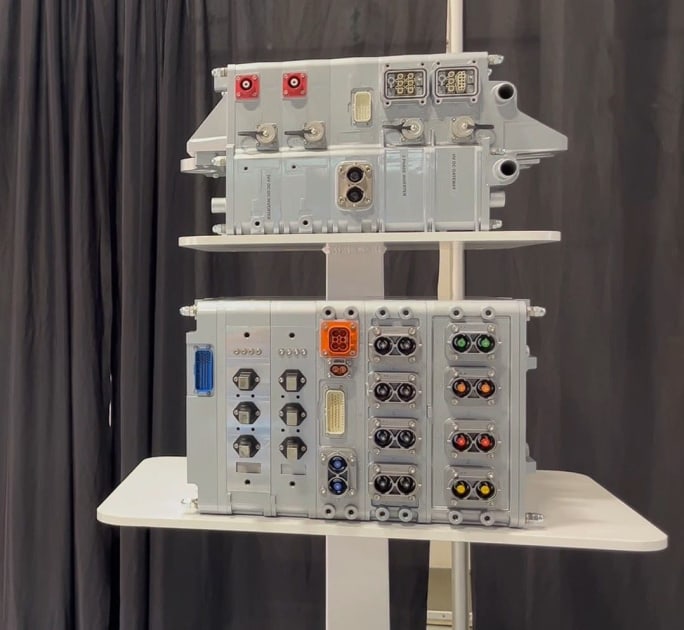
The top unit is the modular power converter, the lower is high voltage power distribution unit. Both feature a modular design to accommodate expansion and flexibility in chassis layout.
Photo: Jim Park
"Having a multi-speed transmission better enables you to go to a smaller lower cost motor," said Justin Hopkins, Eaton's product director, EV gearing and transmissions.
"There's a trade-off here. Copper is more expensive than steel, so paying for more gears and a gearbox is better than paying for a much larger motor with a lot of copper and potentially rare magnets and things like that."
All the shifting is done automatically with no driver involvement. The default starting gears is 2nd. First is used only on grades about 5%, when the weight warrants the downshift. 2nd and 3rd gear are the maneuvering speed gears, getting the truck up about 55 mph, when it shifts into 4th.
There's a reverse position on the gear selector, but no actual reverse gear. The motor simply turns in the opposite direction when backing the truck up.
The transmission weighs about 220 pounds.
Having a variety of gear ratios also improves the regen capability. The lower gear ratios allow more regen torque to come through the drive line.
The transmission itself was formerly a transit bus transmission that Eaton reworked for a MD truck application. They basically removed the reverse gears, switched from forced to splash lubrication, and reengineered all the cogs to handle the additional coast loads (regen torque).
"The gears are designed to take full drive and coast loads of 2,600 newton meters (1,920 lbs-ft) of input torque," Hopkins said. "So, the gears have very precise micro-geometry on both the drive and post flank to be able to handle that. Conventional transmissions don't need to take the high coast loads. The helical gears are designed to a tighter surface finish to bring the noise down."
Since most of the really innovative stuff, the fancy electronics and modularity and integration happen "under the hood," there isn't much to report about driving the Eaton-BAE demonstrator truck.
It's a battery-electric Class 7 truck, therefore it's quiet and torquey, with loads of get-up-and-go — all common traits of most EVs. The 4-speed transmission did come into play in a couple of interesting ways, though.
BAE doesn't have a clever name for it, but the truck has a "hold itself in place" feature where the motor applies a little torque to prevent the truck from rolling back or forward on grades up to 20%. It will hold for about four seconds, then release. This allows the driver time to get his or her foot off the brake and onto the accelerator pedal.
"We couldn't do that with straight-up direct-drive gearing," Matthews said. "We'd need a much bigger motor."
The regen capability is automatically set basically according to the weight of the truck. The idea is to have it feel about the same to the driver, regardless of the load.
Some EVs have a two- or three-position regen switch, instead. I found the regen level set a little low on this truck, but it is programmable.
This truck won't be coming to dealer lots anytime in the future. It's a demonstrator only. A bit of a prototype.
Getting up close with this thing was interesting, coupled with Matthews' explanations for why they did what they did. I've seen so many chassis at trade shows with orange cables running end to end, sometimes multiple times. I never thought to question it. I thought that was just the way they made electric trucks.
Maybe we need to take a fresh look at this.

Volvo’s updated D13 promises lower emissions without sacrificing performance or fuel economy. Take a closer look at what changed inside the engine in this HDT Spotlight video.
Read More →
Energy Vision estimates fleets could recover the higher purchase price of an RNG-fueled Class 8 tractor in 1.3 to 2.8 years under current fuel-price scenarios.
Read More →
Calstart is now Catalyst Mobility, reflecting the nonprofit’s growing national role in clean transportation, including zero-emission trucks, infrastructure and incentive programs.
Read More →
Average U.S. diesel prices have climbed to nearly $6 a gallon, surpassing the 2022 record as tight refinery capacity and Middle East disruptions keep fuel costs elevated.
Read More →
Fuel delivery depends on more than what happens at the injector. For fleet, maintenance and technical professionals, looking at the full path from pump to injector can provide useful context for understanding engine performance.
Read More →
The Port Authority of New York and New Jersey announced millions in incentives for zero-emission drayage trucks, yard tractors, and new charging hubs near the port.
Read More →
Why do battery-electric Class 8 trucks remain so expensive? A California bill headed to Gov. Gavin Newsom would give fleets and state agencies more visibility into what manufacturers charge.
Read More →
Detroit isn’t starting from scratch to meet EPA 2027 diesel emissions standards. Its Gen 6 DD13 and DD15 engines keep much of today’s platform while updating the fuel and aftertreatment systems.
Read More →
California, Oregon, Washington, British Columbia and Baja California are coordinating plans for truck charging and hydrogen fueling from Canada to Mexico.
Read More →
Learn more about Kenworth's T880E battery-electric vocational truck at the Paccar Technical Center, including its range, applications, upfitting considerations, and PTO options, in this HDT Spotlight video.
Read More →