



Series: Electrification Simplified, BAE-Style
Part 1: Eaton, BAE Systems Unveil Lightweight Electronic Powertrain
Part 2: BAE/Eaton's Class 7 demonstrator EV chassis: Keep it Simple
 MENU
MENU SEARCH
With 25 years of experience building electric drive systems for transit buses, BAE Systems brings a fresh perspective on how to electrify trucks.
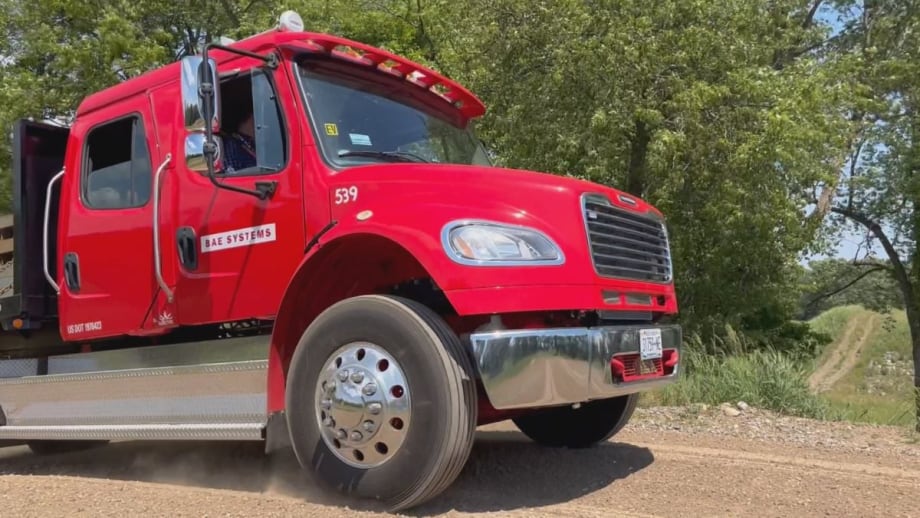
The BAE-Eaton demonstrator truck is a 2018 Freightliner M2 Class 7 cab and chassis -- formerly a diesel -- purchased from a used truck dealer for this project.
Photo: Jim Park
There's a new kid on the block with some fresh ideas on how to build electric trucks. And keep-it-simple is its mantra. The strategy is to eliminate as many parts and as much weight as possible in the powertrain through modularity and integration, along with a new way of thinking about power electronics.
Last year, BAE Systems struck a deal with Eaton to migrate its electric drive technology from the transit bus market into the medium- and heavy-duty truck market.
Part 1 of my report from Eaton's Marshall Proving Grounds in Michigan covered this interesting collaboration developing between Eaton and BAE systems and how that relationship is growing. This installment and part three dig a bit deeper into the results of their efforts so far.
The first love child to emerge from the BAE-Eaton partnership is a medium-duty Class 7 demonstrator truck chassis.
The truck itself is a 2018 Freightliner M2 Class 7 cab and chassis — formerly a diesel — purchased from a used truck dealer for this project. Daimler and Freightliner were not involved in its transformation into an electric vehicle.
The truck has a gross vehicle weight rating of 33,000 lbs and can carry a payload of 18,000 lbs. It weighs just 1,400 lbs more than the diesel chassis from which it was built.
It has battery capacity of 230 kWh in three modules. It's powered by 185 kW (continuous) (250-hp) center-drive motor driven through an Eaton automated-manual 4-speed transmission and a Meritor drive axle with a 3.9:1 ratio.
The truck is capable of 70 mph sustained highway speed in 4th gear (electronically limited). It can also start on grades greater than 21%. BAE says energy consumption is 1.1 kWh/mile at full gross weight.
The extensive consolidation and integration BAE brought to this demonstrator yielded a weight reduction of about 50% compared to a typical first-generation Class 7 EV chassis.
Additionally, the overall EV parts count dropped from 145 to 69. This includes significant reductions in high-voltage cable, connectors, coolant lines and fittings, components and component mounts.
Not only are there fewer parts and much less heavy high-voltage cable, but this configuration also frees up a lot of chassis real estate -- which could be useful in vocational applications.
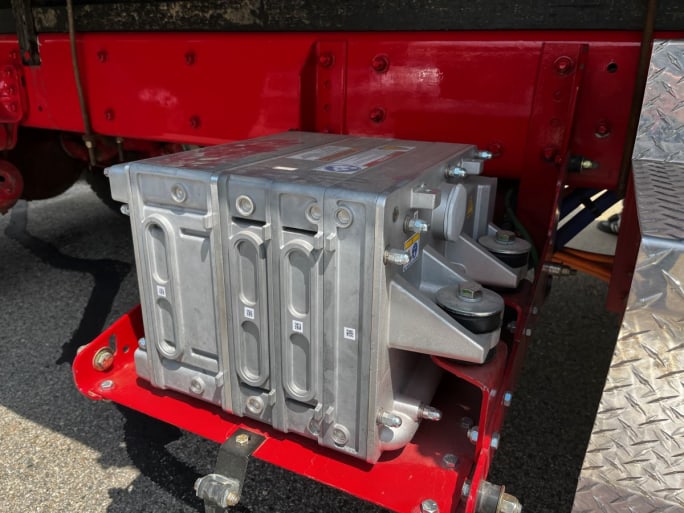
The high voltage power distribution unit is centrally located between the batteries and the motor to help minimize the cable run.
Photo: Jim Parkl
BAE's approach is to eliminate as many of the individual controllers and inverters as possible and run all the accessory loads through a single integrated inverter.
In the case of the demonstrator, that means three separate inverters (air brake compressor, AC compressor and coolant pump) are rolled into a single module designed from the start for expansion.
Additional modules or "slices" can be added to the unit, providing power for additional accessory loads.
Another unit, the high voltage power distribution unit, houses the traction inverter as well as battery connections, slow and fast charging connections, the three-phase inverter, and a DC output for high-voltage accessories.
Again, it's a modular design allowing for additional slices or modules for expansion.
"We think of any electric as vehicle as two separate systems: the accessory systems for all your air brakes, power steering, air conditioning, etc., and the other half is the main power loads," explained Derek Matthews, BAE's global partnership manager and senior business development manager. "So, high-voltage-high-power and high-voltage-low-power."
Matthews also offered this slightly more colorful explanation: "When was the last time you lifted the hood on a truck and went, 'Oh, there's the four-cylinder engine that drives my rear wheels. Look, here's the little one-cylinder engine that runs my air compressor, and I got another little one-cylinder here to drive my power steering?'" he asked during the walk-around, only half joking.
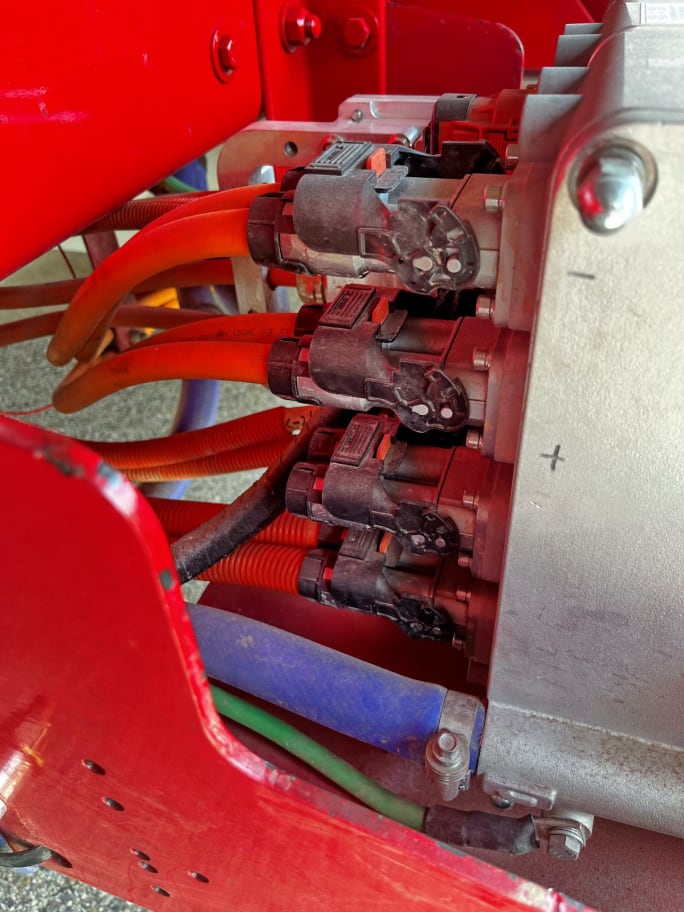
The inboard side of the DC/DC Convertor module. It's where all the HV cables, charging cables and control cables come to a single central point on the chassis.
Photo: Jim Park
Then, sweeping an arm around the more or less empty engine compartment, he added, "Our argument is that this is basically an electric engine.
"We learned early that we need to address the most complicated component first — the one that's got the most regulatory and safety requirements around it — and manage it once," he said. "Everything else, all the accessories, is a load."
Sealing the case for a unified and managed power management system, Matthews said that while electric trucks no longer have emissions regulations to contend with, manufacturers now have to deal with cybersecurity requirements (which change regularly) and high-voltage safety, specifically, SAE's recommended practice ISO 26262. It defines functional safety requirements of electrical and/or electronic systems installed in serial production EVs.
"That's just like the emissions requirements were in terms of level of effort and NRE (non-recurring engineering cost) for the design," he pointed out.
"Do you really want six different suppliers trying to keep up with that? And while choice is important, how many companies that make air brake compressors are also going to be able to give you a million-mile high-voltage inverter that can survive years of rugged use and meet all the cybersecurity requirements that change all the time and will meet ISO 26262?
"And you're going to do that across six or seven different components and keep everybody in sync on software when you do software upgrades because that's always easy. Right?"
In Part 3 of his look at the Eaton-BAE electric truck technology partnership, Jim Park digs into the design and configuration of the powertrain and Eaton's role in reducing vehicle weight with new EV transmission and regen technologies.

Volvo’s updated D13 promises lower emissions without sacrificing performance or fuel economy. Take a closer look at what changed inside the engine in this HDT Spotlight video.
Read More →
Energy Vision estimates fleets could recover the higher purchase price of an RNG-fueled Class 8 tractor in 1.3 to 2.8 years under current fuel-price scenarios.
Read More →
Calstart is now Catalyst Mobility, reflecting the nonprofit’s growing national role in clean transportation, including zero-emission trucks, infrastructure and incentive programs.
Read More →
Average U.S. diesel prices have climbed to nearly $6 a gallon, surpassing the 2022 record as tight refinery capacity and Middle East disruptions keep fuel costs elevated.
Read More →
Fuel delivery depends on more than what happens at the injector. For fleet, maintenance and technical professionals, looking at the full path from pump to injector can provide useful context for understanding engine performance.
Read More →
The Port Authority of New York and New Jersey announced millions in incentives for zero-emission drayage trucks, yard tractors, and new charging hubs near the port.
Read More →
Why do battery-electric Class 8 trucks remain so expensive? A California bill headed to Gov. Gavin Newsom would give fleets and state agencies more visibility into what manufacturers charge.
Read More →
Detroit isn’t starting from scratch to meet EPA 2027 diesel emissions standards. Its Gen 6 DD13 and DD15 engines keep much of today’s platform while updating the fuel and aftertreatment systems.
Read More →
California, Oregon, Washington, British Columbia and Baja California are coordinating plans for truck charging and hydrogen fueling from Canada to Mexico.
Read More →
Learn more about Kenworth's T880E battery-electric vocational truck at the Paccar Technical Center, including its range, applications, upfitting considerations, and PTO options, in this HDT Spotlight video.
Read More →