




Economic Watch: Construction and Leading Indicators Rise, Home Sales Best in 7 Years
UPDATED -- Total new construction starts in the U.S. during 2013 increased 6% from the year before to $516.8 billion. This follows the 10% gain reported for 2012 and modest 2% gains in both 2010 and 2011, according to new data released from construction information services provider McGraw Hill Construction.

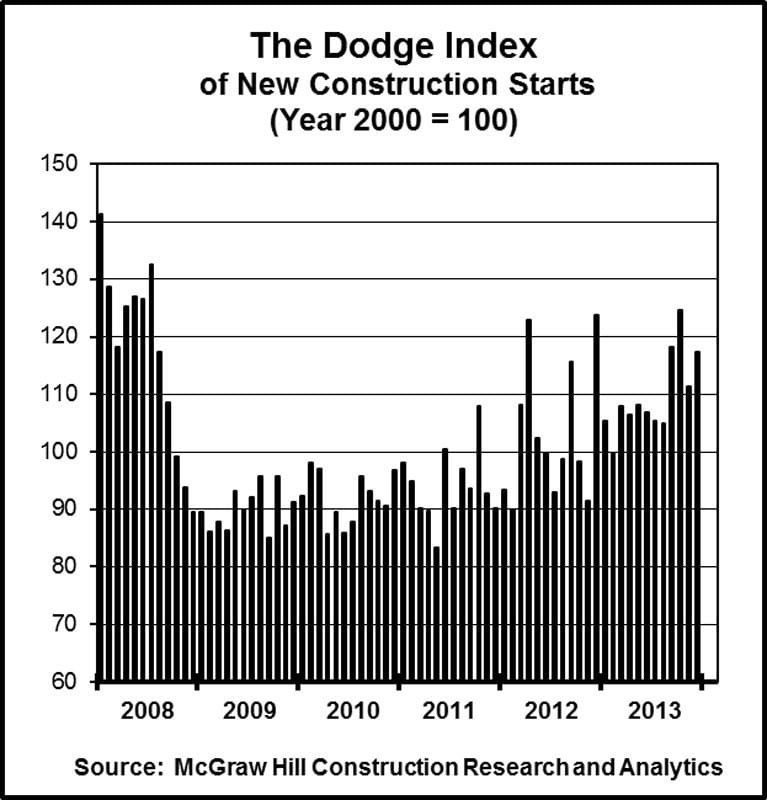
McGraw Hill's Dodge Construction Index tracks total U.S. construction activity.
McGraw Hill's Dodge Construction Index tracks total U.S. construction activity.
UPDATED -- Total new construction starts in the U.S. during 2013 increased 6% from the year before to $516.8 billion. This follows the 10% gain reported for 2012 and modest 2% gains in both 2010 and 2011, according to new data released from construction information services provider McGraw Hill Construction.
"The construction industry in 2013 made progress towards establishing a more broad-based recovery, after several years in which the upturn was more limited in scope," said Robert A. Murray, chief economist for McGraw Hill Construction. "Housing continued to lead the way, strengthening throughout much of 2013, and it was joined by a faster pace for commercial building, albeit from low levels.
He said for 2014, the prospects look good for total construction, with growth anticipated for housing and commercial building, while the institutional building sector should begin to stabilize.
Residential building last year totaled $205.5 billion, up 24%, and close to the 31% gain reported for 2012. Single family housing in dollar terms climbed 26%, similar to the prior year's 29% hike. The regional pattern for single family housing in 2013 showed increases for all five major regions: the South Atlantic, up 33%; the Midwest, up 27%; the West and Northeast, each up 26% and the South Central, up 18%. Multifamily housing in 2013 advanced 16%, showing additional growth on top of the increases in 2010 of 23%, during 2011, up 33%, and 2012, gaining 37%.
For 2013 nonresidential building increased 7% to $168.6 billion, shifting to an upward direction after the 5% decline reported for 2012.
Nonbuilding construction dropped 12% last year to $142.7 billion due to new electric utility starts plunging 57% in from the year before.
A separate report from The Conference Board released on Thursday shows its Leading Economic Index for the U.S. increased 0.1% in December to 99.4 following a 1% increase in November and a 0.1% gain in October.
“Despite month-to-month volatility in the final quarter of 2013, the U.S. LEI continues to point to gradually strengthening economic conditions through early 2014,” said Ataman Ozyildirim, economist at The Conference Board. “The LEI was lifted by its financial components in December, but consumer expectations for business conditions and residential construction continue to pose risks.”
The measure by the private research group is a barometer of where the U.S. economy three to six-months in the future.
“This latest report suggests steady growth this spring, but some uncertainties remain,” said Ken Goldstein, economist at The Conference Board. “Business caution and concern about unresolved federal budget battles persist, but the better-than-expected holiday season might point to sustained stronger demand and could put the U.S. on a faster growth track for 2014.”
Meantime, a new report on existing home sales in December from the National Association of Realtors shows a 1% increase from the month before to an annual rate of 4.87 million.
Sales of existing homes for 2013 were the best since 2006, up 12% from 2012, for a rate of 5.09 million.
Lawrence Yun, NAR chief economist, said housing has experienced a healthy recovery over the past two years. “Existing-home sales have risen nearly 20% since 2011, with job growth, record low mortgage interest rates and a large pent-up demand driving the market,” he said. “We lost some momentum toward the end of 2013 from disappointing job growth and limited inventory, but we ended with a year that was close to normal given the size of our population.”
The national median existing-home price for all of 2013 was $197,100, which is 11.5% above the 2012 median of $176,800, and was the strongest gain since 2005 when it rose 12.4%.
Update add McGraw Hill data.
More Fleet Management

Why Private Fleets Are Taking More Freight
Private fleets are putting their own trucks on demanding customers and high-cost lanes as companies seek greater control over service, costs, and capacity.
Read More →
Color Match Smarter: Tools That Restore & Perform
For fleet managers and collision repair professionals keeping heavy-duty trucks on the road, getting the color right the first time isn't just about appearance — it's about efficiency, turnaround time, and bottom-line results. Discover how today's digital color tools are transforming the repair process from guesswork to precision.
Read More →
FMCSA Pauses Biennial-Update Enforcement Amid Motus Transition
Carriers whose updates were due on or after June 1 have more time, while FMCSA works to stabilize its new registration system and warns of phishing sites impersonating its new carrier registration system, Motus.
Read More →


2026 Blueprint for Countering Smarter Supply Chain Theft
Cargo theft is no longer just the cost of doing business. It's a multi-billion-dollar criminal enterprise exploiting vulnerabilities across your fleet, drivers, and supply chain.
Read More →
How Telematics Improves Visibility, Control, and Performance in Refrigerated Fleets
Explore how telematics help refrigerated fleets improve visibility, uptime, efficiency, compliance, and cargo protection across connected cold chain operations.
Read More →
What the U.S.-Canada Trade War Means for Trucking
Escalating U.S.-Canada tariffs could disrupt cross-border freight, reduce truck volumes, raise costs, and create new uncertainty for carriers on both sides of the border.
Read More →
What Are Trucking’s Top Concerns for 2026?
The American Transportation Research Institute wants to know what's worrying trucking fleet managers, drivers, and other stakeholders in its annual Industry Issues survey.
Read More →
American Trucking Associations Looks for a New Leader
ATA President and CEO Chris Spear abruptly left his job at the association on August 21, at a pivotal time for the trucking industry.
Read More →
Public Wi-Fi Cybersecurity Risks: How Truck Drivers and Fleets Can Protect Their Data
Public Wi-Fi can expose truck drivers and fleets to credential theft, malware, and other cyber threats. Here’s how to reduce the risk on the road.
Read More →
For Nicky Cupp, Fleet Innovation Starts With Frustration
HDT Truck Fleet Innovator Nicky Cupp turns everyday pain points at Fraley & Schilling into opportunities for better technology and smarter processes.
Read More →