




Economic Watch: Inflation, Industrial Production Down; Consumer Sentiment High
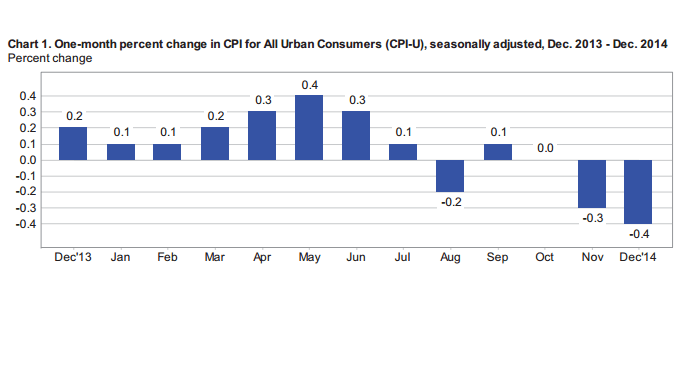
Consumer prices fell 0.4% in December from the month before, according to new U.S. Labor Department report, the biggest decline in six years.

Graph: Bureau of Labor Statistics
Graph: Bureau of Labor Statistics
Consumer prices fell 0.4% in December from the month before, according to new U.S. Labor Department report, the biggest decline in six years.
The drop follows a 0.3% slide in November from October. For all of 2014, the Consumer Price Index increased just 0.8%, the smallest hike since 2008. It compares to increases of 1.5% for 2013 and 1.7% for 2012.
Core prices in December, which do not include the volatile food and energy sectors, were unchanged from the previous month, only the second time this has happened since December 2010, following a 0.1% increase in November from October. For 2014 core prices gained 1.6%
This broadest measure of inflation was pushed down by 9.4% decline in gasoline prices in December, its sixth consecutive monthly drop, while the wider overall energy sector recorded a 4.7% decline. In contrast, prices for food increased 0.3%, the largest increase since September and are up 3.4% over the past 12 months.
The CPI, and especially the core prices, are well below the Federal Reserve’s annual target of 2%, which some analysts say could cause the central bank to delay increasing short term interest rates from near 0%.
“Coupled with yesterday's drop in the Producer Price Index, the widespread price declines across categories in the CPI, outside of energy, bolster the argument for continued accommodation from the Fed,” said Sterne Agee Chief Economist Lindsey Piegza. "While energy price declines are certainly at the forefront of the current acceleration of today's disinflationary trend, sluggish wage pressures have been a lingering theme in this recovery supporting the notion that price weakness is not entirely explained away by the recent fallout in crude prices alone."
She said while the Fed has commented most recently that under certain circumstances a rate increase may be warranted even with inflation at a low level, “a further retreat in inflation undermines confidence in a near-term reversal in prices back towards the Fed's longer-term target of 2%, negating the possibility of a near-term rate increase.”
Industrial Production
A separate report the Federal Reserve shows U.S. industrial production decreased 0.1% in December after rising 1.3 percent in November, which was the strongest performance since February.
The decrease in December reflected a sharp drop in the output of utilities, as warmer-than-usual temperatures reduced demand for heating. Excluding utilities, industrial production rose 0.7% while manufacturing posted a gain of 0.3% for its fourth consecutive monthly increase. Mining increased 2.2% after falling in the previous two months.
Total industrial production in December was 4.9% above its level of a year earlier. For the fourth quarter of 2014 as a whole, industrial production advanced at an annual rate of 5.6%, with widespread gains among the major market and industry groups.
Capacity utilization for the industrial sector decreased 0.3 of a percentage point in December to 79.7%, a rate that is just 0.4 of a percentage point below its 1972 to 2013 average.
Jonathan Starks, analyst for the freight transportation forecasting firm FTR, said in his Twitter feed despite the overall decline the report was “positive” due to the increase in manufacturing.
Consumer Sentiment
Finally, a third report about the health of the American economy shows consumer sentiment in January increased to its highest level in since 2004, according to the Thompson Reuters/University of Michigan Survey of Consumers.
Its consumer sentiment index registered 98.2, a 4.9% increase from December’s final number and 20.9% better than the same time a year earlier.
Big gains were also recorded in its measures of consumer’s feelings about current economic conditions and their expectations.
“Gains in employment and incomes as well as declines in gas prices were cited by record numbers of consumers,” said Survey of Consumers chief economist, Richard Curtin. “More consumers spontaneously cited increases in their household incomes in early January than anytime in the past decade, and more households reported unprompted references to favorable employment prospects as well as lower prices than at any other time in the more than the half-century history of the surveys.”
He cautioned it may that consumers have allowed the confluence of more jobs, higher wages and lower gas prices to fuel a run-up in optimism, which may hard to sustain in the months ahead.
More Fleet Management

What the U.S.-Canada Trade War Means for Trucking
Escalating U.S.-Canada tariffs could disrupt cross-border freight, reduce truck volumes, raise costs, and create new uncertainty for carriers on both sides of the border.
Read More →
What Are Trucking’s Top Concerns for 2026?
The American Transportation Research Institute wants to know what's worrying trucking fleet managers, drivers, and other stakeholders in its annual Industry Issues survey.
Read More →
American Trucking Associations Looks for a New Leader
ATA President and CEO Chris Spear abruptly left his job at the association on August 21, at a pivotal time for the trucking industry.
Read More →
Public Wi-Fi Cybersecurity Risks: How Truck Drivers and Fleets Can Protect Their Data
Public Wi-Fi can expose truck drivers and fleets to credential theft, malware, and other cyber threats. Here’s how to reduce the risk on the road.
Read More →
For Nicky Cupp, Fleet Innovation Starts With Frustration
HDT Truck Fleet Innovator Nicky Cupp turns everyday pain points at Fraley & Schilling into opportunities for better technology and smarter processes.
Read More →
Adam Buttgenbach’s Approach to Electric Trucks: Start With Where They Fit
HDT Truck Fleet Innovator Adam Buttgenbach helped PepsiCo build one of North America’s largest EV fleets by focusing on where electric trucks make operational sense.
Read More →
Deen Albert: Let Automation Do the Math, People Make the Decisions
HDT Truck Fleet Innovator Deen Albert makes sure people are still at the heart of operations at Grand Island Express, even while adopting artificial intelligence tools. AI-assisted dispatch helped boost revenue 25% with the same number of trucks.
Read More →
Trimble’s New AI Agent Takes Aim at Fleet Back-Office Busywork
Arc Agent works across Trimble TMS products to automate repetitive tasks such as freight orders, maintenance, invoices, fuel costs and more.
Read More →
How HDT’s 2026 Truck Fleet Innovators Are Rethinking Fleet Operations
Meet five trucking leaders who are challenging assumptions, solving operational problems, and putting innovative ideas to work.
Read More →
Tight Trucking Capacity Pushes Rates Higher Even as Freight Volumes Fall
“Spot rates moving ahead of contract rates have historically signaled a tightening market, but we haven’t seen a capacity-driven market quite like this one,” said DAT's Dean Croke.
Read More →