




Driverless Trucks Delivering in Permian Basin
A Texas company is using Kodiak-equipped autonomous RoboTrucks to transport proppant used in hydraulic fracturing – without a driver.

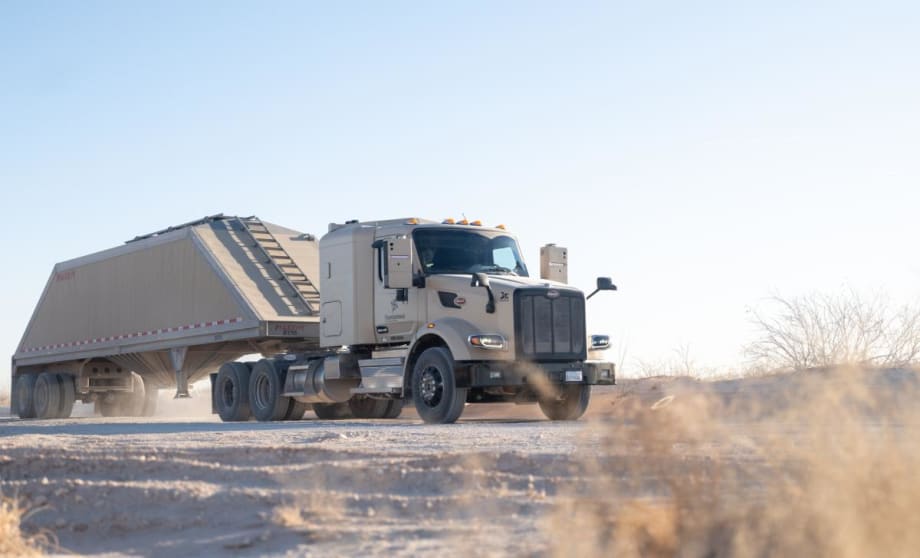
The Kodiak Driver-equipped RoboTrucks feature Kodiak’s sixth-generation platform, which includes all the redundant components required for operations without a safety driver.
Photo: Kodiak Robotics
A Texas company is using Kodiak-equipped autonomous RoboTrucks to transport proppant used in hydraulic fracturing – without a driver.
Atlas Energy Solutions recently completed the delivery of 100 loads of proppant with its two RoboTrucks, semi-trucks equipped with the Kodiak Driver. According to Kodiak Robotics, this milestone marks the first time a customer has taken ownership of a RoboTruck and launched driverless commercial semi-trucking operations.
What is Proppant?
Proppant is a gritty material with uniformly sized particles, such as resin-coated sand, mixed with fracturing fluid during the hydraulic fracturing (fracking) process to hold open fractures made in the ground.
The initial driverless operations, announced in July 2024, involved Kodiak delivering Atlas’s frac sand along a 21-mile off-road route in West Texas’s Permian Basin with Kodiak-owned driverless trucks.
With Kodiak providing the self-driving technology for these initial Atlas-owned RoboTrucks, Atlas can now complete its own driverless deliveries across the 75,000-square-mile Permian Basin in West Texas and Eastern New Mexico.
Today, Atlas operates Kodiak Driver-equipped RoboTrucks that deliver sand daily.
Atlas Energy Solutions concurrently launched the Dune Express, a 42-mile autonomous conveyor system that delivers sand to Atlas’s autonomous RoboTrucks. Once integrated with the Dune Express, this fleet is designed to create a fully automated supply chain.
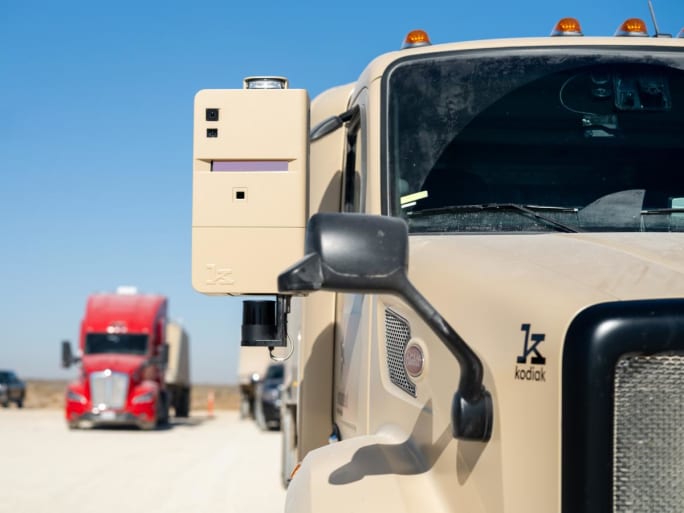
Kodiak’s proprietary SensorPods are pre-calibrated modular units that house all the sensors needed for autonomous driving, enabling fast and easy repairs.
Photo: Kodiak Robotics
Major Milestone for Autonomous Trucks
The Kodiak Driver-equipped RoboTrucks feature Kodiak’s sixth-generation platform, which includes all the redundant components required for operations without a safety driver. This includes Kodiak’s proprietary SensorPods, pre-calibrated modular units that house all the sensors needed for autonomous driving, enabling fast and easy repairs.
“This is an incredible moment, for us and for the autonomous trucking industry as we have officially delivered a commercial RoboTruck to a customer and launched commercial operations,” said Don Burnette, Founder and CEO, Kodiak.
“The commercialization of autonomous trucks has been a goal for the industry for many years, and it has now come to fruition. Kodiak is the first company to make autonomous trucking a real business, and this is a major step towards profitability for our company.”
Atlas intends to scale its RoboTruck deployment considerably throughout 2025 with multiple RoboTruck deployments expected throughout the year.
Given the scale and scope of operations in the Permian Basin, Kodiak announced that it has established an office in Odessa, Texas, to support Atlas’s operations. The 18,000-square-foot facility houses a team of 12 Kodiak employees and is projected to grow to approximately 20 people by the end of the first quarter.
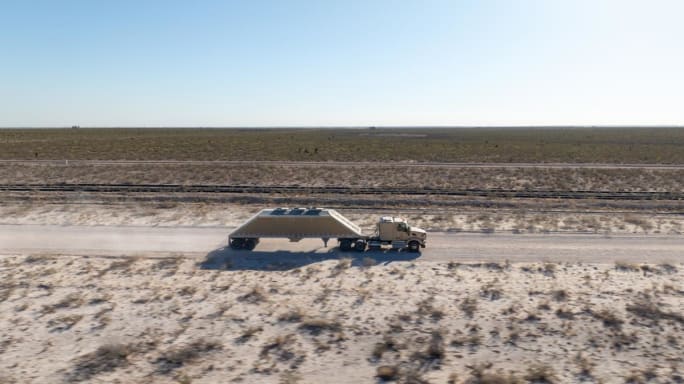
With Kodiak providing the self-driving technology for Atlas-owned RoboTrucks, Atlas can now complete driverless deliveries across the 75,000-square-mile Permian Basin in West Texas and Eastern New Mexico.
Photo: Kodiak Robotics
Why Driverless Trucks Are a Fit for Atlas Energy
“Incorporating these driverless RoboTrucks into our operations is a significant advancement in the automation of our business, enhancing our ability to maintain a fundamentally safe and reliable service at the best price for our customers,” said John Turner, CEO of Atlas.
Study Group Issues Autonomous Truck Guidelines
“Becoming the first company to operate our own autonomous semi-trucks and reaching 100 successful autonomous proppant deliveries demonstrates our unique commitment to driving innovation and automation across the Permian Basin’s rugged terrain, dust, and heat.”
The RoboTrucks are just part of Atlas Energy’s work to automate more of its logistics operations and drive down cost for customers.
Proppant logistics is increasingly a differentiating factor affecting customer choice among proppant producers, according to Atlas. The cost of delivering sand, even short distances, can be a significant component of customer spending on their well completions given the substantial volumes used in modern well designs.
What’s Next for Kodiak Robotics and Driverless Trucks?
Prior to launching driverless operations with Atlas, Kodiak successfully completed its safety case, which is a comprehensive evaluation that demonstrates the safety and readiness of its self-driving system, within Atlas’s operating domain.
The delivery of the world’s first customer-owned driverless RoboTrucks for industrial operations happened in December 2024, and driverless service with these trucks commenced on December 18th, 2024. This is the first stage in Kodiak’s commercialization roadmap.
As a next step, Kodiak will extend its safety case to highways for its long-haul customers.
That includes customers such as J.B. Hunt, which is using Kodiak’s hub-to-hub autonomous truck delivery model to transport Bridgestone tires.
More Equipment

Kodiak Targets Dallas–Houston for Driverless Trucks
The company says its autonomous trucks are completing the I-45 run without a safety observer taking control. It plans to remove the observer by the end of 2026.
Read More →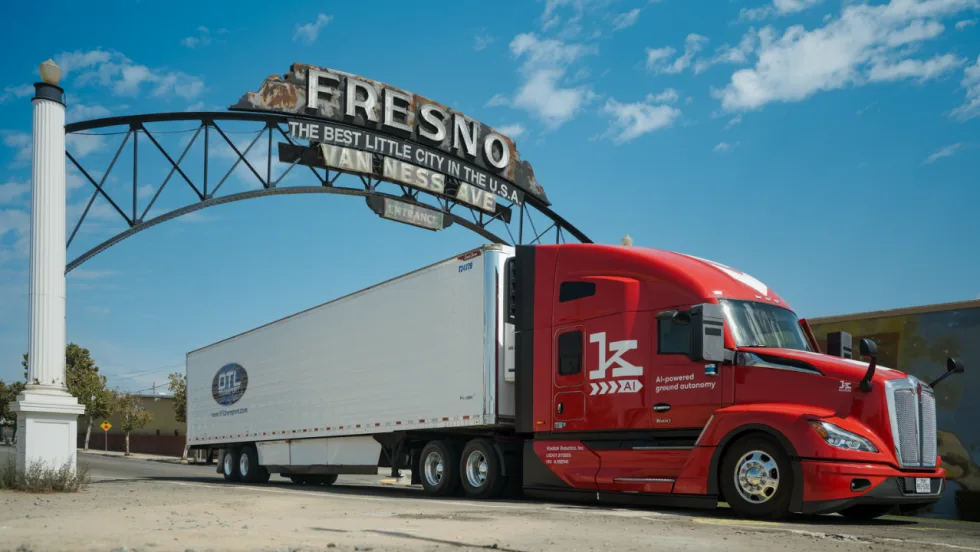
Kodiak Hauls Produce in California Autonomous Truck Pilot
Kodiak AI and DTL Transport have begun hauling produce between Fresno and Los Angeles under California’s new rules for testing heavy-duty autonomous trucks. A safety driver remains behind the wheel.
Read More →
Used-Truck Remarketing Math Is Changing
Used-truck value is no longer just a concern at trade-in. Decisions made throughout a truck’s first life can influence what it’s worth years later.
Read More →
How Volvo Updated Its D13 for EPA 2027 [Watch]
Volvo’s updated D13 promises lower emissions without sacrificing performance or fuel economy. Take a closer look at what changed inside the engine in this HDT Spotlight video.
Read More →
Michelin Tire Improves Efficiency and Durability for Regional Fleets
The Michelin X Multi Energy D2 is a regional haul drive tire engineered to help fleets improve fuel efficiency, durability and traction in demanding stop-and-go operations.
Read More →
ZF Expands Commercial Vehicle Push in North America
ZF is expanding its North American commercial-vehicle presence with new transmission applications, electrification, trailer technology and autonomous-driving systems.
Read More →
Tesla Wants a Self-Driving Semi. Are Cameras Enough?
Could Tesla’s camera-only autonomous driving technology work on an 80,000-pound Semi? In this commentary, HDT's Deborah Lockridge takes a look at Tesla, Cybercab, and how autonomous trucks see the road.
Read More →Kodiak: Driverless Long-Haul Truck Launch on Track for 2026
Kodiak AI says its driverless long-haul safety case is 93% complete and it remains on track to begin commercial operations by year-end 2026.
Read More →
What DOT’s Automated Vehicle Strategy Means for Trucking
The U.S. Department of Transportation issued a new automated-vehicle strategy that outlines plans for driverless-truck regulations, cross-state freight corridors, and federal safety standards.
Read More →
East Coast Port Launches $45M Electric Truck Push
The Port Authority of New York and New Jersey announced millions in incentives for zero-emission drayage trucks, yard tractors, and new charging hubs near the port.
Read More →