




DOE Invests $68 Million in Heavy-Duty Truck Charging Solutions
The U.S. Department of Energy’s SuperTruck Charge initiative is designed to boost large-scale charging solutions for heavy-duty electric vehicles.

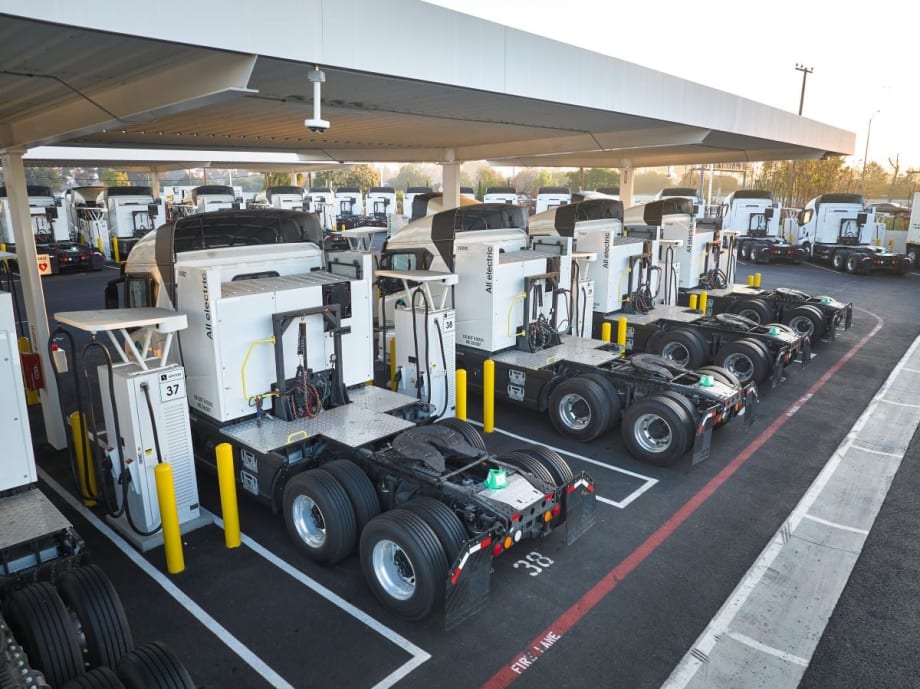
The U.S. Department of Energy is investing $68 million to design, develop, and demonstrate innovative electric vehicle (EV) charging sites near key ports, distribution hubs, and major corridors.
Photo: Volterra
The U.S. Department of Energy has announced a $68 million investment to design, develop, and demonstrate innovative electric vehicle (EV) charging sites near key ports, distribution hubs, and major freight corridors.
SuperTruck Charge projects will accelerate deployment of large-scale public EV charging infrastructure for medium-and heavy-duty EVs to improve grid resiliency and reliability.
The projects are selected and funded through DOE’s SuperTruck Charge initiative. The program’s aim is to accelerate deployment of large-scale public EV charging infrastructure for medium-and heavy-duty (MHD) EVs for improved grid resiliency and reliability.
SuperTruck’s Ongoing Mission
DOE’s SuperTruck Program launched in 2009 with four industry participants successfully demonstrating new, efficient technologies for Class 8 tractor trucks, including many that have been commercialized.
SuperTruck2 followed with five industry participants more than doubling Class-8 tractor truck efficiency while significantly improving engine brake thermal efficiency.
SuperTruck3 projects, scheduled to be completed in 2027, will reduce MHD truck greenhouse gas and air pollution emissions by 75% (on a lifecycle basis) and reduce the total cost of truck ownership, concentrating on electric and hydrogen fuel cell trucks.
“The U.S. Department of Energy’s SuperTruck program has significantly advanced energy-efficient technologies for freight trucks which play a vital role in our economy," said Jeff Marootian, principal deputy assistant secretary for the Office of Energy Efficiency and Renewable Energy. “The new SuperTruck Charge projects will add to these advancements by demonstrating replicable models that deliver cost-effective, high-power charging for electric trucks while improving grid resiliency and reliability for medium- and heavy-duty EV deployment.”
Nationwide Reach
Each SuperTruck Charge project targets large-scale, replicable, high-power charging installations to serve MHD electric fleets with tens to hundreds of vehicles.
They will develop and demonstrate high-capacity charging infrastructure to serve MHD electric trucks for long-haul use cases (more than 500 miles per day) along major corridors and rural regions where grid capacity is limited. As momentum grows for MHD electrification, spurred by falling technology costs, continued innovation will scale up infrastructure to improve air quality, enhance the reliability of commercial road transport, and establish America's global competitiveness and leadership in MHD electrification.
Selected projects include:
Supercharging the Southwest: Charging Deployment Along the I-10 Corridor, Pearl Street Property Company (Terawatt Infrastructure), San Francisco, CA ($20 million) will demonstrate innovative grid and load management strategies at a charging site along the I-10 corridor in either Goodyear, Arizona or Tucson, Arizona. This project provides 10 pull-through truck charging stalls with megawatt charging systems (MCS) compatible chargers, solar canopies, and 3 megawatts (MW) of battery electric storage systems. The team will achieve this by supplementing available utility power with energy storage systems and on-site generation if power demand exceeds utility power available.
Mega Charging the I-15 Corridor, Greenlane Infrastructure, LLC, Santa Monica, CA ($26 million) will support multiple generations of MHD EV charging on freight corridors, producing real world operational data resulting in the validation of innovative controls all while reducing electric-grid impact. Greenlane will deploy a publicly accessible 10+ MW MHD EV charging station at Greenlane Center in Barstow, California. The site will feature distributed energy resource (DER) systems to help balance the utility load, including solar arrays and energy storage. Additionally, the site will offer combined charging systems and be futureproofed with scalable MCS direct current fast charging MHD EV chargers. The project will create replicable, scalable, grid-integrated high-power charging infrastructure along the I-15 corridor to support widespread adoption of Class 6-8 electric trucks.
SuperCharge: Sustainable Utilization of Power Infrastructure Enabling Rapid and Replicable MHDVs Charging through Hybrid AC/DC Distribution Networks and Renewable Grid Energy Integration, Utah State University, Logan, UT ($22 million) will establish a reliable, replicable, and scalable charging infrastructure blueprint that can be implemented nationwide, even in areas with limited grid capacity. The team will demonstrate the SuperCharge charging facility with 9 MW of max concurrent charging capability and 12 MW of installed EV charging equipment, while drawing less than 4.5 MW from the grid. This will be realized through advanced facility energy and fleet management tools and cost-effective architecture that combines existing AC charging and distribution infrastructure with emerging solid-state DC distribution, DERs, and MW-class charging.
A Complementary Strategy
SuperTruck Charge, administered by DOE’s Vehicle Technologies Office, complements other efforts DOE announced today to expand access to EV charging through innovative grid and planning solutions. Connected Communities 2.0 focuses on advancing grid-edge solutions for resilient communities, including demonstrating various unique urban, suburban, and rural-use cases to build confidence in smart charge management.
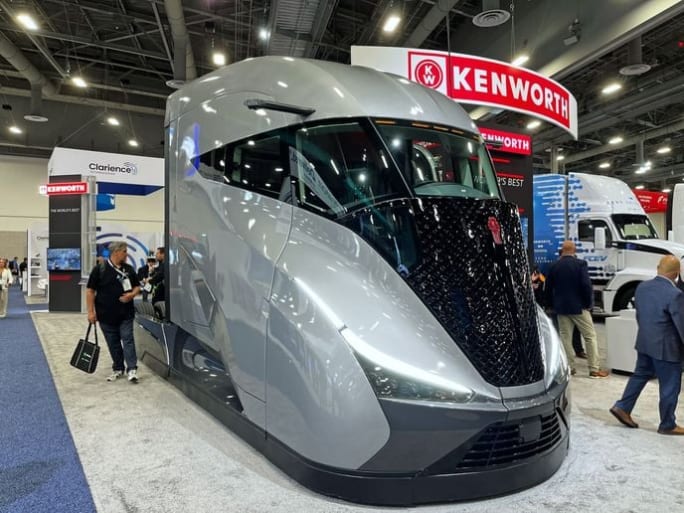
The DOE's SuperCharge initiative is an offshoot of its SuperTruck2 technology program.
Photo: Jack Roberts
The Joint Office of Energy and Transportation’s Communities Taking Charge Accelerator invests more than $43 million in projects that fill gaps in public charging infrastructure, such community charging for those without home charging access, e-mobility options for fleets of all sizes, and grid-friendly managed charging.
In addition, SuperTruck Charge advances DOE activities described in A Report on Actions for Medium- and Heavy-Duty Vehicle (MHDV) Energy and Emissions Innovation, which builds on the U.S. National Blueprint for Transportation Decarbonization and the National Zero-Emission Freight Corridor Strategy.
More Fuel Smarts

How Volvo Updated Its D13 for EPA 2027 [Watch]
Volvo’s updated D13 promises lower emissions without sacrificing performance or fuel economy. Take a closer look at what changed inside the engine in this HDT Spotlight video.
Read More →
Diesel Price Spike Shortens Payback for Natural Gas Trucks, Report Says
Energy Vision estimates fleets could recover the higher purchase price of an RNG-fueled Class 8 tractor in 1.3 to 2.8 years under current fuel-price scenarios.
Read More →
Calstart Becomes Catalyst Mobility, Reflecting Broader Focus
Calstart is now Catalyst Mobility, reflecting the nonprofit’s growing national role in clean transportation, including zero-emission trucks, infrastructure and incentive programs.
Read More →

Record Diesel Prices Squeeze Trucking Fleets
Average U.S. diesel prices have climbed to nearly $6 a gallon, surpassing the 2022 record as tight refinery capacity and Middle East disruptions keep fuel costs elevated.
Read More →
How Fuel Delivery Shapes Engine Performance
Fuel delivery depends on more than what happens at the injector. For fleet, maintenance and technical professionals, looking at the full path from pump to injector can provide useful context for understanding engine performance.
Read More →
East Coast Port Launches $45M Electric Truck Push
The Port Authority of New York and New Jersey announced millions in incentives for zero-emission drayage trucks, yard tractors, and new charging hubs near the port.
Read More →
California Bill Could Shed Light on Electric Truck Prices
Why do battery-electric Class 8 trucks remain so expensive? A California bill headed to Gov. Gavin Newsom would give fleets and state agencies more visibility into what manufacturers charge.
Read More →
Detroit Opens Orders for EPA 2027 Engines
Detroit isn’t starting from scratch to meet EPA 2027 diesel emissions standards. Its Gen 6 DD13 and DD15 engines keep much of today’s platform while updating the fuel and aftertreatment systems.
Read More →
Zero-Emission Truck Corridor Planned for West Coast
California, Oregon, Washington, British Columbia and Baja California are coordinating plans for truck charging and hydrogen fueling from Canada to Mexico.
Read More →
A Closer Look at Kenworth’s Electric T880E Vocational Truck [Video]
Learn more about Kenworth's T880E battery-electric vocational truck at the Paccar Technical Center, including its range, applications, upfitting considerations, and PTO options, in this HDT Spotlight video.
Read More →