




DB Schenker Specs Rear-View Camera in New Volvo VNLs
DB Schenker intends to deploy more than 120 all-new Volvo VNLs with the camera monitor system by the end of 2025, the fleet said.

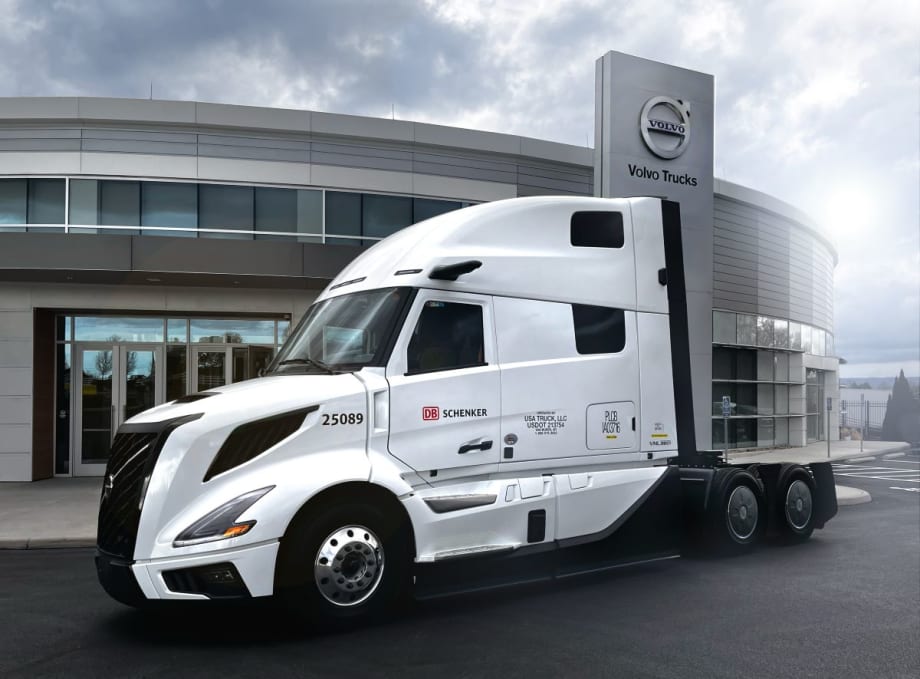
DB Schenker has ordered 20 Volvo VNL860 models with rearview camera systems.
Photo: Volvo Trucks North America
DB Schenker has added 20 all-new Volvo VNLs to its fleet. And all of the new trucks feature Volvo’s integrated camera monitor system to enhance safety, the OEM has announced.
According to Volvo, the fully integrated camera monitor system improves upon traditional cab mounted and hood mounted mirrors with a wider range of visibility, helping drivers reduce the risk of collisions during lane changes or backing maneuvers.
A New Standard for Safety
“When we launched the all-new Volvo VNL, our focus was on delivering maximum value to customers with a truck that sets new industry standards for safety and fuel efficiency,” said Peter Voorhoeve, president, Volvo Trucks North America. “We’re proud of our partnership with DB Schenker, and it's exciting to see them outfitting their trucks with a fully integrated camera monitor system, maximizing both safety and fuel efficiency. This collaboration highlights how Volvo Trucks continues to innovate and lead the industry, ensuring our customers benefit from cutting-edge technology and superior design.”
“We were impressed with the advanced safety features of the all-new Volvo VNL, particularly the camera monitor system,” added said George Henry, head of land for region Americas, DB Schenker. “The new camera solutions give our drivers additional tools to improve their visibility, helping us continue our pursuit to become the industry leader in safety, The increased scope of vision provided by the camera monitor system — including blind spot vision, zoom while backing, and the digital video recorder capability — provides us with further possibilities to protect our company in the event of an accident.”
Henry attended an immersive customer event at Volvo Trucks’ New River Valley Assembly Plant in Dublin, Virginia, along with three DB Schenker drivers with diverse backgrounds to experience the all-new Volvo VNL’s advanced safety features firsthand.
Their experience influenced the decision to increase the Volvo footprint in their fleet with the all-new Volvo VNL.
Superior Visibility
Volvo said the integrated camera monitor system in the new VNL enhances vehicle safety by offering superior visibility compared to traditional mirrors.
The advanced system employs infrared technology to optimize rear visibility in all conditions, improving drivers’ ability to see clearly even in low-light or adverse weather situations.
The system also tracks the trailer’s position, providing enhanced lines of sight, particularly where collisions most commonly occur — cornering, lane changes and backing maneuvers.
By replacing bulky exterior mirrors, the camera monitor system also contributes to aerodynamic improvements, which in turn make the truck more fuel efficient. These innovations underscore Volvo Trucks’ commitment to leveraging cutting-edge technology to maximize both safety and fuel efficiency for their customers.
DB Schenker operates in more than 130 countries, providing transportation and supply chain solutions across industries such as automotive, healthcare, and retail.
The company operates a fleet of 1,800 vehicles in North America and chose to spec its new VNLs according to Volvo Trucks’ recommendations rather than its traditional specifications.
The fleet said by doing it so it will be able to evaluate many of the new technological advancements integrated into the design. It will also be able to compare how they improve safety, total cost of ownership and driver retention.
Safety and Efficiency
DB Schenker ordered 20 of Volvo Trucks’ flagship sleeper VNL860 model in Edge trim. The spec includes the next-generation D13 engine with I-Shift.
Volvo said the I-Shift transmission offers up to 30 percent faster shifting speeds, amplifying acceleration and minimizing energy loss during gear changes, resulting in heightened overall efficiency.
I-Shift also uses intelligent electronics to continuously monitor grade, speed, weight, and engine load, shifting when necessary or holding a gear — whichever saves more fuel.
Regardless of experience or training, Volvo said, I-Shift has the ability to help every driver become more productive and fuel-efficient.
The all-new Volvo VNL also features a suite of driver assistance systems. These include the Volvo Active Driver Assist (VADA) package that comes standard across all VNL models. It also includes the new optional Volvo Active Driver Assist Plus (VADA Plus).
VADA features forward collision avoidance technology to assist drivers in maintaining safe speeds and distances, with adaptive cruise control, and provides audible and haptic alerts to help the driver maintain a safe following distance.
DB Schenker said its drivers are enthusiastic about the upgraded VADA Plus package, which provides support for lane changes and active lane centering, as well as a variety of alerts to help drivers reduce the risk of side-collisions.
VADA Plus is powered by Volvo Dynamic Steering (VDS), which helps drivers maintain effective maneuvering, steering control, and stability under various speeds and road conditions — including high crosswinds, highway crowning, and emergency situations like tire failure.
The oversteer guidance in VDS, included in the VADA Plus option, provides additional support to the driver in avoiding rollover events.
An Optimized Work Environment
Volvo engineered the new VNL to achieve a fuel efficiency improvement of up to 10 percent compared to the legacy VNL model. This is the result of improved aerodynamics and Volvo’s advanced powertrain offering, the OEM added.
According to Volvo, this increased fuel efficiency will aid DB Schenker in achieving its sustainability goal of becoming carbon neutral by 2040.
Volvo said its new VNL model is the most driver-centric truck ever built for North America.
The truck is equipped with customizable features that minimize fatigue and enhance the overall driving experience.
DB Schenker anticipates that the all-new Volvo VNL will help attract and retain drivers by offering an optimized environment for work, life, and rest. The groundbreaking model redefines driver comfort and operational efficiency in heavy-duty trucking.
More Safety & Compliance

FMCSA Pauses Biennial-Update Enforcement Amid Motus Transition
Carriers whose updates were due on or after June 1 have more time, while FMCSA works to stabilize its new registration system and warns of phishing sites impersonating its new carrier registration system, Motus.
Read More →
ZF Expands Commercial Vehicle Push in North America
ZF is expanding its North American commercial-vehicle presence with new transmission applications, electrification, trailer technology and autonomous-driving systems.
Read More →
Truck Drivers Need More Than Another Alert
Fleets have more visibility into truck health, safety events, and driver activity than ever. The next challenge is turning all that information into useful guidance for the person who has to decide what to do next.
Read More →
Tesla Wants a Self-Driving Semi. Are Cameras Enough?
Could Tesla’s camera-only autonomous driving technology work on an 80,000-pound Semi? In this commentary, HDT's Deborah Lockridge takes a look at Tesla, Cybercab, and how autonomous trucks see the road.
Read More →
What DOT’s Automated Vehicle Strategy Means for Trucking
The U.S. Department of Transportation issued a new automated-vehicle strategy that outlines plans for driverless-truck regulations, cross-state freight corridors, and federal safety standards.
Read More →
NYC Expands Speed, Pedestrian Safety Tech Across Fleet
New York City is expanding intelligent speed assistance and pedestrian-alert systems across its municipal fleet, moving the technologies from pilot programs into vehicle procurement and retrofit requirements.
Read More →
FMCSA Removes 110 Truck Driver Training Schools from Certified ELDT List
Federal regulators also are targeting more than 160 additional training providers and launching a nationwide audit of third-party CDL skills testers as part of a broader crackdown on trucking fraud.
Read More →
Beyond DOT Compliance: What Makes a Trucking Fleet Truly Safe?
A trucking fleet can follow every rule and still make unsafe decisions. The real test comes when safety conflicts with freight, productivity, or cost.
Read More →
Hours of Service Pilot Programs: FMCSA Readies for 2027 Rollout
Two pilot programs could eventually reshape hours-of-service rules, giving truck drivers options to pause their 14-hour clock or use longer split sleeper rest periods.
Read More →
New Guide Offers Pet Safety Tips for Truck Drivers
Hundreds of thousands of pets travel in truck cabs. A new safety guide from Volvo Trucks and the Center for Pet Safety offers practical advice for truck drivers who bring dogs and cats along for the ride.
Read More →