




Daimler Trucks North America to Build Electric Cascadia, M2 Trucks
Freightliner Trucks premiered two fully electrified commercial vehicles, a Freightliner eCascadia and a Freightliner eM2 106, during the Daimler Trucks Capital Market and Technology Day.

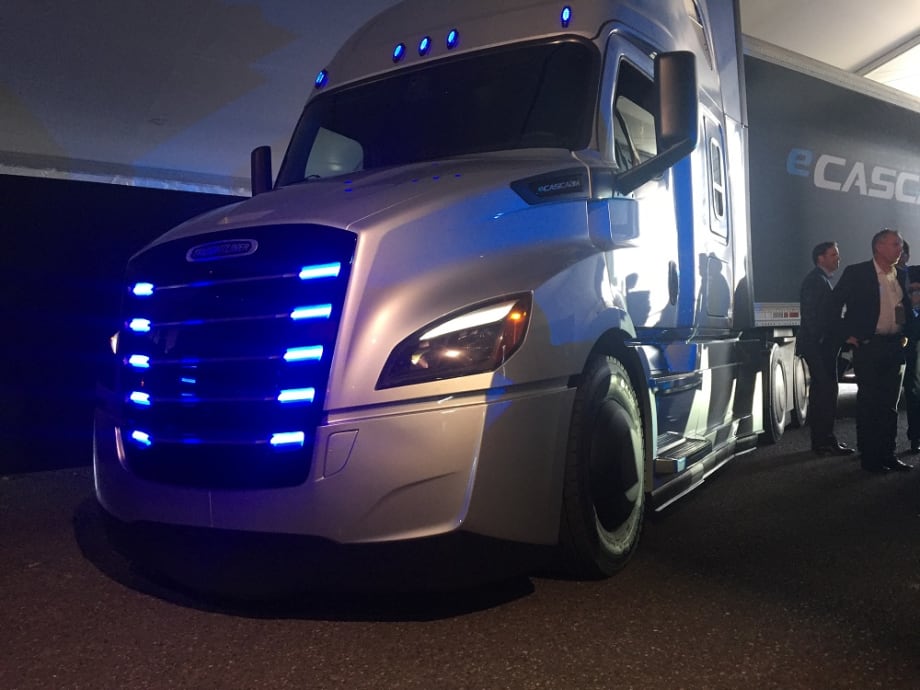
Freightliner announced plans to produce an electric eCascaida model as part of its Electric Innovation Fleet that customers can test in real world conditions.
Photo: Deborah Lockridge
PORTLAND, OREGON. Freightliner Trucks premiered two fully electrified commercial vehicles, a Freightliner eCascadia and a Freightliner eM2 106, during the Daimler Trucks Capital Market and Technology Day on June 6. Freightliner plans to deliver an Electric Innovation Fleet of 30 vehicles to customers later this year for further testing under real-world operating conditions.
Both electrified Freightliner models are designed to fit specific applications, carefully identified through an extensive “co-creation process” with customers.
For the eCascadia, for instance, the focus is on port drayage and local and regional distribution. The eM2 is designed for local distribution, pickup and delivery, food and beverage delivery, and last-mile logistics applications.
The eCascadia uses wheel-end motors to produce up to 730 peak horsepower. The batteries provide 550 Kwh usable capacity, a range of up to 250 miles, and have the ability to charge up to 80% (providing a range of 200 miles) in about 90 minutes.
The eM2 has up to 480 peak horsepower. The batteries provide 325 Kwh of usable capacity, a range of up to 230 miles, and have the ability to charge up to 80% (providing a range of 184 miles) in about 60 minutes.
“The Freightliner eCascadia and eM2 are designed to meet customer needs for electrified commercial vehicles serving dedicated, predictable routes where the vast majority of daily runs fall between 45 and 150 miles,” said Roger Nielsen, president and chief executive officer of DTNA.
The Freightliner eCascadia with 80,000 lb. gross combined weight rating (GCWR) and eM2 with 26,000 lb. GCWR are part of Daimler Trucks’ global electrified truck initiative. The Mercedes-Benz eActros, with a range up to 124 miles and a 55,000 lb. GCWR, is now entering testing for distribution applications with customers in Europe, while the E-Fuso Vision One, a Class 8 concept truck in Japan with a range of 220 miles and a 51,000 lb. GCWR, gives an outlook on the electrification of the Fuso portfolio. The Fuso eCanter, a light-duty truck, is already in regular production as a fully electric truck from Daimler Trucks.
“Our primary goal at DTNA is bringing vehicles to market that are safe, reliable and efficient. Heavy-duty electric vehicles present the greatest engineering challenges, but they also are the best learning laboratories,” Nielsen said.
“DTNA is preparing to pivot our future business environment to bring e-mobility solutions into the realm of our core business,” he noted. “Battery technology is rapidly improving and bringing costs down and power density up. Now we see applications to develop use cases for electric vehicles that match the real cost of ownership with conventional powertrains.”
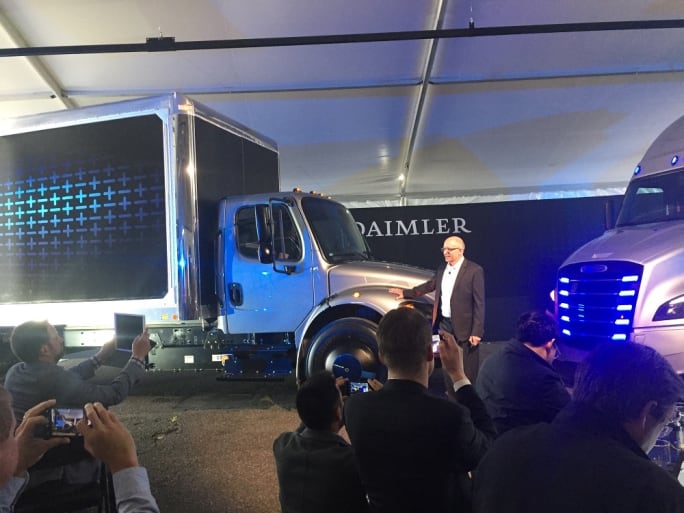
An electric eM2 106 was also shown off at the Daimler Trucks Capital Market and Technology Day in Portland, Ore.
Photo: Deborah Lockridge
Leveraging Global Scale
Daimler emphasized that this rollout is part of a global effort, and in fact the goal is to develop a single proprietary electric system that will be used on its products around the world.
Saying that it aims to become “the undisputed number one when it comes to e-mobility,” Daimler said it has bundled all of its electric activities under a new organization for e-mobility: the E-Mobility Group (EMG).
EMG will define the strategy for everything from electrical components to completely electric vehicles for all brands and all business divisions, while also working to create a single global electric architecture.
EMG is globally structured, with employees working cross-functional in various locations throughout the company's worldwide development network, e.g. in Portland (U.S.), Stuttgart (Germany) and Kawasaki (Japan)
Daimler Trucks commercial electric vehicles breakthroughs already entering the market include:
Thomas Built Buses Saf-T-Liner C2 electric school bus, Jouley, with a range of up to 100 miles that starts limited production in 2019
More than 100 electric vehicles built by Freightliner Custom Chassis Corp. in 2012 with supplier Electric Vehicles International (EVI) on the MT-55 walk-in van chassis are still on the roads today
The Fuso eCanter, a fully electric Class 4 light-duty truck in regular production with electric urban delivery vehicles being delivered to various customers in North America, Asia and Europe
The fully electric Mercedes-Benz Citaro is based on the global bestseller Mercedes-Benz Citaro, going into full production in late 2018
The Mercedes-Benz eActros is a fully electrified heavy-duty distribution truck starting operations with initial first customers in the second half of 2018
Developing Charging Infrastructure
DTNA understands the success of electric commercial vehicles requires extensive knowledge and support on the infrastructure side, and is leading the initiative to develop a commercial vehicle charging infrastructure for North America.
Germany-based Daimler AG, DTNA’s parent, is a founding member of CharIN, the Charging Interface Initiative – an effort to develop a standard charging system for battery-powered vehicles. DTNA itself is heading a CharIN taskforce to develop a new electric commercial vehicle charging standard globally, collaborating with utilities and service providers.
While the Society of Automotive Engineers recently released charging recommendations for medium- and heavy-duty vehicles, Andreas Juretzka, chief engineer for Daimler’s e-mobility efforts, told HDT that they are concerned that the SAE process may not move quickly enough. The trucks shown here to journalists and investors were equipped with European charging ports.
Stay tuned for more reports from HDT Editor in Chief Deborah Lockridge, who is covering this special event from Portland.
Related: SAE Publishes Charging Recommendation for Medium- and Heavy-Duty Electric Vehicles
More Equipment

How Volvo Updated Its D13 for EPA 2027 [Watch]
Volvo’s updated D13 promises lower emissions without sacrificing performance or fuel economy. Take a closer look at what changed inside the engine in this HDT Spotlight video.
Read More →
Michelin Tire Improves Efficiency and Durability for Regional Fleets
The Michelin X Multi Energy D2 is a regional haul drive tire engineered to help fleets improve fuel efficiency, durability and traction in demanding stop-and-go operations.
Read More →
ZF Expands Commercial Vehicle Push in North America
ZF is expanding its North American commercial-vehicle presence with new transmission applications, electrification, trailer technology and autonomous-driving systems.
Read More →
Tesla Wants a Self-Driving Semi. Are Cameras Enough?
Could Tesla’s camera-only autonomous driving technology work on an 80,000-pound Semi? In this commentary, HDT's Deborah Lockridge takes a look at Tesla, Cybercab, and how autonomous trucks see the road.
Read More →
Kodiak: Driverless Long-Haul Truck Launch on Track for 2026
Kodiak AI says its driverless long-haul safety case is 93% complete and it remains on track to begin commercial operations by year-end 2026.
Read More →
What DOT’s Automated Vehicle Strategy Means for Trucking
The U.S. Department of Transportation issued a new automated-vehicle strategy that outlines plans for driverless-truck regulations, cross-state freight corridors, and federal safety standards.
Read More →
East Coast Port Launches $45M Electric Truck Push
The Port Authority of New York and New Jersey announced millions in incentives for zero-emission drayage trucks, yard tractors, and new charging hubs near the port.
Read More →
PlusAI Going Public to Fund Autonomous Truck Launch
A SPAC deal could provide PlusAI with up to $300 million as it works toward a 2027 commercial launch of factory-built autonomous trucks.
Read More →
NHTSA Moves to Rewrite Truck Fuel-Economy Rules
The National Highway Traffic Safety Administration says it lacks authority to regulate medium- and heavy-duty truck engines separately from complete vehicles, but the existing standards have not yet been eliminated.
Read More →
Detroit Opens Orders for EPA 2027 Engines
Detroit isn’t starting from scratch to meet EPA 2027 diesel emissions standards. Its Gen 6 DD13 and DD15 engines keep much of today’s platform while updating the fuel and aftertreatment systems.
Read More →