




Daimler Rolls Out BEV Dealer Certification Program
A new Daimler BEV dealer certification program covers all areas required to help customers navigate moving toward emissions-free driving.

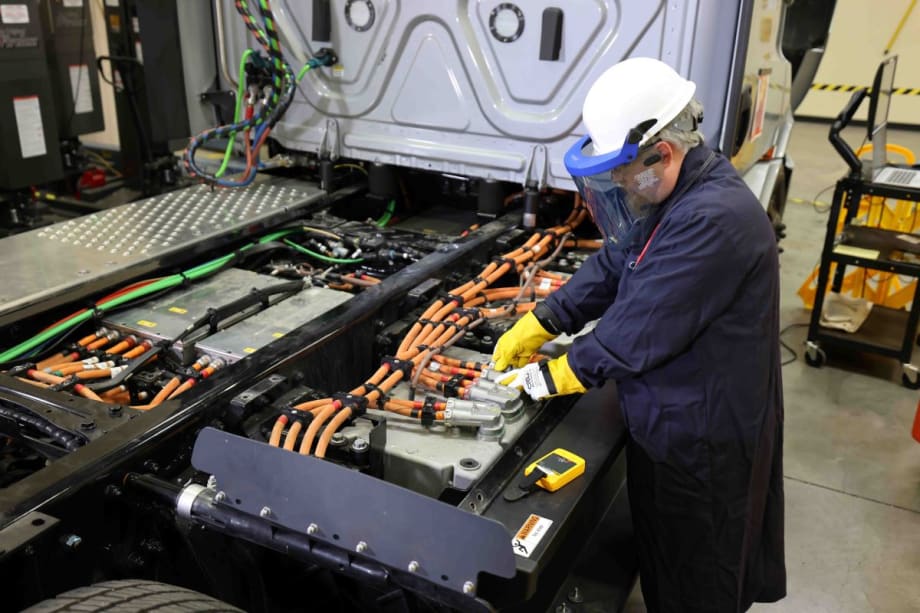
A new BEV dealer cerfitication program from Daimler Truck North America provides training and resources for sales, service and parts for electric trucks.
Photo: Daimler Truck North America
Daimler Truck North America announced a comprehensive battery-electric vehicle (BEV) dealer certification program. Daimler said the new program builds on the foundations of its Elite Support program. That is a certified network of Freightliner dealers delivering customer experience throughout all areas of dealership operations.
With the heavy-duty Freightliner eCascadia and medium-duty Freightliner eM2, DTNA said it has already deployed battery-electric trucks in over 50 fleets across the country, logging over 4 million customer battery-electric miles.
“After several months of collaboration between DTNA and the Freightliner Dealer Council Principals, representing over 40% of all dealer locations in the USA and Canada, we are pleased to introduce and support the BEV Dealer Certification Program that will become the model for our entire industry at providing a safe and world-class customer experience for our battery-electric truck customers,” said John Hopkins, co-chair of the Freightliner Dealer Council.
Helping Fleets Move to Emissions-Free Trucking
The BEV Dealer Certification program covers all areas required to help customers navigate moving toward emissions-free driving, according to Daimler.
The Detroit eConsulting program helps customers understand their infrastructure and vehicle optimization needs. It also aids them in spec’ing and maintaining electric trucks.
Freightliner’s dealer network is investing substantially to meet the requirements of the BEV Dealer Certification Program, which covers over 75 specific criteria in four key areas:
Safety -- Comprehensive safety policy and training, nominating a frontline contact person, and being fully equipped with high-voltage safety-specific equipment
Charging Infrastructure -- Commercial vehicle charging infrastructure including stationary or mobile charging solutions. And baseline competency to enable infrastructure and vehicle deployment readiness activities backed by the expert-level support of the Detroit eConsulting team
Dealership Infrastructure -- Dedicated BEV service bays, battery storage space and key parts stocking, plus installation of safety signage
Training -- BEV training and resources for the dealership personnel covering all aspects of the dealership business; sales, service and parts.
“Having our dealer network BEV certified benefits the market as a whole. For customers owning or purchasing an electric vehicle in the near term, it is likely their first experience with electrification in the heavy-duty truck space. We see it as our responsibility to support them on their journey,” states Drew Backeberg, senior vice president of aftermarket at DTNA. “For wider market adoption, we need experts and safety leaders and we want to ensure that our dealer network sets the standard high through our new BEV Dealer Certification Program.”
Eight dealerships have already completed the rigorous certification and the number is doubling in the coming weeks. With the growth of electric vehicles and the deployment throughout North America, now is the time to rapidly expand the optional BEV Dealer Certification throughout the Freightliner dealer network, with a plan to have 100 dealer locations certified by 2025.
More Fleet Management

Color Match Smarter: Tools That Restore & Perform
For fleet managers and collision repair professionals keeping heavy-duty trucks on the road, getting the color right the first time isn't just about appearance — it's about efficiency, turnaround time, and bottom-line results. Discover how today's digital color tools are transforming the repair process from guesswork to precision.
Read More →
FMCSA Pauses Biennial-Update Enforcement Amid Motus Transition
Carriers whose updates were due on or after June 1 have more time, while FMCSA works to stabilize its new registration system and warns of phishing sites impersonating its new carrier registration system, Motus.
Read More →
2026 Blueprint for Countering Smarter Supply Chain Theft
Cargo theft is no longer just the cost of doing business. It's a multi-billion-dollar criminal enterprise exploiting vulnerabilities across your fleet, drivers, and supply chain.
Read More →


How Telematics Improves Visibility, Control, and Performance in Refrigerated Fleets
Explore how telematics help refrigerated fleets improve visibility, uptime, efficiency, compliance, and cargo protection across connected cold chain operations.
Read More →
What the U.S.-Canada Trade War Means for Trucking
Escalating U.S.-Canada tariffs could disrupt cross-border freight, reduce truck volumes, raise costs, and create new uncertainty for carriers on both sides of the border.
Read More →
What Are Trucking’s Top Concerns for 2026?
The American Transportation Research Institute wants to know what's worrying trucking fleet managers, drivers, and other stakeholders in its annual Industry Issues survey.
Read More →
American Trucking Associations Looks for a New Leader
ATA President and CEO Chris Spear abruptly left his job at the association on August 21, at a pivotal time for the trucking industry.
Read More →
Public Wi-Fi Cybersecurity Risks: How Truck Drivers and Fleets Can Protect Their Data
Public Wi-Fi can expose truck drivers and fleets to credential theft, malware, and other cyber threats. Here’s how to reduce the risk on the road.
Read More →
For Nicky Cupp, Fleet Innovation Starts With Frustration
HDT Truck Fleet Innovator Nicky Cupp turns everyday pain points at Fraley & Schilling into opportunities for better technology and smarter processes.
Read More →
Adam Buttgenbach’s Approach to Electric Trucks: Start With Where They Fit
HDT Truck Fleet Innovator Adam Buttgenbach helped PepsiCo build one of North America’s largest EV fleets by focusing on where electric trucks make operational sense.
Read More →