




CVSA Roadcheck: Wheel Ends Account for Nearly 23% of OOS Violations
Over CVSA's three day International Roadcheck, inspectors placed 8,718 vehicles out of service, which is a 23% vehicle out-of-service rate for North America.

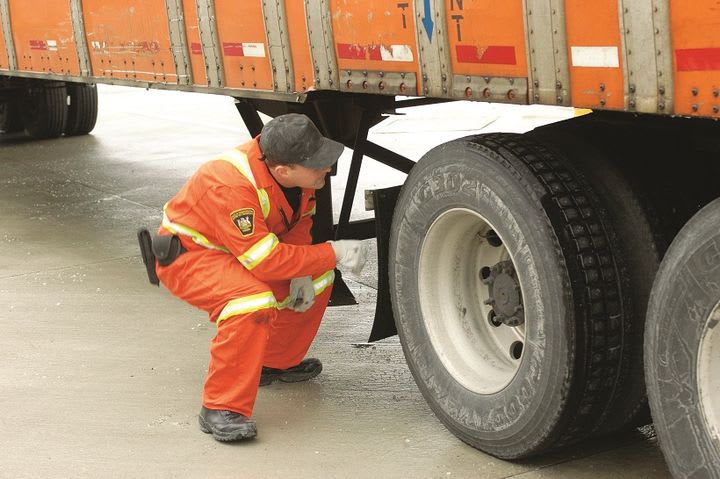
Wheel end (tire and wheel) violations accounted for 22.8% of all out-of-service vehicle violations throughout North America.
Photo: Jim Park
Over the three days of the Commercial Vehicle Safety Alliance’s (CVSA) International Roadcheck commercial motor vehicle inspection and enforcement initiative, inspectors conducted 59,026 inspections and placed 12,456 commercial motor vehicles and 3,714 commercial motor vehicle drivers out of service.
Each year, CVSA highlights a certain aspect of the roadside inspection. This year, the focus was on wheel ends. Wheel end (tire and wheel) violations accounted for 22.8% of all out-of-service vehicle violations throughout North America.
Out of the top 10 vehicle out-of-service violations, tires ranked second and wheels came in seventh. Of the 18,213 total vehicle out-of-service violations, there were 3,374 tire out-of-service violations, accounting for 18.5% of all vehicle out-of-service violations, and there were 784 wheel out-of-service violations, which is 4.3% of all vehicle out-of-service violations.
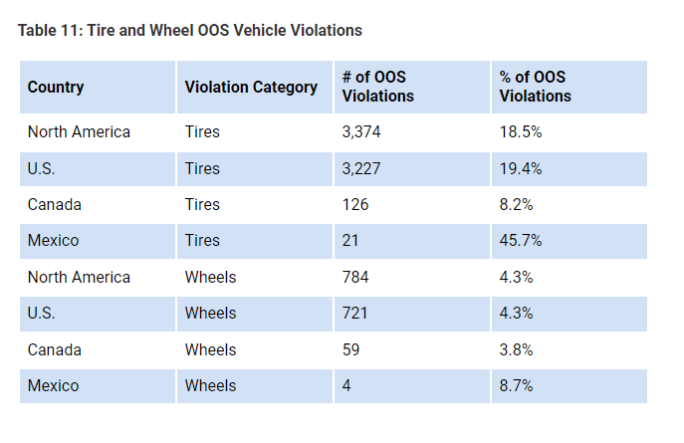
Table: CVSA
A commercial motor vehicle is placed out of service when an inspector finds critical vehicle inspection item out-of-service violations, which are outlined in CVSA’s North American Standard Out-of-Service Criteria, during a roadside inspection. Being placed out of service means the driver or vehicle is prohibited from operation for a specified period of time or until the violation is corrected.
This year, inspectors in Canada and the U.S. conducted 36,555 Level I Inspections and inspectors in Mexico conducted 1,150 Level V Inspections, for a combined total of 37,705 Level I and V Inspections. They placed 8,718 vehicles out of service, which is a 23.1% vehicle out-of-service rate for North America.
Out of the 48,966 Level I and II Inspections conducted in Canada and the U.S., 11,181 vehicles were placed out of service, which is a 22.8% vehicle out-of-service rate, and 3,118 drivers were placed out of service, which is a 6.4% driver out-of-service rate.
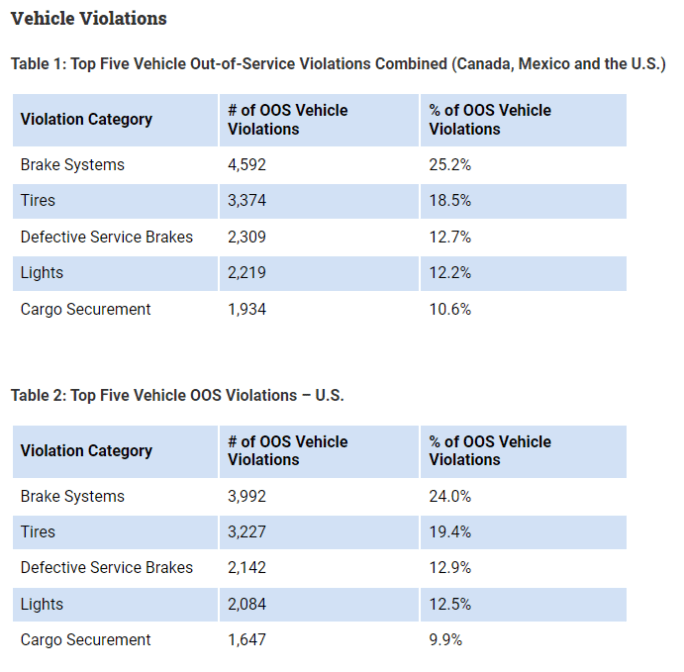
Table: CVSA
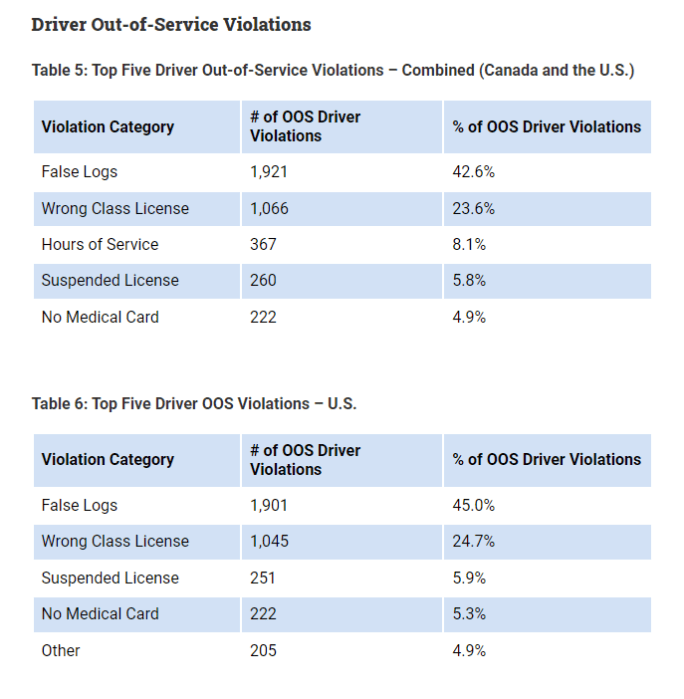
Table: CVSA
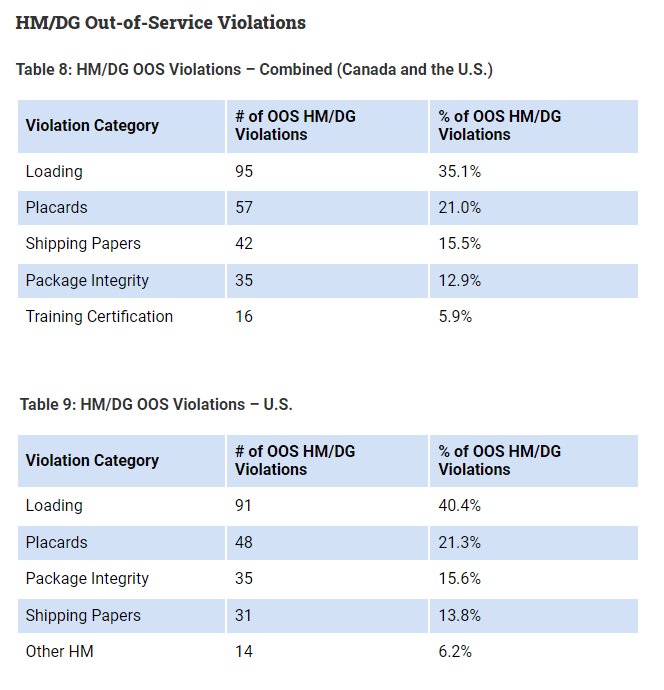
Table: CVSA
That also means that 77.2% of the vehicles and 93.6% of the drivers inspected did not have out-of-service violations.
Vehicles that do not have any critical vehicle inspection item violations, after a Level I or V Inspection, are eligible to receive a CVSA decal. The CVSA decal, valid for up to three consecutive months after inspection, is a visual indicator that signals to inspectors that the vehicle has “passed inspection.” Inspectors distributed 14,200 CVSA decals, which were placed on 10,135 power units, 3,876 trailers and 189 motorcoaches.
All Inspection Levels
On May 17-19, inspectors conducted a total of 58,287 North American Standard Inspections, which consisted of:
36,555 Level I Inspections – This 37-step process checks the driver’s operating credentials and requirements and the vehicle’s mechanical fitness and regulatory compliance.
12,411 Level II Inspections – This inspection involves reviewing the driver’s operating credentials and requirements and includes only vehicle inspection items that can be inspected without the inspector physically getting under the vehicle.
8,171 Level III Inspections – This is the driver credentials and operating requirements inspection.
1,150 Level V Inspections – This inspection involves vehicle inspection items and may be conducted without a driver present, at any location.
Level I Inspections
During International Roadcheck, inspectors in Canada and the U.S. primarily conduct the Level I Inspection, which is a comprehensive 37-step inspection process that involves thorough inspection of the vehicle (including underneath the vehicle) and the driver’s operating credentials.
Of the 36,555 Level I Inspections conducted in Canada and the U.S., 23.7% of the vehicles inspected (8,672) were placed out of service and 6.1% (2,242) of drivers were placed out of service.
In the U.S., of the 33,196 Level I Inspections were conducted, 7,912 commercial motor vehicles (23.8%) and 2,051 drivers (6.2%) were placed out of service.
In Canada, of the 3,359 Level I Inspections were conducted, 760 commercial motor vehicles (22.6%) and 191 (5.7%) drivers were placed out of service
More Equipment

How Volvo Updated Its D13 for EPA 2027 [Watch]
Volvo’s updated D13 promises lower emissions without sacrificing performance or fuel economy. Take a closer look at what changed inside the engine in this HDT Spotlight video.
Read More →
Michelin Tire Improves Efficiency and Durability for Regional Fleets
The Michelin X Multi Energy D2 is a regional haul drive tire engineered to help fleets improve fuel efficiency, durability and traction in demanding stop-and-go operations.
Read More →
ZF Expands Commercial Vehicle Push in North America
ZF is expanding its North American commercial-vehicle presence with new transmission applications, electrification, trailer technology and autonomous-driving systems.
Read More →
Tesla Wants a Self-Driving Semi. Are Cameras Enough?
Could Tesla’s camera-only autonomous driving technology work on an 80,000-pound Semi? In this commentary, HDT's Deborah Lockridge takes a look at Tesla, Cybercab, and how autonomous trucks see the road.
Read More →
Kodiak: Driverless Long-Haul Truck Launch on Track for 2026
Kodiak AI says its driverless long-haul safety case is 93% complete and it remains on track to begin commercial operations by year-end 2026.
Read More →
What DOT’s Automated Vehicle Strategy Means for Trucking
The U.S. Department of Transportation issued a new automated-vehicle strategy that outlines plans for driverless-truck regulations, cross-state freight corridors, and federal safety standards.
Read More →
East Coast Port Launches $45M Electric Truck Push
The Port Authority of New York and New Jersey announced millions in incentives for zero-emission drayage trucks, yard tractors, and new charging hubs near the port.
Read More →
PlusAI Going Public to Fund Autonomous Truck Launch
A SPAC deal could provide PlusAI with up to $300 million as it works toward a 2027 commercial launch of factory-built autonomous trucks.
Read More →
NHTSA Moves to Rewrite Truck Fuel-Economy Rules
The National Highway Traffic Safety Administration says it lacks authority to regulate medium- and heavy-duty truck engines separately from complete vehicles, but the existing standards have not yet been eliminated.
Read More →
Detroit Opens Orders for EPA 2027 Engines
Detroit isn’t starting from scratch to meet EPA 2027 diesel emissions standards. Its Gen 6 DD13 and DD15 engines keep much of today’s platform while updating the fuel and aftertreatment systems.
Read More →