




CVSA Calls for Repeal of Hours of Service Exemptions
The Commercial Vehicle Safety Alliance is calling for the repeal of agricultural and utility industry exemptions to hours of service exemptions, following the results of a study of truck crash and out of service rate
The Commercial Vehicle Safety Alliance is calling for the repeal of agricultural and utility industry exemptions to hours of service exemptions, following the results of a study of truck crash and out of service rates
by the U.S. Department of Transportation's Volpe National Transportation Systems Center.
Agricultural carriers operating exclusively within a 100-mile radius had a 19 percent higher crash rate than agricultural carriers operating outside a 100-mile radius during the period of 2005-2007. The study also saw utility service motor carrier crash rates jump by 40 percent during this same period.
"Since driver related factors are such a large contributor to crashes, it stands to reason that the hours-of-service exemptions provided in the last Highway Act (SAFETEA-LU) are largely responsible for the increased rates," said CVSA Executive Director Stephen Campbell, who called the Volpe study a compelling reason to repeal the hours-of-service exemptions created in 2005.
"Safety is clearly compromised by these exemptions and they should be repealed in the upcoming Transportation Reauthorization Act," he said.
SAFETEA-LU exempted agricultural carriers from the hours-of-service regulations if they operated only within a 100-mile radius from their central base of operation. It also exempted utility service vehicle drivers from all hours-of-service regulations.
The study also showed that in 2007 agricultural carriers as a whole had higher violation and out-of-service rates than the rest of the trucking industry in the categories of unsafe driver, driver fitness, vehicle maintenance, and improper loading. The overall average increase was 32 percent. Agricultural carriers operating solely within a 100-mile radius had higher violations and out-of-service rates than those operating outside of a 100-mile radius in the categories of unsafe driving, driver fitness, vehicle maintenance, and improper loading. The overall average increase in this case was 24 percent.
In addition to repealing these exemptions based on the data in the Volpe study, CVSA is proposing that all motor carrier safety exemptions, whether provided in statue or by regulation, should be sunsetted on a date certain in the future with the requirement that they be re-applied for following the process specifically outlined in Section 31315 of the U. S. Code, Title 49. Section 31315 requires that in order for a safety exemption to be granted, the group seeking such an exemption must demonstrate to the Secretary of Transportation that "such exemption would likely achieve a level of safety that is equivalent to, or greater than, the level that would be achieved absent such exemption." This effort would also require FMCSA to review their 1988 tolerance guidelines on intrastate exemptions and withdraw those no longer justified.
"If an exemption is not justified based on performance data, or pursued in a uniform and systematic manner, it not only compromises safety it also violates the basic principle of uniformity which CVSA advocates," said Campbell. "This lack of uniformity creates confusion among roadside officers which leads to less than optimal oversight and enforcement."
CVSA is an international not-for-profit organization comprised of local, state, provincial, territorial and federal motor carrier safety officials and industry representatives from the United States, Canada and Mexico.
More Safety & Compliance
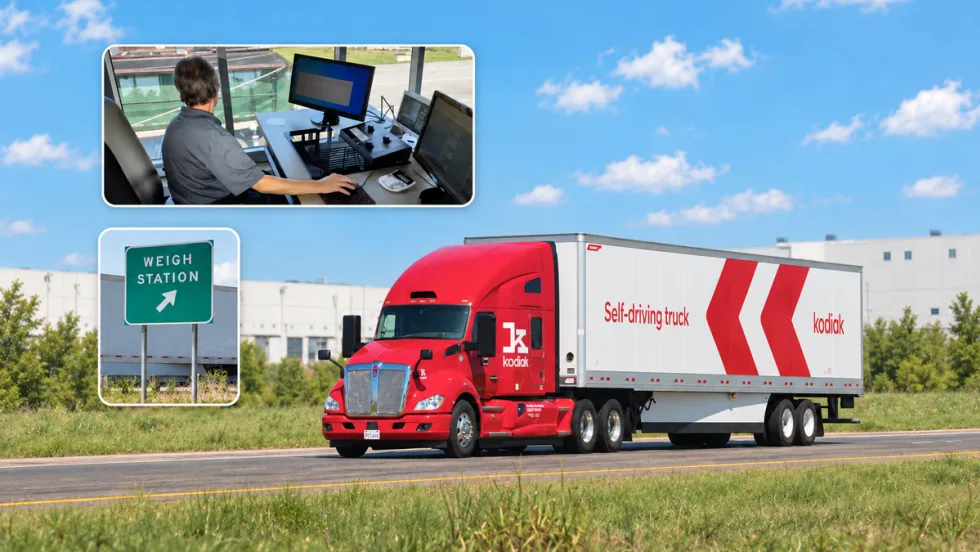
PrePass, Kodiak Connect Driverless Trucks to Roadside Enforcement
The system will allow enforcement agencies to verify Enhanced Inspection information and decide whether Kodiak’s autonomous trucks can bypass roadside screening sites.
Read More →
From One Generation to the Next: How Mentorship Builds Safer Truck Drivers
After three decades in trucking, Harold Perry shares what he's learned about driver safety, mentorship, and helping the next generation build confidence behind the wheel.
Read More →
FMCSA Pauses Biennial-Update Enforcement Amid Motus Transition
Carriers whose updates were due on or after June 1 have more time, while FMCSA works to stabilize its new registration system and warns of phishing sites impersonating its new carrier registration system, Motus.
Read More →
ZF Expands Commercial Vehicle Push in North America
ZF is expanding its North American commercial-vehicle presence with new transmission applications, electrification, trailer technology and autonomous-driving systems.
Read More →
Truck Drivers Need More Than Another Alert
Fleets have more visibility into truck health, safety events, and driver activity than ever. The next challenge is turning all that information into useful guidance for the person who has to decide what to do next.
Read More →
Tesla Wants a Self-Driving Semi. Are Cameras Enough?
Could Tesla’s camera-only autonomous driving technology work on an 80,000-pound Semi? In this commentary, HDT's Deborah Lockridge takes a look at Tesla, Cybercab, and how autonomous trucks see the road.
Read More →
What DOT’s Automated Vehicle Strategy Means for Trucking
The U.S. Department of Transportation issued a new automated-vehicle strategy that outlines plans for driverless-truck regulations, cross-state freight corridors, and federal safety standards.
Read More →
NYC Expands Speed, Pedestrian Safety Tech Across Fleet
New York City is expanding intelligent speed assistance and pedestrian-alert systems across its municipal fleet, moving the technologies from pilot programs into vehicle procurement and retrofit requirements.
Read More →
FMCSA Removes 110 Truck Driver Training Schools from Certified ELDT List
Federal regulators also are targeting more than 160 additional training providers and launching a nationwide audit of third-party CDL skills testers as part of a broader crackdown on trucking fraud.
Read More →
Beyond DOT Compliance: What Makes a Trucking Fleet Truly Safe?
A trucking fleet can follow every rule and still make unsafe decisions. The real test comes when safety conflicts with freight, productivity, or cost.
Read More →