





Related: Cummins Acquires Electric and Hybrid Powertrain Provider
Cummins PowerDrive Powertrain Turned a T370 Into a Hybrid
Cummins unveiled its PowerDrive suite of plug-in hybrid electric solutions on a functional Kenworth T370 utility truck at the IAA Commercial Vehicles Show in Hannover, Germany.
September 19, 2018
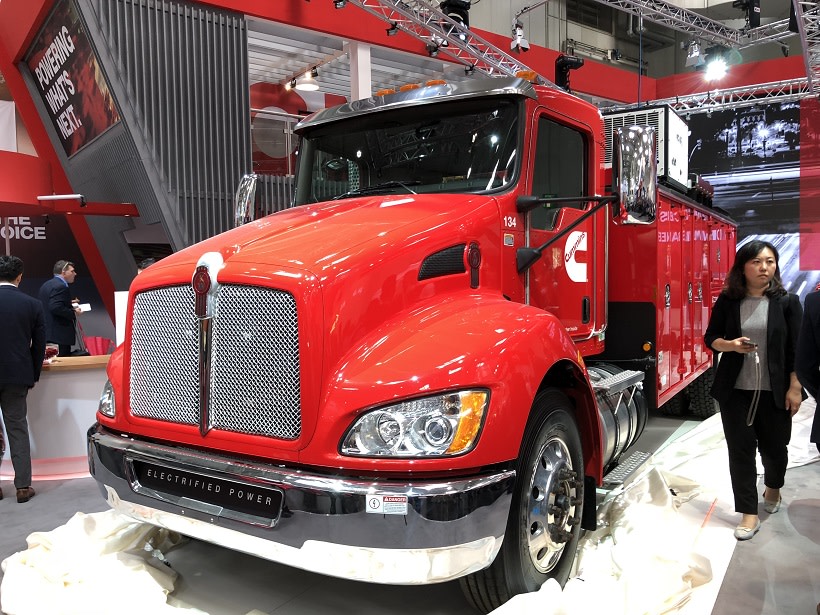
Cummins showed off a Kenworth T370 with its PowerDrive hybrid powertrain.
Photo: Jack Roberts
2 min to read
Cummins unveiled its PowerDrive suite of plug-in hybrid electric solutions on a functional Kenworth T370 utility truck at the IAA Commercial Vehicles Show in Hannover, Germany.
PowerDrive replaces the conventional transmission and switches in real time between two hybrid and pure electric modes, optimizing the powertrain for the best fuel economy in any situation. The hybrid utility truck featured a recovery crane that could operate off of either engine power take-off or electric power. The vehicle is also configured with exportable grid quality electric power to recharge other vehicles.
The PowerDrive hybrid system is designed for light, medium, and heavy-duty applications and it can be paired with various sizes of diesel or natural gas engines and battery pack outputs. So far, vehicles using the system have travelled over 6 million miles in a fleet setting in the U.S. and China. Work is underway to introduce it to the European market in the near future.
The flexible hybrid architecture shifts between pure electric with a 50-mile range and hybrid for jobs requiring more than 300 miles of range. It operates as a hybrid in either series or parallel configuration modes. Series is better suited to low speeds and urban driving while parallel is ideal for higher road speeds on the highway.
In a series hybrid, the electric motor is the only means of providing power to the wheels. The motor receives electric power from either the battery pack or from the engine generator. In a parallel hybrid, the engine and electric motor combine to provide the power that drives the wheels. The third mode of electric plus comes online when higher energy is required when the system senses gradient climbing or acceleration for overtaking.
The Kenworth T370 with PowerDrive 6000 is paired with a Cummins B6.7 engine. The service vehicle was commissioned by Cummins to support EV and PHEV vehicle field tests and pilot routes. It features three vehicle charging stations with direct charging cables from the truck to the PHEV or EV vehicle requiring charging. A Class 6 truck powered by PowerDrive can realize reduced emissions of up to 80%, according to Cummins, and can also reduce fuel costs.
“The Cummins PowerDrive is intelligent, versatile and compact, providing our on-highway customers the flexibility needed to meet the demands of their diverse jobs and markets,” said Julie Furber, Cummins executive director of electrified power. “Cummins is ready to offer the new PowerDrive suite through our OEM partners. We look forward to discussing how the PowerDrive’s compact packaging envelope and weight saving benefits will enable OEMs to produce PHEV (plug-in hybrid electric vehicles) vehicles for diverse needs without compromising performance or range.”
More Fuel Smarts

How Volvo Updated Its D13 for EPA 2027 [Watch]
Volvo’s updated D13 promises lower emissions without sacrificing performance or fuel economy. Take a closer look at what changed inside the engine in this HDT Spotlight video.
Read More →
Diesel Price Spike Shortens Payback for Natural Gas Trucks, Report Says
Energy Vision estimates fleets could recover the higher purchase price of an RNG-fueled Class 8 tractor in 1.3 to 2.8 years under current fuel-price scenarios.
Read More →
Calstart Becomes Catalyst Mobility, Reflecting Broader Focus
Calstart is now Catalyst Mobility, reflecting the nonprofit’s growing national role in clean transportation, including zero-emission trucks, infrastructure and incentive programs.
Read More →

Record Diesel Prices Squeeze Trucking Fleets
Average U.S. diesel prices have climbed to nearly $6 a gallon, surpassing the 2022 record as tight refinery capacity and Middle East disruptions keep fuel costs elevated.
Read More →
Sponsored•September 9, 2026
How Fuel Delivery Shapes Engine Performance
Fuel delivery depends on more than what happens at the injector. For fleet, maintenance and technical professionals, looking at the full path from pump to injector can provide useful context for understanding engine performance.
Read More →
East Coast Port Launches $45M Electric Truck Push
The Port Authority of New York and New Jersey announced millions in incentives for zero-emission drayage trucks, yard tractors, and new charging hubs near the port.
Read More →
California Bill Could Shed Light on Electric Truck Prices
Why do battery-electric Class 8 trucks remain so expensive? A California bill headed to Gov. Gavin Newsom would give fleets and state agencies more visibility into what manufacturers charge.
Read More →
Detroit Opens Orders for EPA 2027 Engines
Detroit isn’t starting from scratch to meet EPA 2027 diesel emissions standards. Its Gen 6 DD13 and DD15 engines keep much of today’s platform while updating the fuel and aftertreatment systems.
Read More →
Zero-Emission Truck Corridor Planned for West Coast
California, Oregon, Washington, British Columbia and Baja California are coordinating plans for truck charging and hydrogen fueling from Canada to Mexico.
Read More →
A Closer Look at Kenworth’s Electric T880E Vocational Truck [Video]
Learn more about Kenworth's T880E battery-electric vocational truck at the Paccar Technical Center, including its range, applications, upfitting considerations, and PTO options, in this HDT Spotlight video.
Read More →