





Related - Q&A: Convoy on a Better Way to Connect Truckers and Shippers
Convoy Says Freight Marketplace Now Matching 100% of Loads Automatically
Load-matching technology provider Convoy said it has reached a major milestone: The company reports that its freight marketplace is automatically matching — without human intervention — 100% of loads to trucks in top markets.
February 5, 2019
Load-matching technology provider Convoy said it has reached a major milestone: The company reports that its freight marketplace is automatically matching — without human intervention — 100% of loads to trucks in top markets.
Image via Convoy
3 min to read
Load-matching technology provider Convoy said it has reached a major milestone: The company reports that its freight marketplace is automatically matching — without human intervention — 100% of loads to trucks in top markets.
According to Convoy, this includes routes from major West Coast markets such as Seattle, Portland, and Los Angeles; Midwest routes from Chicago, Cincinnati, and Milwaukee; routes from Texas markets such as Houston, Dallas, and San Antonio; Northeast routes from New York and Philadelphia; and Southeast routes from Atlanta and others.
Nationwide, Convoy said it is now automatically matching 95% of loads to trucks, with that number climbing as new markets increasingly adopt its technology.
Convoy measures booking loads with carriers in two parts: First, by finding a truck that is available and can arrive on time (matching), and secondly by agreeing on the rate at which that work will happen (pricing). The company said it has been tracking its level of automation for both of these metrics as indicators of its progress since the company’s founding.
For matching, the company says it has largely eliminated the call-intensive model for finding the right truck across Convoy’s national network. For pricing, the majority of loads are now also being handled without any human interaction. By reducing waste in the matching process, Convoy says, it can pass along these savings by reducing costs for shippers, improving earnings for carriers, and investing in new innovations.
Convoy said according to studies, labor expenses account for about 65% of a typical broker’s expenses. In the traditional brokerage model, Convoy says, a brokerage representative makes roughly 100 calls in order to book 10 loads. Finding the right truck is one of the most time-consuming tasks for brokers.
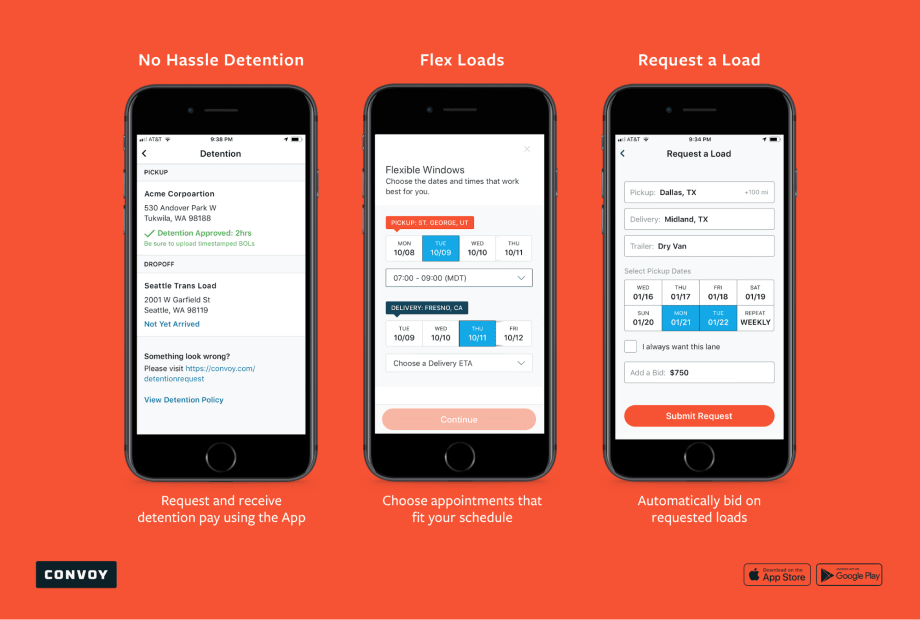
Convoy said it has made this labor-intensive system obsolete thanks to increased app use and new features that empower carriers, such as No Hassle Detention, Flex Loads, and Instant Bidding.
At the same time, Convoy said it has been gathering better data on driver preference and behavior, which its system uses to “learn” from. As a result, the company said, with each load, the system gets better at recommending the next load. A new feature, called Request a Load, boosts this performance metric by allowing carriers to directly share preferences and get them the loads they want with less effort.
The result, Convoy said, is a system that is now working without the cost structure and operating model of a traditional brokerage. For shippers, Convoy said, this means its automated matching and pricing system covers loads faster than ever. As a result, the company said it is now consistently seeing freight being matched within minutes of being offered, which it said translates to higher service levels for both shippers and carriers.
More Fleet Management

Sponsored•September 16, 2026
Color Match Smarter: Tools That Restore & Perform
For fleet managers and collision repair professionals keeping heavy-duty trucks on the road, getting the color right the first time isn't just about appearance — it's about efficiency, turnaround time, and bottom-line results. Discover how today's digital color tools are transforming the repair process from guesswork to precision.
Read More →
FMCSA Pauses Biennial-Update Enforcement Amid Motus Transition
Carriers whose updates were due on or after June 1 have more time, while FMCSA works to stabilize its new registration system and warns of phishing sites impersonating its new carrier registration system, Motus.
Read More →
Sponsored•September 14, 2026
2026 Blueprint for Countering Smarter Supply Chain Theft
Cargo theft is no longer just the cost of doing business. It's a multi-billion-dollar criminal enterprise exploiting vulnerabilities across your fleet, drivers, and supply chain.
Read More →


Sponsored•September 1, 2026
How Telematics Improves Visibility, Control, and Performance in Refrigerated Fleets
Explore how telematics help refrigerated fleets improve visibility, uptime, efficiency, compliance, and cargo protection across connected cold chain operations.
Read More →
What the U.S.-Canada Trade War Means for Trucking
Escalating U.S.-Canada tariffs could disrupt cross-border freight, reduce truck volumes, raise costs, and create new uncertainty for carriers on both sides of the border.
Read More →
What Are Trucking’s Top Concerns for 2026?
The American Transportation Research Institute wants to know what's worrying trucking fleet managers, drivers, and other stakeholders in its annual Industry Issues survey.
Read More →
American Trucking Associations Looks for a New Leader
ATA President and CEO Chris Spear abruptly left his job at the association on August 21, at a pivotal time for the trucking industry.
Read More →
Public Wi-Fi Cybersecurity Risks: How Truck Drivers and Fleets Can Protect Their Data
Public Wi-Fi can expose truck drivers and fleets to credential theft, malware, and other cyber threats. Here’s how to reduce the risk on the road.
Read More →
For Nicky Cupp, Fleet Innovation Starts With Frustration
HDT Truck Fleet Innovator Nicky Cupp turns everyday pain points at Fraley & Schilling into opportunities for better technology and smarter processes.
Read More →
Adam Buttgenbach’s Approach to Electric Trucks: Start With Where They Fit
HDT Truck Fleet Innovator Adam Buttgenbach helped PepsiCo build one of North America’s largest EV fleets by focusing on where electric trucks make operational sense.
Read More →