





Related: Continental Shows its Vision of Future Driving at CES
Continental Unveils Predictive Driving Technology
Continental's technology division unveiled three new advanced vehicle control and interface systems at the NACV Show in Atlanta.
November 8, 2019
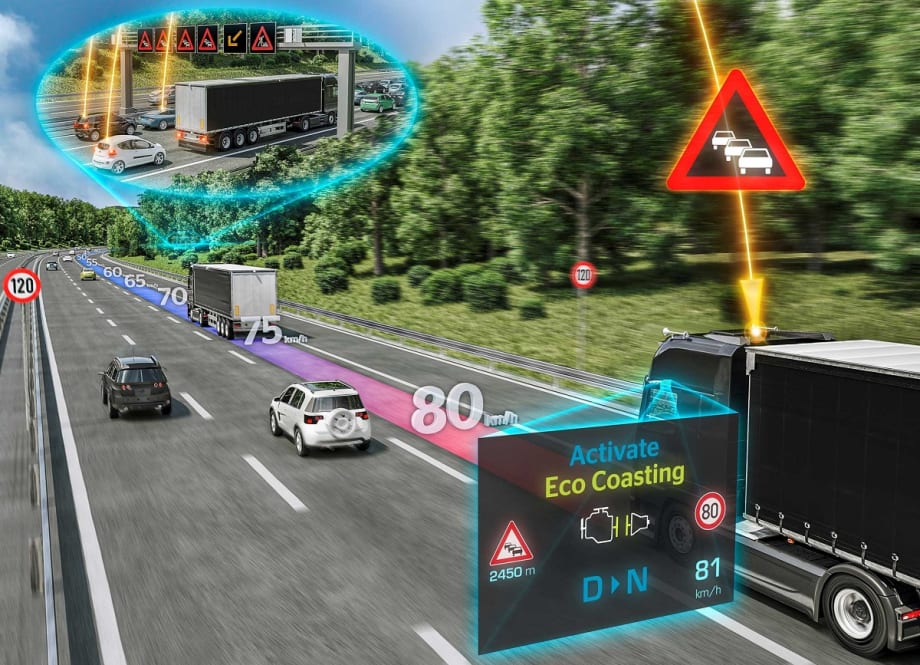
Continental’s static eHorizon uses detailed topographic route data and a GPS signal to send information on the road ahead to control units in the vehicle.
Image: Continental
5 min to read
You probably know Continental as a tire company. But, in truth, the company is an automotive technology innovator and considers itself a tech company with a tire manufacturing division today. And lately, Continental has been working to establish itself as a leader when it comes to emerging autonomous vehicle technologies.
At the North American Commercial Vehicle Show in Atlanta, Continental announced an expansion of its eHorizon predictive driving technology with its new Dynamic eHorizon. This latest generation of the electronic horizon optimizes the performance and safety in commercial vehicle applications based on real-time data related to traffic conditions, the company said. As a result, drivers will be able to save fuel even in slow-moving traffic – by up to two percent compared with the previous model, the static eHorizon, as shown by comprehensive simulations and tests.
Continental’s static eHorizon already uses detailed topographic route data and a GPS signal to send information on the road ahead to control units in the vehicle. The control units then automatically adjust the vehicle’s driving style and speed. Trucks with Continental’s static eHorizon were able to save an estimated 1.5 billion liters of diesel, the equivalent of nearly two billion euros, since 2012. This totals to more than 4 million metric tons of CO2.
The dynamic eHorizon now provides even more data on the traffic situation thanks to real-time information such as road conditions, traffic restrictions, and traffic flow. The enhanced system, therefore, enables additional potential savings to be made and provides more safety, as the driving behavior can be modified to suit the current traffic situation at the right time. In the future, other data sets such as live events, weather, accidents, and construction activities can potentially be included.
In addition to making driving safer and more efficient by letting the driver see what is further up the road or around the next corner, eHorizon forms a basis for several new applications, from a connected powertrain through to automated driving.
Continental is also working to modernize the driver-vehicle interface to enhance safety and efficiency. Continental Commercial Vehicles & Aftermarket (CVAM), a business unit of Continental, showcased its MultiViu Professional instrument cluster-style displays for a wide range of truck dashboard and cockpit design applications.
The company called this a state-of-the-art, multi-purpose information display, which it said offers commercial vehicle designers and manufacturers maximum design freedom for creative and functional instrumentation options, including animation and video implementation.
The MultiViu Professional is fully programmable and easily adapts to individual customer requirements. It features a modular structure that can fit seamlessly into any front frame. This innovative cluster can take the appearance of traditional analog gauges or show animated text, scales, bar charts, diagnostic videos, and tell-tale symbols. It features a high-contrast, true-color, TFT display with resolution and an 8:3 format that can display 2D/2.5D graphics, now in screen sizes up to 12.3 in. and 15.6 in. These graphics are developed using model-based programming software that allows designers to create a completely unique look and feel for the display, according to Continental.
Programming and control of graphics, texts, and animations are managed by CGI Studio, while functional programming and control of the instrument and Human Machine Interface is achieved via KIBES 32. The unit’s software is based on OSEK and Linux operating systems. Several interfaces are available, including high-speed CAN, video, LIN, I/Os, Audio, and Ethernet.
In addition to displaying instrument panels and animations, the MultiViu Professional can be used to display a video feed, which can be accessed automatically or on-demand. It provides four capacitive buttons below the screen for fixed functions such as reset and illumination. An optional telltale module places 11 tell-tales at the top of the display.
Continental said its instruments and display feature crisp, easy to read graphics, offering premium image quality and a wide range of user-customizable options. They are scalable, robust, and quality certified. These attributes, combined with powerful hardware and performance software, provide the necessary capability and flexibility to meet the requirements for every type of vehicle and task.
The company also announced at NACV that it has developed and is shipping samples of its new and advanced automotive-grade solid-state LIDAR to the Commercial Vehicle Market.
According to Continental, the HFL110 3D Flash Lidar enhances the company’s existing ADAS sensor suite or radar and 2D color sensors for automated driving, noting that the ability to create a precision 3D profile of a vehicle’s surroundings is a fundamental prerequisite for automated and safe driving. To meet these goals, Continental said, the HFL110 sensor delivers a detailed and accurate 3-dimensional profile in 330 nanoseconds per frame, regardless of time-of-day or weather conditions.
The new 3D Flash Lidar HFL110 sensor operates at a close range (50m or less). Continental; engineers designed it to be immune to vibration or speed distortion, the company said, while its sensor generates a high-resolution 3D point cloud 25 times per second within its 120-degree field of view. The system can handle either dense urban or highway environments, and its multiple precise distance measurements capture 4,096 contiguous pixels of depth data in real-time across the field of view, enabling and assisting with challenging maneuvers, safely.
Additionally, Continental said, the contiguous HFL110 pixels tolerate nearby high or low reflectivity surfaces, producing a point cloud and/or an object list to define and track the vehicle’s surroundings and moving objects within it. Enhanced by an integrated heater and an optional automatic washer system, it can be combined with Continental’s radars and 2D cameras for a power sensor suite to assure a high degree of reliability in a wide range of weather conditions.
More Fleet Management

Sponsored•September 16, 2026
Color Match Smarter: Tools That Restore & Perform
For fleet managers and collision repair professionals keeping heavy-duty trucks on the road, getting the color right the first time isn't just about appearance — it's about efficiency, turnaround time, and bottom-line results. Discover how today's digital color tools are transforming the repair process from guesswork to precision.
Read More →
FMCSA Pauses Biennial-Update Enforcement Amid Motus Transition
Carriers whose updates were due on or after June 1 have more time, while FMCSA works to stabilize its new registration system and warns of phishing sites impersonating its new carrier registration system, Motus.
Read More →
Sponsored•September 14, 2026
2026 Blueprint for Countering Smarter Supply Chain Theft
Cargo theft is no longer just the cost of doing business. It's a multi-billion-dollar criminal enterprise exploiting vulnerabilities across your fleet, drivers, and supply chain.
Read More →


Sponsored•September 1, 2026
How Telematics Improves Visibility, Control, and Performance in Refrigerated Fleets
Explore how telematics help refrigerated fleets improve visibility, uptime, efficiency, compliance, and cargo protection across connected cold chain operations.
Read More →
What the U.S.-Canada Trade War Means for Trucking
Escalating U.S.-Canada tariffs could disrupt cross-border freight, reduce truck volumes, raise costs, and create new uncertainty for carriers on both sides of the border.
Read More →
What Are Trucking’s Top Concerns for 2026?
The American Transportation Research Institute wants to know what's worrying trucking fleet managers, drivers, and other stakeholders in its annual Industry Issues survey.
Read More →
American Trucking Associations Looks for a New Leader
ATA President and CEO Chris Spear abruptly left his job at the association on August 21, at a pivotal time for the trucking industry.
Read More →
Public Wi-Fi Cybersecurity Risks: How Truck Drivers and Fleets Can Protect Their Data
Public Wi-Fi can expose truck drivers and fleets to credential theft, malware, and other cyber threats. Here’s how to reduce the risk on the road.
Read More →
For Nicky Cupp, Fleet Innovation Starts With Frustration
HDT Truck Fleet Innovator Nicky Cupp turns everyday pain points at Fraley & Schilling into opportunities for better technology and smarter processes.
Read More →
Adam Buttgenbach’s Approach to Electric Trucks: Start With Where They Fit
HDT Truck Fleet Innovator Adam Buttgenbach helped PepsiCo build one of North America’s largest EV fleets by focusing on where electric trucks make operational sense.
Read More →