





Related: Continental Showcases Advanced Technology Ahead of IAA Show
Continental Shows Future Technology Vision at CES
Dog-like robots could one day be delivering packages from driverless vans, as demonstrated in a vision of the future presented by Continental at the CES electronics show in Las Vegas.
January 10, 2019
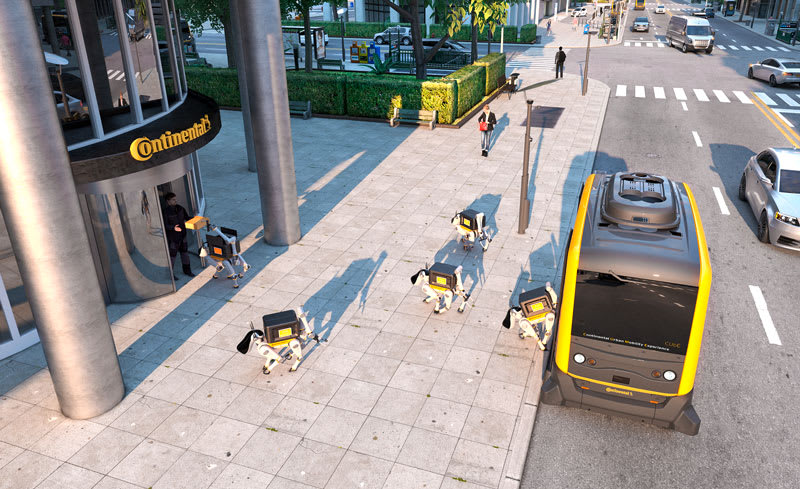
Continental is showing attendees at the Consumer Electronics Show in Las Vegas how a driverless vehicle could be used to stage and deploy delivery robots, taking packages all the way to the consumer – even when they’re not able to physically receive them.
Photo courtesy Continental
4 min to read
Dog-like robots could one day be delivering packages from driverless vans, as demonstrated in a vision of the future presented by Continental at the CES electronics show in Las Vegas.
Anyone doubting the rush of technology coming head-on at the trucking industry need look no farther than CES. Once known as the Consumer Electronics Show, a bastion of geeks and gamers, the renamed show now features a lot of business and transportation technology as well.
Continental is Germany’s largest manufacturer of tires for passenger cars and commercial vehicles. But the company has always asserted that it began as a technology company more than a century ago, when pneumatic tires were cutting-edge automotive science. Today, in the midst of a global technology rush similar to the one that swept Europe and North American a century ago, the company has rededicated itself to researching and developing new automotive technology. As such, it’s not surprising to see Continental demonstrating seamless goods-delivery systems that leverage both delivery robots and driverless vehicles.
At CES, Continental is showing attendees how a driverless vehicle could be used to stage and deploy delivery robots, taking packages all the way to the consumer – even when they’re not able to physically receive them. Many of these systems were previewed to HDT and other select North American transportation journalists last summer ahead of the IAA Commercial Vehicle Show in Hannover, Germany, last fall.
According to Continental, the seamless integration of a driverless vehicle – in this case, the Continental Urban Mobility Experience (CUbE) – and a delivery robot offers a more effective and efficient distribution of goods. Driverless vehicles such as the CUbE, Continental’s autonomous electrified development platform, are generally considered a solution for urban “first or last mile” mobility. This type of vehicle – often referred to as a robo-taxi or pod – will be a part of the seamless mobility value chain. But these vehicles can go beyond automated taxis and be used for goods delivery to make the most of available transport capacity and reduce idle times. Continental says market estimates show the need to transport goods will even outpace the strongly growing need for people transport in densely populated areas.
“With the help of robot delivery, Continental’s vision for seamless mobility can extend right to your doorstep,” said Ralph Lauxmann, head of Systems & Technology, Chassis & Safety division, Continental. “Our vision of cascaded robot delivery leverages a driverless vehicle to carry delivery robots, creating an efficient transport team. Both are electrified, both are autonomous and, in principle, both can be based on the same scalable technology portfolio.”
Automated Vehicles a Last-Mile Enabler
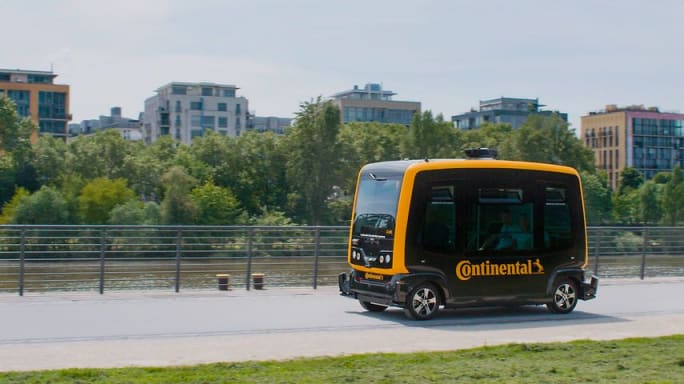
At the Consumer Electronics Show in Las Vegas, Continental said electric, autonomous delivery vans will be key enablers for the fast-evolving last mile delivery transporation segment.
Photo: Continental
In making the case that goods and parcel delivery to residential areas is a growing and dynamic market, Continental developers point out that e-commerce sales are increasing every year. With the growth of this segment, delivery cost per hour is gaining importance. This, the company says, positions last mile and delivery services as a differentiator for fleets in business today and in the near future. Automated goods delivery is forecasted to provide an answer for up to 80% of all business-to-consumer deliveries, according to multiple research sources, says the company.
Continental views automated goods delivery as an integral part of future urban mobility – as an addition to conventional goods delivery. Driverless vehicles like the CUbE can carry one or multiple delivery robots and deploy them to handle the last yards of the goods and parcel delivery logistics chain.
“Industrializing the automation of goods delivery requires reliable, robust, high-performing and best-cost technology – a mix perfectly reflected in the automotive equivalent of automation,” Lauxmann said.
With existing delivery robots serving as a development platform, Continental says it is ready to transfer and scale automotive technology to meet robot manufacturers’ requirements. “The challenges to a delivery robot parallel what we already solve for in automated vehicles,” said Jeremy McClain, director of Systems & Technology, Continental North America. “Plus, delivery robots will require technology that is just as advanced and robust as our automotive solutions.”
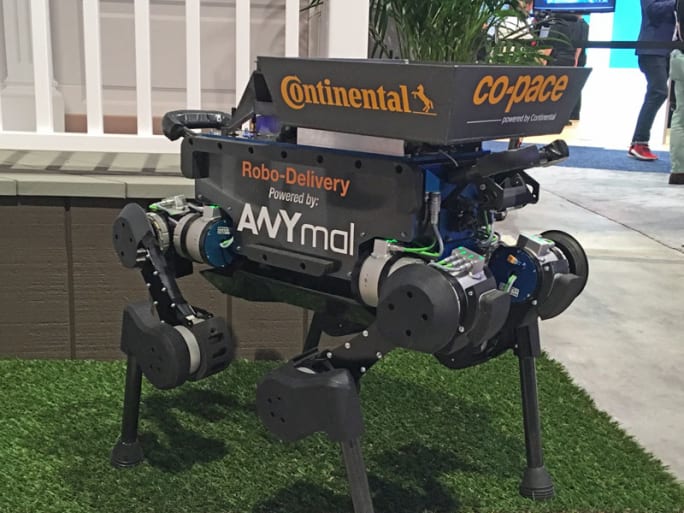
A closer look at the package-delivering robot dogs Continenal showcased at CES 2019.
Photo by Jim Park
Seamless Mobility for Smart Cities
Continental also notes that autonomous vehicles will represent a very important element in the Smart Cities of the future. They are considered by many experts as a key element of future mobility concepts to solve the challenges of urbanization. A driverless vehicle can be in use almost 24/7.
“There will be peaks in demand for driverless vehicles during the day. To make use of driverless vehicles outside those peak rush hours is where robot-delivery comes in,” said McClain.
Since many deliveries are made during the day, when many people are working, at school or otherwise occupied, the robo-taxi’s off-peak hours could be perfectly utilized for such delivery trips when combined with delivery robots.
More Fleet Management

Sponsored•September 16, 2026
Color Match Smarter: Tools That Restore & Perform
For fleet managers and collision repair professionals keeping heavy-duty trucks on the road, getting the color right the first time isn't just about appearance — it's about efficiency, turnaround time, and bottom-line results. Discover how today's digital color tools are transforming the repair process from guesswork to precision.
Read More →
FMCSA Pauses Biennial-Update Enforcement Amid Motus Transition
Carriers whose updates were due on or after June 1 have more time, while FMCSA works to stabilize its new registration system and warns of phishing sites impersonating its new carrier registration system, Motus.
Read More →
Sponsored•September 14, 2026
2026 Blueprint for Countering Smarter Supply Chain Theft
Cargo theft is no longer just the cost of doing business. It's a multi-billion-dollar criminal enterprise exploiting vulnerabilities across your fleet, drivers, and supply chain.
Read More →


Sponsored•September 1, 2026
How Telematics Improves Visibility, Control, and Performance in Refrigerated Fleets
Explore how telematics help refrigerated fleets improve visibility, uptime, efficiency, compliance, and cargo protection across connected cold chain operations.
Read More →
What the U.S.-Canada Trade War Means for Trucking
Escalating U.S.-Canada tariffs could disrupt cross-border freight, reduce truck volumes, raise costs, and create new uncertainty for carriers on both sides of the border.
Read More →
What Are Trucking’s Top Concerns for 2026?
The American Transportation Research Institute wants to know what's worrying trucking fleet managers, drivers, and other stakeholders in its annual Industry Issues survey.
Read More →
American Trucking Associations Looks for a New Leader
ATA President and CEO Chris Spear abruptly left his job at the association on August 21, at a pivotal time for the trucking industry.
Read More →
Public Wi-Fi Cybersecurity Risks: How Truck Drivers and Fleets Can Protect Their Data
Public Wi-Fi can expose truck drivers and fleets to credential theft, malware, and other cyber threats. Here’s how to reduce the risk on the road.
Read More →
For Nicky Cupp, Fleet Innovation Starts With Frustration
HDT Truck Fleet Innovator Nicky Cupp turns everyday pain points at Fraley & Schilling into opportunities for better technology and smarter processes.
Read More →
Adam Buttgenbach’s Approach to Electric Trucks: Start With Where They Fit
HDT Truck Fleet Innovator Adam Buttgenbach helped PepsiCo build one of North America’s largest EV fleets by focusing on where electric trucks make operational sense.
Read More →