




Colorado Trucking Group Urges Drivers to Obey New Chain Laws
The Colorado Motor Carriers Association is trying to get the word out to truck drivers that Colorado's new chain law and rules are in effect and to proceed carefully in the snow
The Colorado Motor Carriers Association is trying to get the word out to truck drivers that Colorado's new chain law and rules are in effect and to proceed carefully in the snow.
"Unfortunately, we had our first snow storm [recently] and I-70 was closed for several hours because trucks without chains were stuck or jackknifed on the highway," said Gregory D. Fulton, president of CMCA. "Many truck drivers ignored the chain law either because they did not have chains or chose not to apply them. As a result the State Patrol issued a number of tickets ranging from $500 for drivers without chains to $1,000 for those drivers whose trucks without chains caused the closure of a lane."
He said his group has worked with the state to add more chain -up sites and make these sites safer, adding the state has spent nearly $2.5 million in adding new chain up sites, improving existing areas, and adding lighting and signage to these areas.
In the past year the Colorado Legislature passed stiffer penalties for chain law violators and also instituted a "must-carry" requirement for chains for truck drivers traveling on I-70 through the mountains from Sept. 1 through May 31 each year. The Legislature passed these measures in response to a rash of truck incidents and accidents that closed portions of I-70 for extended periods of time during last winter. In many cases these incidents and accidents were due to the failure of some truck drivers to use chains or other traction devices during inclement weather.
The new law will:
• Require Tire Chains on Interstate 70. Commercial vehicles operating on I-70 between mile 163 (Edward exit) and mile 259 (Morrison exit) from Sept. 1 to May 31 must carry sufficient chains to be in compliance with the Colorado chain law. This law will be enforced only through a Commercial Vehicle Safety Alliance certified inspection and will not preclude a commercial vehicle from complying with the Colorado chain law as adopted by the Colorado Department of Transportation.
• Increase fines for violating Colorado's chain law. Commercial truck drivers who do not carry chains along the Interstate 70 Corridor between Edwards (mile 163) and Morrison Road (mile 259) during the specified season will be fined $50 plus a $17 surcharge. Statewide, the fine for not chaining up when the chain law is in effect is $500 with a $157 surcharge. The fine for not chaining and subsequently blocking the highway is $1000 plus a $313 surcharge.
Colorado's chain law applies to all state, federal and interstate highways. It includes two levels for commercial vehicles. Chain Law Level 1 requires all single-drive axle combinations commercial vehicles* to chain up. All four-drive wheels must be chained; cables are not permitted as an alternate traction device. All other commercial vehicles must have snow tires or chains. Level 1 may be implemented any time there is snow covering any part of the traveled portion of pavement on an ascending grade. Chain Law Level 2 requires all commercial vehicles to chain up. Cables and alternative traction devices (i.e. sanders) are permitted for use for dual drive axle combinations. Auto transports must comply, to the extent possible without causing damage to hydraulic lines. Buses must chain two drive wheels to comply. Level 2 may be implemented any time there is snow covering the entire traveled portion of pavement on an ascending grade or when driving conditions dictate this level is necessary to protect safety and minimize closures.
More Safety & Compliance
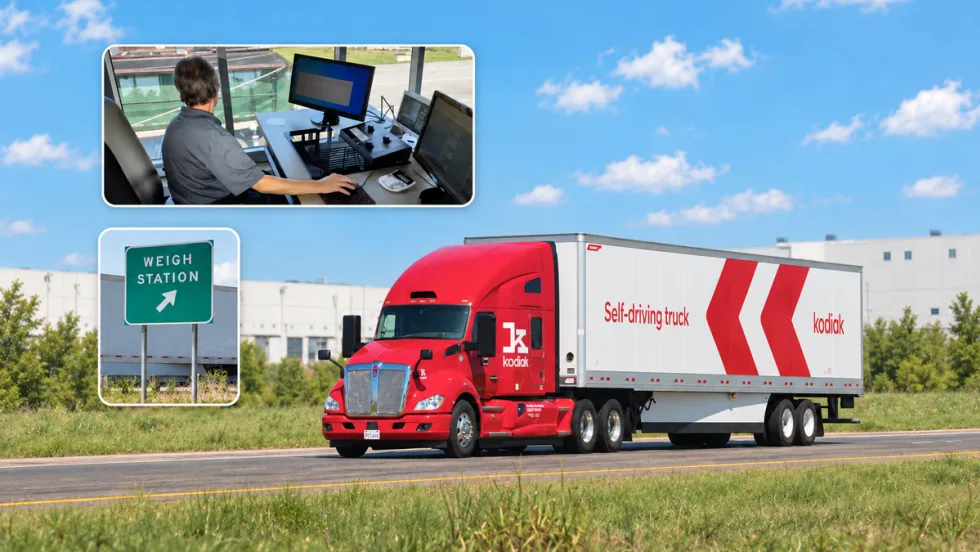
PrePass, Kodiak Connect Driverless Trucks to Roadside Enforcement
The system will allow enforcement agencies to verify Enhanced Inspection information and decide whether Kodiak’s autonomous trucks can bypass roadside screening sites.
Read More →
From One Generation to the Next: How Mentorship Builds Safer Truck Drivers
After three decades in trucking, Harold Perry shares what he's learned about driver safety, mentorship, and helping the next generation build confidence behind the wheel.
Read More →
FMCSA Pauses Biennial-Update Enforcement Amid Motus Transition
Carriers whose updates were due on or after June 1 have more time, while FMCSA works to stabilize its new registration system and warns of phishing sites impersonating its new carrier registration system, Motus.
Read More →
ZF Expands Commercial Vehicle Push in North America
ZF is expanding its North American commercial-vehicle presence with new transmission applications, electrification, trailer technology and autonomous-driving systems.
Read More →
Truck Drivers Need More Than Another Alert
Fleets have more visibility into truck health, safety events, and driver activity than ever. The next challenge is turning all that information into useful guidance for the person who has to decide what to do next.
Read More →
Tesla Wants a Self-Driving Semi. Are Cameras Enough?
Could Tesla’s camera-only autonomous driving technology work on an 80,000-pound Semi? In this commentary, HDT's Deborah Lockridge takes a look at Tesla, Cybercab, and how autonomous trucks see the road.
Read More →
What DOT’s Automated Vehicle Strategy Means for Trucking
The U.S. Department of Transportation issued a new automated-vehicle strategy that outlines plans for driverless-truck regulations, cross-state freight corridors, and federal safety standards.
Read More →
NYC Expands Speed, Pedestrian Safety Tech Across Fleet
New York City is expanding intelligent speed assistance and pedestrian-alert systems across its municipal fleet, moving the technologies from pilot programs into vehicle procurement and retrofit requirements.
Read More →
FMCSA Removes 110 Truck Driver Training Schools from Certified ELDT List
Federal regulators also are targeting more than 160 additional training providers and launching a nationwide audit of third-party CDL skills testers as part of a broader crackdown on trucking fraud.
Read More →
Beyond DOT Compliance: What Makes a Trucking Fleet Truly Safe?
A trucking fleet can follow every rule and still make unsafe decisions. The real test comes when safety conflicts with freight, productivity, or cost.
Read More →