



This article is part of an HDT series, “NACFE’s Electric Fleet Leaders.”
Tesla Semis Shine on PepsiCo’s Long-Haul Electric Routes
Flexibility, Scalability Guide OK Produce’s Path to Fleet Electrification
 MENU
MENU SEARCH
A dual-cord dispenser capable of charging two vehicles at once is a highlight of Schneider's South El Monte, California, transition to battery-electric trucks.
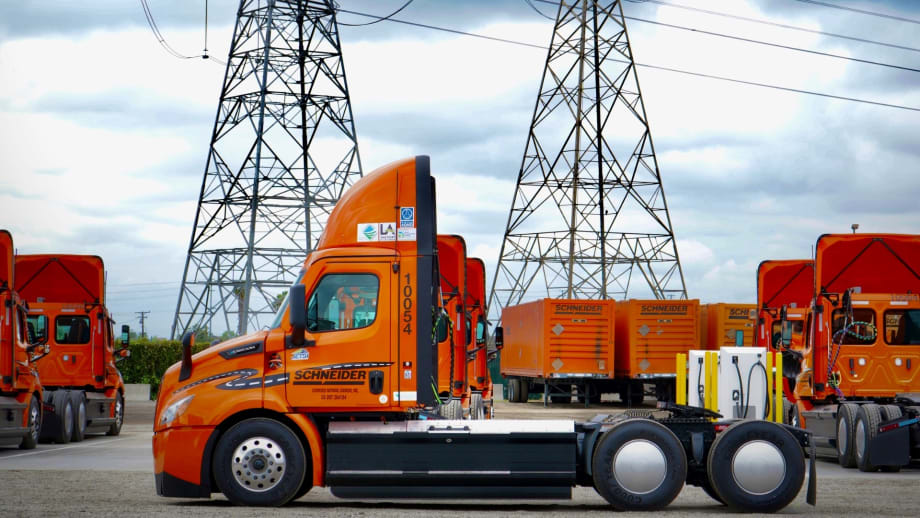
Schneider is currently running 32 Freightliner eCascadia's at its South El Monte, California, intermodal facility. But expects to have 92 trucks operating by September of this year.
Photo: NACFE
The ability to charge 32 battery-electric Class 8 trucks simultaneously is a highlight of Schneider's South El Monte, California, transition to battery-electric trucks.
Information about the dual-cord chargers is part of the first North American Council for Freight Efficiency profile of fleets leading the way in converting to battery-electric trucks.
The profiles feature fleets participating in NACFE's Run on Less Electric-Depot program. ROL-E Depot is a year-long study by NACFE analysts studying real-world battery-electric truck use and infrastructure issues. The goal is to help North American fleets begin to transition to BETs by conveying lessons learned by fleets in the study.
As part of that process, NACFE is releasing profiles of the fleets it is working with on this latest Run on Less project, to give as much insight as possible into their electric-truck operations and adopting electric trucks at scale.
The first participant Fleet Profile looks at Schneider’s South El Monte, California, intermodal distribution center. At this location, Schneider is transitioning away from diesel-powered Class 8 tractors to the Freightliner eCascadia electric truck.
When this process is complete by September of this year, Schneider will have 92 electric trucks operating from the South El Monte facility engaged in domestic intermodal, short-haul operations. For the most part, the trucks remain between 80 and 100 miles away from the charging base at El Monte during the course of a day. Payload on the trucks is “variable.” But they can go up to 82,000 lbs. GVWR, according to NACFE.
The process of converting to electric trucks and installing modern charging infrastructure has been challenging for everyone involved, said Jeremy Hock, equipment engineer, Schneider, in a fleet profile video created by NACFE. It has meant many adjustments.
One example is the way drivers are given trucks.
“We’ve made some minor adjustments to the driver truck assignments,” Hock said. “Instead of having an assigned truck, they’re in the next truck that has completed charging.”
“I go to one of the rail yards, pick up a container, take it to a warehouse,” Marty Boots, a Schneider driver at El Monte, said in the video. “Depending on how many miles and how much weight there is, I may have to schedule a stop back at the yard. I don’t have to stop and charge. I just drop the truck off, put it on the charger and grab another truck and continue my day.”
The experiences of drivers like Boots, and the lessons they’ve learned, have been critical not just for Schneider, but for Freightliner as well, said Rakesh Aneja, vice president, electric mobility, Daimler Truck North America, also featured in the video.
“Feedback came in from real-world drivers hauling real-world freight,” Aneja said. “They were giving us design input; where the charge port should be located, for example. But equally, if not more importantly, what infrastructure and ecosystem do we need to operate these trucks.”
“I wouldn’t put this in the ‘easy to do,’ category,” Hock added. “The list of learnings we’ve had to do over the last few years here wouldn’t be a short one.”
One of the unique features at the El Monte Schneider facility that NACFE paid particular attention to are the electric power dispensers.
According to John Richardson, electric charging specialist, NACFE, Schneider selected a somewhat unusual charging system for El Monte operations.
“Another unique feature here at this Schneider facility is the power cabinet they’ve selected to serve the dispensers that charge the electric trucks,” he explained in the NACFE video. “They are manufactured by Power Electronics. And they are enormous compared to what you’ll typically see.”
Richardson said all of the power modules that are inside each charging system are linked together to provide power to each of four different dispensers. Those four dispensers, in turn, each feed two power cables.
“So, they can have multiple charging events at each dispenser,” Richardson explained. “One liquid-cooled cable provides 500 amps of charging power, and an air-cooled cable provides 300 amps. The cables can be used to charge either one truck, or on two separate trucks.”
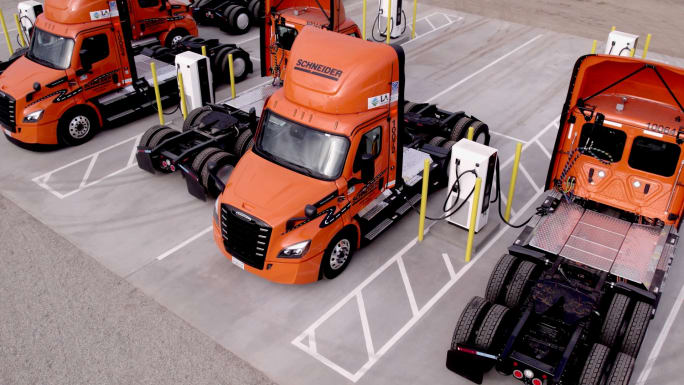
The charging system at the Schneider South El Monte facility features two power cables which can charge two different trucks simultaneously.
Photo: NACFE
“The electrification of transportation is an opportunity to think about energy as an asset – not an expense,” added Randall Kaufman, sales director for Black and Veatch, which built the new charging station on the site. “It can be applied to buildings, on-site generation and energy storage, monetization of energy. Now, energy is fuel for your vehicles. But the facilities are already using electricity as energy. So, there’s an interesting opportunity to shift the way of thinking about electricity.”
"I think five years from now, success for this facility is it’s a routine operation that happens to be electric,” added Rob Reich, chief administrative officer, Schneider. “It’s great for our business. It’s great for our customers. It’s great for our drivers. It’s great for our community. And I think the other measure of success is that we look back on it as the first of many.”

Volvo’s updated D13 promises lower emissions without sacrificing performance or fuel economy. Take a closer look at what changed inside the engine in this HDT Spotlight video.
Read More →
Energy Vision estimates fleets could recover the higher purchase price of an RNG-fueled Class 8 tractor in 1.3 to 2.8 years under current fuel-price scenarios.
Read More →
Calstart is now Catalyst Mobility, reflecting the nonprofit’s growing national role in clean transportation, including zero-emission trucks, infrastructure and incentive programs.
Read More →
Average U.S. diesel prices have climbed to nearly $6 a gallon, surpassing the 2022 record as tight refinery capacity and Middle East disruptions keep fuel costs elevated.
Read More →
Fuel delivery depends on more than what happens at the injector. For fleet, maintenance and technical professionals, looking at the full path from pump to injector can provide useful context for understanding engine performance.
Read More →
The Port Authority of New York and New Jersey announced millions in incentives for zero-emission drayage trucks, yard tractors, and new charging hubs near the port.
Read More →
Why do battery-electric Class 8 trucks remain so expensive? A California bill headed to Gov. Gavin Newsom would give fleets and state agencies more visibility into what manufacturers charge.
Read More →
Detroit isn’t starting from scratch to meet EPA 2027 diesel emissions standards. Its Gen 6 DD13 and DD15 engines keep much of today’s platform while updating the fuel and aftertreatment systems.
Read More →
California, Oregon, Washington, British Columbia and Baja California are coordinating plans for truck charging and hydrogen fueling from Canada to Mexico.
Read More →
Learn more about Kenworth's T880E battery-electric vocational truck at the Paccar Technical Center, including its range, applications, upfitting considerations, and PTO options, in this HDT Spotlight video.
Read More →