




Chanje Electric Vans Unveiled
Chanje is here. The Los Angeles-based electric vehicle supplier (pronounced “change”) officially unveiled its electric medium-duty panel van in Brooklyn, New York, with Ryder taking delivery of 125 units for its rental and leasing fleet.
by John G. Smith and Jim Park
November 6, 2017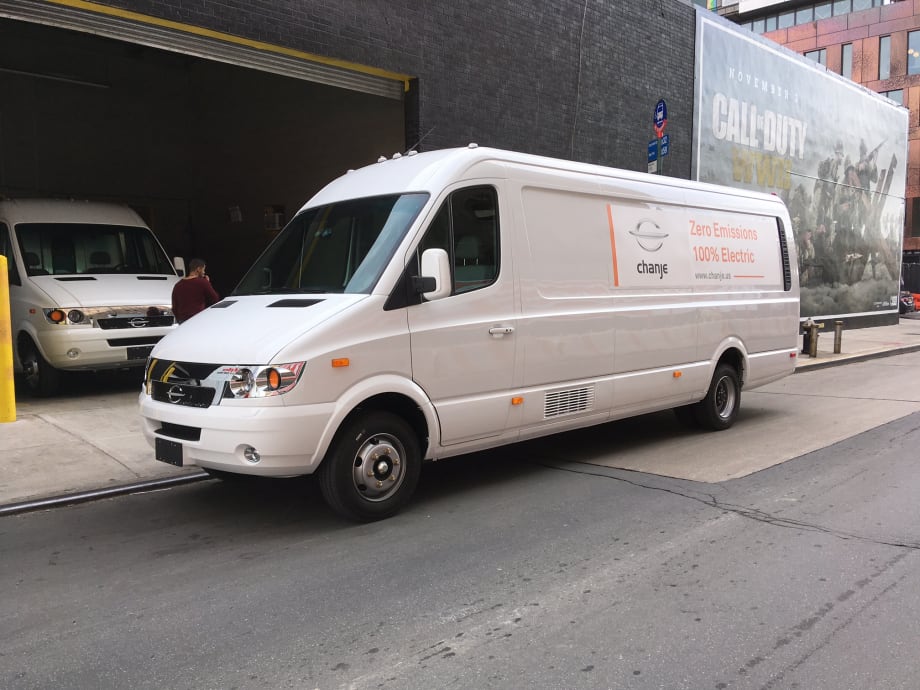
The Chanje van on the streets of Brooklyn. The U.S. market sets the highest bar for vehicle reliability and safety, and it is home to some of the largest delivery companies and consumer brands expected to use the vehicles. Photo: Jim Park
7 min to read
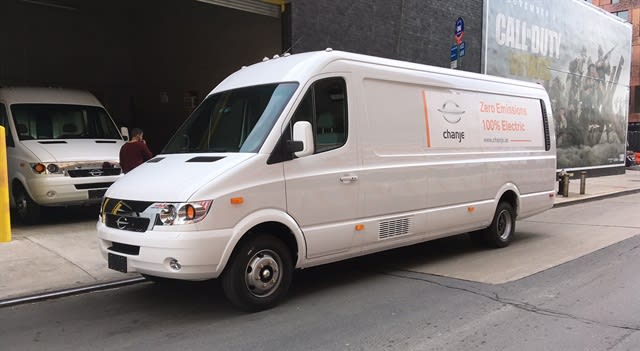
The Chanje van on the streets of Brooklyn. The U.S. market sets the highest bar for vehicle reliability and safety, and it is home to some of the largest delivery companies and consumer brands expected to use the vehicles. Photo: Jim Park
BROOKLYN, NY – Chanje is here.
The Los Angeles-based electric vehicle supplier (pronounced “change”) has officially unveiled its electric medium-duty panel van in Brooklyn, New York, with Ryder taking delivery of 125 units for its rental and leasing fleet.
The initial rollout will be in key California markets including Los Angeles, San Francisco, and San Diego, as well as New York and Chicago. Ryder will provide parts distribution, service and support.
“All the trends in diesel are going in the wrong direction,” said Chanje CEO Bryan Hansel, noting that diesel equipment is increasingly expensive to build, purchase, and maintain.
China’s demand for electric vehicles is expected to outpace North America’s needs in coming years, but the U.S. market sets the highest bar for vehicle reliability and safety, and it is home to some of the largest delivery companies and consumer brands expected to use the vehicles, Hansel says. This is being developed as a “world” truck for markets here and elsewhere, and the company says it has invested about $1 billion in the design and related tooling.
The Vehicle
The Chinese-built V8070 van will reportedly hold a 6,000-pound payload in its cavernous 580-cubic-foot cargo bay. “For package delivery, it’s a lot,” Hansel said, referring to the growing trend in home deliveries as a key driver behind such vehicles.
"Driving the truck is extremely intuitive, and drivers will very easily adapt to the working environment," Hausmann said. "The dash panel may look a little different, but it's really the same as a traditional dash. Rather than a fuel gauge, for example, we have a range meter show drivers the state of charge and how far they can drive. There's also a traditional speedometer and trip meter. There's nothing nuanced about this vehicle. It's designed to be very intuitive for the everyday driver."
The turning radius is also a tight 25 feet.
“When you're driving this, it feels like you’re driving a minivan,” he said. “These were designed for an urban environment. You need to be able to drive them, you need to be able to park them, you need to be able to maneuver them.”
Meanwhile, the van promises a 160-kilometer range, depending on the application, and is charged at the equivalent cost of 4.7 liters per 100 kilometers. That’s based on an average payload of 50% through the day. Where a fuel cap would traditionally be found, drivers can access the SAE J1772 connector for the 7.2-kilowatt onboard charger. Regenerative braking is also used to extend the battery’s range.
"The Chanje V8070 is a last-mile logistics solution," said Chanje Vice President of research and Development Austin Hausmann. "With the big uptick in e-commerce, getting those packages from the warehouse to the end user is where we fit. We know that a typical urban delivery route is about 65 miles a day, so our 100-mile range is perfectly suited to that environment."
Hansel founded Smith Electric in 2009 and launched a commercial electric truck in 2010, but that was a retrofit. Chanje offers a purpose-built platform, engineered as an electric vehicle. And that’s presented as an important distinction.
The torque delivered through the pair of rear electric motors offers 30% gradeability, giving it enough power to accelerate from a stopped position on a steep hill.
Electric vehicles don’t traditionally offer the gear ratios for a climb like that. “They usually quote [a gradeability of] 20%, and even though torque seems to be your friend, the gear ratios that people tend to put into them don’t give them the ability to climb really steep grades. And if they do, they tend to lose highway speed. We have an 80-mph top end and we have the gradeability,” Hansel said.
“If you’re running through a driveshaft and a rear differential by just upfitting an existing vehicle, then you’re going to lose on one of those ends," he continued. "Either you’re not going to be able to climb the hill or you’re not going to be able to go fast on the highway.”
Chanje’s battery sits midway between the frame rails, offering a low center of gravity, and the power is delivered through a pair of electric motors at the rear.
At the center of the dash is a 10.4-inch touchscreen display based on an Android operating system that can be programmed for such things as navigation and telematics feedback.
The model on display in Brooklyn devoted screens to such things as HVAC controls, radio, phone, backup camera screen, and charging information. “We’ve built it from the ground up to be a connected vehicle,” Hansel said, referring to data being downloaded to company servers. “If you’ve got an app on your phone, you can mirror it into the vehicle.”
As for cost, the choice of the electric van compared to its diesel-based counterpart is no longer financial, he said, adding that Chanje offers price parity when comparing lease costs, maintenance, and fuel. “The net number at the end of the month will be net-even cash flow.”
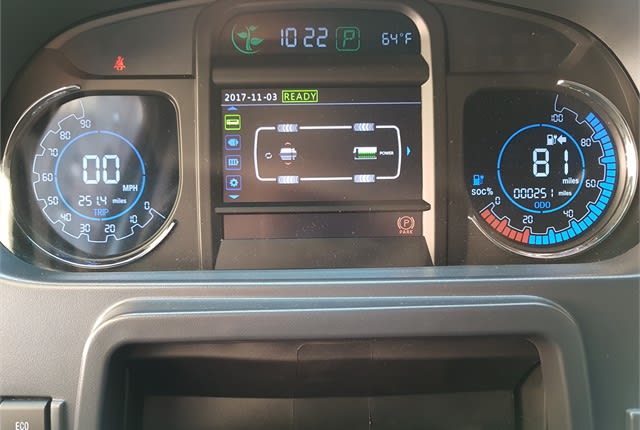
Rather than a fuel gauge, a range meter shows drivers the state of charge and how far they can drive. There's also a traditional speedometer and trip meter.Photo: Jim Park
Ryder as a Cornerstone
Ryder’s involvement has been a “cornerstone” of the company’s rollout strategy, Hansel stressed, referring to the distribution model. It gives users the confidence that, should something need to be repaired, the work can be completed nearby. “You need to be able to drive down the street and get it fixed.”
Ryder trainers have already been studying the equipment, and are now preparing technicians in the key markets. The first graduated just weeks ago. And about 200 unique replacement parts are also being stocked in distribution centers.
“We realize that we need to be able to support customers when they bring a vehicle in from a diagnostic perspective, so we’re installing chargers inside our shops,” said Chris Nordh, Ryder’s senior director-- advanced vehicle technologies and global fuel products. Charging equipment will also be installed in Ryder lots to support rentals as well as leasing customers who need time to prepare for electrified equipment.
“Chanje is bringing a product to market that has the scale, the quality that we need to feel comfortable, but they’re way ahead of the rest of the market,” he said.
Of course, this is just the latest step in Ryder’s embrace of electrification. The company already announced similar roles with Nikola Motors and Workhorse.
“We have a unique position in that we’re not aligned with a single OEM, so we have that capability to be able to be agnostic, and we are acting as a springboard on multiple levels,” Nordh said.
Chanje also helps customers manage their energy needs and charging infrastructure, which isn't a core part of customers’ business yet.
“Putting electric trucks into the market is one thing, but supporting the customer is terribly important as well," said Hausmann. “There’s a massive energy storage component that comes behind that. We're helping our customers solve the challenges of putting 100 or 200 of these trucks into their depot. It’s not as simple as just plugging it in. Most of our customers don't feel that they have the expertise to pull that off, but we do. While that has traditionally been seen as a risk or a barrier to entry, we see it as a huge opportunity in terms of risk services and the associated energy solutions.”
The Chanje truck will be manufactured in Hangzhou, China, via a partnership with Hong Kong-based FDG Group, but final assembly in North America will be completed at a site with a capacity of 10,000 to 20,000 vans. “That’s a reasonably light investment,” Hansel said. The search for a location to house that work is focusing around ports and is expected in coming weeks.
“There’s nothing out there like this at all,” Nordh said, referring to everything from the quiet ride to lack of exhaust.
There are more vehicles to come. A model with a shorter wheelbase, as well as a 20-plus passenger luxury shuttle, is in the works.
Watch for a test drive by HDT Equipment Editor Jim Park in an upcoming print issue of Heavy Duty Trucking magazine.
Specs
Wheelbase: 194.3 inches
Overall length: 318.1 inches
Gross Vehicle Weight: 16,535 pounds
Maximum payload: 6,000 pounds
Battery capacity: 70 kWh
Total peak power: 198 hp
Total peak torque: 564 lb-ft
Top speed: 130 kilometers per hour
Turning radius: 26.6 feet
More Fuel Smarts

How Volvo Updated Its D13 for EPA 2027 [Watch]
Volvo’s updated D13 promises lower emissions without sacrificing performance or fuel economy. Take a closer look at what changed inside the engine in this HDT Spotlight video.
Read More →
Diesel Price Spike Shortens Payback for Natural Gas Trucks, Report Says
Energy Vision estimates fleets could recover the higher purchase price of an RNG-fueled Class 8 tractor in 1.3 to 2.8 years under current fuel-price scenarios.
Read More →
Calstart Becomes Catalyst Mobility, Reflecting Broader Focus
Calstart is now Catalyst Mobility, reflecting the nonprofit’s growing national role in clean transportation, including zero-emission trucks, infrastructure and incentive programs.
Read More →

Record Diesel Prices Squeeze Trucking Fleets
Average U.S. diesel prices have climbed to nearly $6 a gallon, surpassing the 2022 record as tight refinery capacity and Middle East disruptions keep fuel costs elevated.
Read More →
Sponsored•September 9, 2026
How Fuel Delivery Shapes Engine Performance
Fuel delivery depends on more than what happens at the injector. For fleet, maintenance and technical professionals, looking at the full path from pump to injector can provide useful context for understanding engine performance.
Read More →
East Coast Port Launches $45M Electric Truck Push
The Port Authority of New York and New Jersey announced millions in incentives for zero-emission drayage trucks, yard tractors, and new charging hubs near the port.
Read More →
California Bill Could Shed Light on Electric Truck Prices
Why do battery-electric Class 8 trucks remain so expensive? A California bill headed to Gov. Gavin Newsom would give fleets and state agencies more visibility into what manufacturers charge.
Read More →
Detroit Opens Orders for EPA 2027 Engines
Detroit isn’t starting from scratch to meet EPA 2027 diesel emissions standards. Its Gen 6 DD13 and DD15 engines keep much of today’s platform while updating the fuel and aftertreatment systems.
Read More →
Zero-Emission Truck Corridor Planned for West Coast
California, Oregon, Washington, British Columbia and Baja California are coordinating plans for truck charging and hydrogen fueling from Canada to Mexico.
Read More →
A Closer Look at Kenworth’s Electric T880E Vocational Truck [Video]
Learn more about Kenworth's T880E battery-electric vocational truck at the Paccar Technical Center, including its range, applications, upfitting considerations, and PTO options, in this HDT Spotlight video.
Read More →