




CDL Schools Say Proposed Training Standards Would Make Driver Shortage Worse
In a Friday "listening session" the Federal Motor Carrier Safety Administration hosted regarding its proposed entry-level driver training stories, truck driver training school officials warned that the proposal would make the current driver shortage even worse.


FMCSA Administrator Anne Ferro, right, and a panel of FMCSA officials listen to comments about proposed entry level driver training regulations.
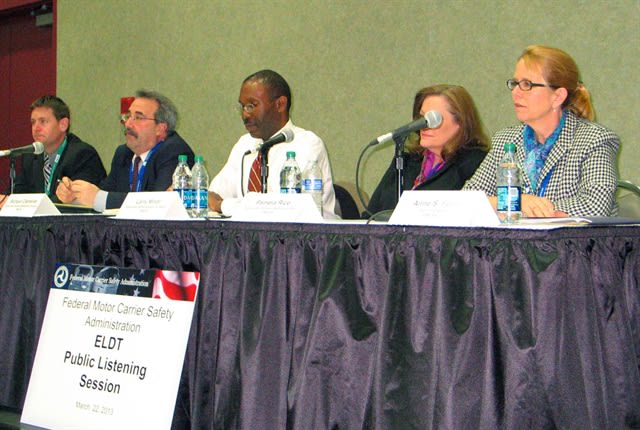
FMCSA Administrator Anne Ferro, right, and a panel of FMCSA officials listen to comments about proposed entry level driver training regulations.
LOUISVILLE -- In a Friday "listening session" the Federal Motor Carrier Safety Administration hosted regarding its proposed entry-level driver training stories, truck driver training school officials warned that the proposal would make the current driver shortage even worse.
As FMCSA Administrator Anne Ferro explained during opening remarks in the Friday afternoon session at the Mid-America Trucking Show, the agency has been working on this for more than two decades. Back in 1991 Congress ordered safety regulators to start work on a training rule. A 2004 rule requires new drivers to know basic information about the job, over and above the skills they need to pass the CDL exam.
Advocates for Highway Safety sued, saying that the lack of a requirement for road training is a fatal flaw in the rule. The court agreed and forced the agency to take another look. That led to a 2007 proposed rule that would require anyone applying for a new or updated CDL to graduate from an accredited program that includes road training as well as class training.
Last year's highway bill, MAP-21, requires the agency to post a final rule by October. The most recent version would require anyone applying for a new or updated CDL to graduate from an accredited program that includes road training as well as class training.
"We received lots of comments," Ferro said, "and as we worked through those areas of concern and recommendations, we realized we really had more work to do as an agency in understanding the impact training has on the safety of a driver's operation, and the right components of that. We understood the accreditation requirement would create barriers, and that performance-based standards might be a better way, but we are still very open to additional input before we finalize the next phase."
The agency realized, she said, that it lacked input on the simple question of how much safer a trained driver is in the long run.
"I think almost anyone you talk to about it says on the face of it we've got know that training is required if you're going to operate in the complex environment of commercial vehicle operation."
The supporting facts and data as to exactly how much and what kind of training, however, were not there, she said.
This was illustrated by the comments of Brent Quire, a Con-way Freight driver and trainer with 38 years of experience and more than 2 million accident-free miles. Con-way, he said, has graduated more than 1,000 drivers from its training school over the past three years.
"Our graduates have shown improved safety performance compared to similar-experienced drivers who were hired and did not go through the school," Quire said. However, when asked by the FMCSA panel for statistics on safety and performance before vs. after starting the driver training school, he was unable to provide them.
A Call for Performance-Based Training
Driver training school representatives at the listening session argued that mandatory numbers of hours behind the wheel is arbitrary and that there is no evidence proving that a certain number of hours automatically means quality training. The accreditation standard, they argued, would cost schools too much money and end up increasing the cost and availability of driver training to students, at a time when the trucking industry is facing perhaps its worst driver shortage ever.
Lou Spoonhour, representing DriveCo, Gary, Ind., and the Commercial Vehicle Training Association of 180 truck driver training locations, called for performance-based standards. As an example, he cited the backing portion of the CDL test, which requires you to back a tractor-trailer 100 feet in a 12-foot-wide lane.
"I can tell you from our experience, we have students who can get in that truck and the first time back can do it perfectly. It would be very difficult for someone to explain to mandate that everyone has to do this for a specific time frame to work on this particular skill."
Driver training school executive Tom Rhuban pointed out that accreditation is very expensive. "This may seem like a self-serving statement, but it has far-reaching consequences," he said. "Small single location schools cannot shoulder the additional expense, while large schools such as ours have the cost multiplied. This forces smaller schools to close and keeps large schools from growing.

FMCSA Administrator Anne Ferro speaks to one of the people offering their comments during Friday's listening session.
"We also feel it will restrict U.S. job growth. It's well documented there's a shortage of trained drivers and demand far exceeds the ability of schools to supply. How can legislation that reduces the opportunity to put people back to work be a positive step?" he asked, adding, "For over 40 years the trucking industry has recruited qualified candidates from both accredited and non accredited schools with no evidence the accredited schools are better."
Don Harris, director of compliance with New England Tractor-Trailer Training School, contended that "accreditation does not provide uniform oversight. Each accrediting body has different standards. Typically, the school must submit itself to lengthy process that can take two years or longer."
Harris called for flexible, performance-based standards, noting that some students might acquire skills faster than others, and some students might miss some of the training due to sickness or family issues.
Martin Garsee of Houston community college, representing the National Association of Publicly Funded Truck Driving Schools, said his members offer programs ranging from three weeks to 10 weeks.
"We believe we should have the ability to arrange those hours in what is most beneficial to the student," Garsee said. "Not every student learns at the same rate. I think the one thing that is different in truck driver training [from other forms of education] is it is truly one on one training."
No Proven Effect on Safety
John Frey, associate vice president of driver school relations for Werner Enterprises and a board member of the Commercial Vehicle Training Association, noted that the CVTA's 18 schools in its Motor Carrier Committee last year hired 50,000 pus graduates, the majority of those from private, non-accredited schools.
"The Motor Carrier group investigates schools to determine the quality of the programs and continues to evaluate the quality of these students. Programs vary from 150 to 480 hours in the number of hours in the program, but to date, we've found no culpable difference of safety records of graduates basted on the type of school or accreditation status."
The CVTA's Motor Carrier Committee has a number of serious concerns with the current proposal, Frey said, saying it has no proven effect on improving highway safety.
Like others commenting during the listening session, Frey said, "Our experience does not suggest that a shorter or longer program is a better program or produces a better or safer driver. Whether the student can perform to the standard may be more significant than time behind the wheel."
In fact, Frey contended that requiring a minimum number of hours is going against the latest thinking in education circles. He cited a recent article in Inside Higher Ed, "Beyond the Credit Hour," which reported that:
"The U.S. Department of Education has endorsed competency-based education with the release today of a letter that encourages interested colleges to seek federal approval for degree programs that do not rely on the credit hour to measure student learning."
"Currently there is a well-documented shortage of drivers," Frey said, "and this rule could seriously impede the ability to recruit drivers and the number of drivers coming into our industry," he said.
While we don't know what its effect will be on highway safety, Frey said, "What we do know is it will increase costs. Accreditation will drive some good but marginally profitable schools out of business and discourage new schools. Anything that will increase the costs of students receiving their CDL needs to be very carefully evaluated in the cost benefit analysis."
Photos by Evan Lockridge
Related Story: FMCSA Advisory Panel Takes on Driver Training
More Drivers

EEOC Sues Texas Trucking Company Over Driver Age Limits
The agency says Trancasa USA rejected applicants over 65 and applied tougher driving-record standards to those over 60.
Read More →
Nussbaum, Roehl Announce Second Driver Pay Increase This Year
This year has seen a swath of major truck driver pay increases as freight capacity has tightened.
Read More →
From One Generation to the Next: How Mentorship Builds Safer Truck Drivers
After three decades in trucking, Harold Perry shares what he's learned about driver safety, mentorship, and helping the next generation build confidence behind the wheel.
Read More →
Truck Drivers Need More Than Another Alert
Fleets have more visibility into truck health, safety events, and driver activity than ever. The next challenge is turning all that information into useful guidance for the person who has to decide what to do next.
Read More →
FMCSA Removes 110 Truck Driver Training Schools from Certified ELDT List
Federal regulators also are targeting more than 160 additional training providers and launching a nationwide audit of third-party CDL skills testers as part of a broader crackdown on trucking fraud.
Read More →
Hours of Service Pilot Programs: FMCSA Readies for 2027 Rollout
Two pilot programs could eventually reshape hours-of-service rules, giving truck drivers options to pause their 14-hour clock or use longer split sleeper rest periods.
Read More →
Medical Cards, English Proficiency Reshape Roadcheck Violations
Medical-card violations jumped to the top of the driver out-of-service list during CVSA’s 2026 International Roadcheck, while English-language proficiency violations appeared among the leading violations for the first time.
Read More →
Driver Trust Can Make or Break the Success of Fleet Safety Technology
New Teletrac Navman research suggests that onboarding, transparency about driver data, and positive feedback can play a significant role in how commercial drivers respond to safety and coaching technology.
Read More →
EEOC Sues KLLM Over Alleged Sex Discrimination in Driver Training
KLLM is facing a federal sex-discrimination lawsuit over policies the EEOC alleges put female truck driver trainees at a disadvantage.
Read More →
FMCSA Moves to Codify English Language Requirements for Commercial Drivers
By changing regulations on English-language proficiency requirements for commercial drivers, rather than relying on a guidance memo, the FMCSA said future administrations won't be able to walk back the Trump administration's stricter enforcement with just a memo.
Read More →