




Cat-Brand Trucks to Roam Highways in Australia
Less than two years after Caterpillar announced its departure from the on-highway truck engine business, and just a few weeks after news that the relationship between Iveco Trucks Australia and International was being scrapped, the world's first Cat-branded trucks are about to be launched on the Australian market. And they will be on-highway trucks, not just the widely expected vocational-targeted models
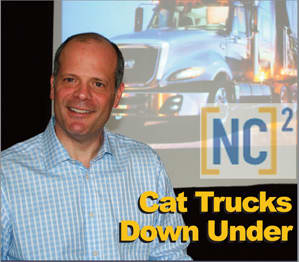
NC2 president Al Saltiel. In the background is a mock-up image of the Cat CT 630 based on International's Prostar model. With the CT 610, the two Cat conventionals will soon make their world debut on the Australian market.
Less than two years after Caterpillar announced its departure from the on-highway truck engine business, and just a few weeks after news that the relationship between Iveco Trucks Australia and International was being scrapped, the world's first Cat-branded trucks are about to be launched on the Australian market. And they will be on-highway trucks, not just the widely expected vocational-targeted models.
At the recent Melbourne Truck Show, it was announced that two conventional models will become available within the next few months, first the CT 610 and soon after, the CT 630. The 610 will be powered by a 470-horsepower Caterpillar C13 Acert engine and the 630 by the C15 Acert at 550 horsepower.
The models will be assembled from semi-knocked down (SKD) kits on a dedicated line within Caterpillar's Australian headquarters in Tullamarine, Melbourne. Early reports say the cabs - the CT 610 based on Navistar's Transtar model and the CT 630 on the slick Prostar - will arrive fully trimmed and painted from the U.S. and likewise, chassis rails will be pre-drilled for the local fitting of axle, driveline, fuel tanks and ancillary assemblies.
Initially, both models will be available in day cab or 26-inch 'extended' cab configuration. The CT 610 comes with a bumper to back-of-cab (BBC) measurement of 2.72 meters (107 inches) and will be targeted primarily at 19-meter (approx. 62-foot) single trailer and short B-double applications. Gross combination rating is up to 57 tonnes (nearly 63 U.S. tons). The CT 630 has a BBC dimension of 3.1 meters (122 inches) and for B-double and on-highway roadtrain double applications will carry gross combination ratings of 72 (79 U.S. tons) and 90 tonnes (99 U.S. tons) respectively.
At the Melbourne Truck Show
News of the imminent release of the Cat trucks was delivered at a press conference during the recent Melbourne truck show by Al Saltiel, formerly with Navistar International and now president of NC2 - or NC 'squared' - the 50/50 joint venture company formed by Caterpillar and Navistar to develop, manufacture and distribute Caterpillar and International branded trucks outside North America and India.
NC2 was formed in the immediate wake of Caterpillar's announcement that it would not develop engines to meet U.S. 2010 emissions regulations but would pursue markets outside North America with Cat-branded trucks developed in association with Navistar. It was initially expected that any Cat-branded truck would be developed specifically for construction, logging, oilfield and low-loader applications, but the pending appearance of the CT 610 and CT 630 for on-highway work has put those expectations to rest. NC2 obviously has far bigger plans.
Indeed, as a prepared statement from the company states, "NC2's product line will feature both conventional and cabover truck designs and will be sold under both the Cat and International brands.
"The joint venture leverages the potent combination of Navistar's truck manufacturing expertise and Caterpillar's powerful global network. Headquartered in Illinois, USA, a 2010 business plan has been formalised embracing high-potential markets, with initial focus on Australia, Brazil, and South Africa, and has taken a number of concrete steps focused on the high-priority Australian market."
Critically, according to NC2, those steps include "... an Australian product and brand strategy, including medium, heavy and vocational vehicles." In effect, the two Cat models appear to be just the tip of iceberg. It's also worth noting the joint venture company has applied for membership of the Truck Industry Council, the organization that represents the interests of Australian truck manufacturers, importers, diesel engine companies and major component suppliers.
Asked if the International 9200, 9900 and 7600 models currently available through Iveco will be continued under either the Cat or International nameplates, an adamant Saltiel said simply, "No. And they have no similarities with the trucks we'll be offering."
According to NC2's press release, the trucks, "... will be sold and serviced by a network of Cat dealers who have been selected based on market coverage, service orientation, experience with servicing Cat engines, and commitment to the on-highway truck market.
Australian Durability Test?
The Australian truck market is no place for the faint-hearted. Truck operators in this country are spoiled for choice and have fiercely long memories, with both these factors creating considerable peril for those who deliver products without adequate local testing.
Yet it seems NC2 is content to launch the CT 610 and CT 630 with what appears limited exposure to Australian conditions in the months leading up to the launch of the models around June or July this year. However, as Saltiel commented during our discussions after the official announcement, he has no concerns about any perceived lack of durability testing in this country.
"We have had trucks running now for several months," he emphasised. Will it be enough? Time will tell, but for now NC2's American executives are entirely confident of the Cat trucks' capacity to reliably endure Australian workloads, firmly emphasising that the International cabs and chassis have been suitably optimized for local conditions.
Caterpillar Acert engines are an established entity in Australia, and operators know what they'll be getting when it comes to performance, fuel economy and overall durability standards. This time 'round, though, Cat and its agents will be responsible for far more than just the lump of hardware under the snout.
Meeting Emissions Regs
According to early information, the engines will be 'tuned' to U.S. 2004 emissions standards, which will satisfy Australia's current ADR 80/02 (Euro 4) emissions regulation but not the upcoming ADR 80/03 (Euro 5) standard to be introduced in January 2011. Asked about future engine plans, Al Saltiel conceded that Acert's future here will be limited to just this year and next. "We will meet Euro 5 in the 2012 timeframe and our emissions solution will be EGR (exhaust gas recirculation)," he confirmed.
He would not, however, confirm whether future engine platforms for Cat-branded trucks will be based on Navistar MaxxForce engines, including 11 and 13 liter versions developed in conjunction with MAN and a larger displacement unit based in large part on Cat's C15 design. It would seem logical though that MaxxForce - whether branded with Cat or International badges - will be the force under future Cat trucks, particularly given Navistar's adherence to EGR when all other U.S. engine makers have moved to an SCR (selective catalytic reduction) emissions solution.
Passion for Cat
The greatest asset of the NC2 venture in Australia, at least in the establishment phase, is the brand itself. Cat! Despite the fact that Caterpillar's stated withdrawal from the truck engine business left a sour taste in the mouths of many loyal followers, and Acert was not the technical panacea Cat and its supporters had hoped for, there's no shortage of operators with yellow blood flowing strong in their veins.
As one long-serving and highly respected Cat engine representative commented at the Melbourne show, "There's already a huge amount of interest in these trucks and there's probably 20 people I know of who want the first one." After all, it's not every day a world first is launched on the Australian market.
It's this sort of deep-seeded passion and respect for the Cat brand that make "Australia a great place to start," according to Saltiel. Moreover, success here will provide a valuable marketing platform for NC2 ambitions in other parts of the world. "Australia is a top priority market for us, and we are committed to taking full advantage of its strong potential," he added.
Future Plans
While the two Cat models are unque
More Equipment

How Volvo Updated Its D13 for EPA 2027 [Watch]
Volvo’s updated D13 promises lower emissions without sacrificing performance or fuel economy. Take a closer look at what changed inside the engine in this HDT Spotlight video.
Read More →
Michelin Tire Improves Efficiency and Durability for Regional Fleets
The Michelin X Multi Energy D2 is a regional haul drive tire engineered to help fleets improve fuel efficiency, durability and traction in demanding stop-and-go operations.
Read More →
ZF Expands Commercial Vehicle Push in North America
ZF is expanding its North American commercial-vehicle presence with new transmission applications, electrification, trailer technology and autonomous-driving systems.
Read More →
Tesla Wants a Self-Driving Semi. Are Cameras Enough?
Could Tesla’s camera-only autonomous driving technology work on an 80,000-pound Semi? In this commentary, HDT's Deborah Lockridge takes a look at Tesla, Cybercab, and how autonomous trucks see the road.
Read More →
Kodiak: Driverless Long-Haul Truck Launch on Track for 2026
Kodiak AI says its driverless long-haul safety case is 93% complete and it remains on track to begin commercial operations by year-end 2026.
Read More →
What DOT’s Automated Vehicle Strategy Means for Trucking
The U.S. Department of Transportation issued a new automated-vehicle strategy that outlines plans for driverless-truck regulations, cross-state freight corridors, and federal safety standards.
Read More →
East Coast Port Launches $45M Electric Truck Push
The Port Authority of New York and New Jersey announced millions in incentives for zero-emission drayage trucks, yard tractors, and new charging hubs near the port.
Read More →
PlusAI Going Public to Fund Autonomous Truck Launch
A SPAC deal could provide PlusAI with up to $300 million as it works toward a 2027 commercial launch of factory-built autonomous trucks.
Read More →
NHTSA Moves to Rewrite Truck Fuel-Economy Rules
The National Highway Traffic Safety Administration says it lacks authority to regulate medium- and heavy-duty truck engines separately from complete vehicles, but the existing standards have not yet been eliminated.
Read More →
Detroit Opens Orders for EPA 2027 Engines
Detroit isn’t starting from scratch to meet EPA 2027 diesel emissions standards. Its Gen 6 DD13 and DD15 engines keep much of today’s platform while updating the fuel and aftertreatment systems.
Read More →