




CarriersEdge offers Cross-Border Training to Drivers
CarriersEdge is offering a new Border Crossing/C-TPAT training course for drivers, covering security and threat awareness, security inspections and successful border crossing.
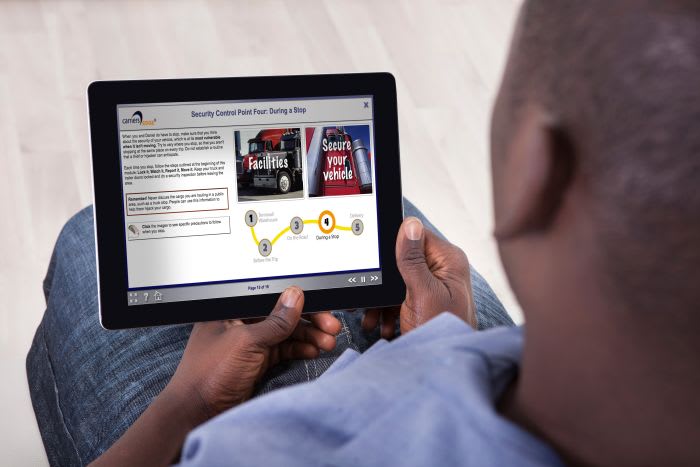
Photo: CarriersEdge

Photo: CarriersEdge
CarriersEdge is offering a new Border Crossing/C-TPAT training course for drivers, covering security and threat awareness, security inspections and successful border crossing.
Carriers with C-TPAT (Customs-Trade Partnership Against Terrorism) certification are required to perform inspections and to provide driver training. CarriersEdge’s training courses help drivers ensure that they are prepared at the border and that inspections are completed properly.
“Canada and the United States share the longest land border in the world that thousands of trucks and about $500 million in trade cross daily,” said Mark Murrell, vp, sales & marketing, at CarriersEdge. “It can be a long and frustrating task when a driver is not prepared with an understanding of security issues. Our new Border Crossing training courses explain security inspections, procedures and issues to minimize a driver's chances of facing long delays at the border.”
The training course is divided into four modules that can be completed separately or all at once. Included is a single course incorporating all modules that is designed for orientation purposes and the following three modules for refresher or remedial training:
C-TPAT/PIP Security and Threat Awareness covers five main areas where possible security issues can arise, including at the terminal, before the trip, on the road, during a stop and during a delivery. Additionally, it covers threat awareness, including such topics as how to recognize suspicious behavior, communication practices, and how to handle a hijacking.
C-TPAT/PIP Security Inspections covers when and how to conduct a security inspection on trailers or containers and on security seals, and how these practices differ from regular pre-trip inspections.
Successful Border Crossing covers how to minimize a driver's chances of facing long delays at the U.S./Canada border by focusing on border security and customs pre-clearance programs, personal identification needs, vehicle requirements, and a variety of best practices.
C-TPAT (Customs-Trade Partnership Against Terrorism) is a voluntary program from U.S. Customs and Border Protection (CBP) focused on improving the security of supply chains with respect to terrorism.
Companies that achieve C-TPAT certification have a documented process for determining and alleviating risk, resulting in expedited processing of their cargo. The Partners in Protection program is a voluntary commercial security program between the Canadian Border Services Agency and companies involved in cross-border trade. PIP members commit to securing the supply chain by complying with physical, infrastructure and procedural security measures.
CarriersEdge courses are designed to provide interactive training for drivers, regardless of their learning style, age or industry experience. The compay said this instructional approach can foster a deeper understanding of course material than comparable video-based offerings by fully engaging drivers in the e-learning process.
More Drivers

EEOC Sues Texas Trucking Company Over Driver Age Limits
The agency says Trancasa USA rejected applicants over 65 and applied tougher driving-record standards to those over 60.
Read More →
Nussbaum, Roehl Announce Second Driver Pay Increase This Year
This year has seen a swath of major truck driver pay increases as freight capacity has tightened.
Read More →
From One Generation to the Next: How Mentorship Builds Safer Truck Drivers
After three decades in trucking, Harold Perry shares what he's learned about driver safety, mentorship, and helping the next generation build confidence behind the wheel.
Read More →
Truck Drivers Need More Than Another Alert
Fleets have more visibility into truck health, safety events, and driver activity than ever. The next challenge is turning all that information into useful guidance for the person who has to decide what to do next.
Read More →
FMCSA Removes 110 Truck Driver Training Schools from Certified ELDT List
Federal regulators also are targeting more than 160 additional training providers and launching a nationwide audit of third-party CDL skills testers as part of a broader crackdown on trucking fraud.
Read More →
Hours of Service Pilot Programs: FMCSA Readies for 2027 Rollout
Two pilot programs could eventually reshape hours-of-service rules, giving truck drivers options to pause their 14-hour clock or use longer split sleeper rest periods.
Read More →
Medical Cards, English Proficiency Reshape Roadcheck Violations
Medical-card violations jumped to the top of the driver out-of-service list during CVSA’s 2026 International Roadcheck, while English-language proficiency violations appeared among the leading violations for the first time.
Read More →
Driver Trust Can Make or Break the Success of Fleet Safety Technology
New Teletrac Navman research suggests that onboarding, transparency about driver data, and positive feedback can play a significant role in how commercial drivers respond to safety and coaching technology.
Read More →
EEOC Sues KLLM Over Alleged Sex Discrimination in Driver Training
KLLM is facing a federal sex-discrimination lawsuit over policies the EEOC alleges put female truck driver trainees at a disadvantage.
Read More →
FMCSA Moves to Codify English Language Requirements for Commercial Drivers
By changing regulations on English-language proficiency requirements for commercial drivers, rather than relying on a guidance memo, the FMCSA said future administrations won't be able to walk back the Trump administration's stricter enforcement with just a memo.
Read More →