




Canada, Mexico Borders Closed to Everything But ‘Essential Travel’
While the U.S., Canada, and Mexico are all in agreement concerning the current restrictions on border crossings, all parties also acknowledge that the bans will not stop the commercial trucking industry from the making the necessary deliveries throughout North America.

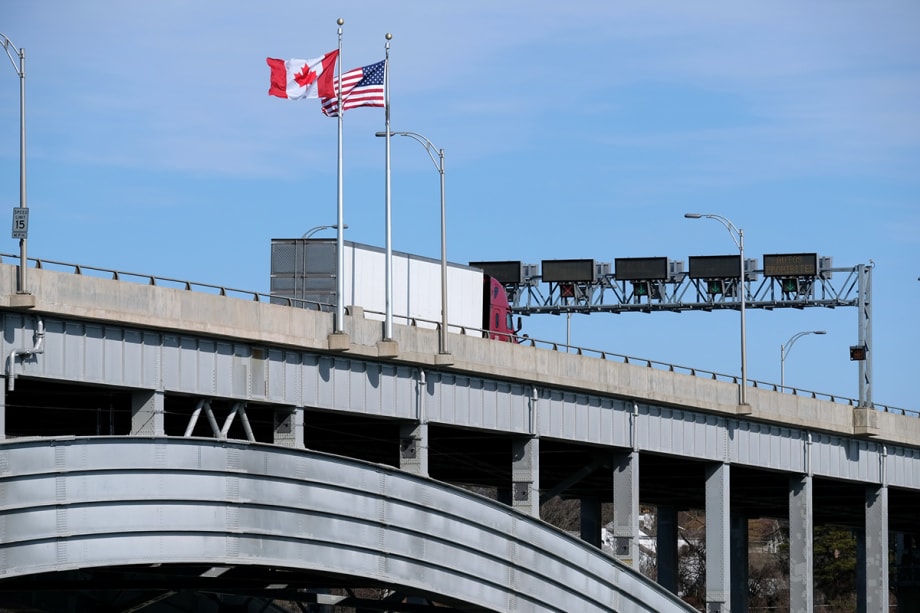
While the U.S. and Canada have instituted restrictions on border crossing, both countries agree that the bans will not stop the commercial trucking industry from the making “essential” deliveries.
Photo: Jim Park
While the U.S., Canada, and Mexico are all in agreement concerning the current restrictions on border crossing, all parties also acknowledge that the bans will not stop the commercial trucking industry from the making the necessary deliveries throughout North America.
At a recent press conference in Ottawa, Canadian Prime Minister Justin Trudeau stressed, “trucking will not be affected.”
“These supply chains ensure that food, fuel, and life-saving medicines reach people on both sides of the border,” Trudeau added.
He said he spoke to U.S. President Donald Trump earlier in the day, and both leaders agreed to temporarily restrict all non-essential travel across the U.S.-Canada border as the two countries fight the COVID-19 pandemic.
“We understand that it is very important for the border to remain open because we are talking about $2 billion worth of goods that cross the border every single day,” Trudeau said.
“So, it is critical, not just for the health of our economy but for the health of our citizens that continue to be the case.”
Trudeau said he and Trump both want to ensure the smooth flow of essential goods across the border.
“That is something that we remain committed to. We will work in close collaboration on an ongoing basis to make sure that continues. And these measures will last in place as long as we feel that they need to last, we will again closely coordinate on that as well.”
On March 20th, the U.S. and Mexico jointly announced a limit to “nonessential travel” across the southern border. Exceptions include traveling for medical purposes and attending school, according to a report from CNN.
The Centers for Disease Control and Prevention has also directed the Department of Homeland Security to suspend entry of all migrants "seeking to enter the U.S. without proper travel documentation," according to acting Secretary Chad Wolf.
Drivers crossing the Canada border are also being encouraged to carry copies of a U.S. Department of Homeland Security notice that defines the movement of cargo as “essential travel.” And while the U.S. temporarily suspended hours-of-service rules (HoS) for drivers hauling COVID-19 relief items, Canada has not yet followed suit. Any driver operating in Canada must still adhere to Canadian HoS rules, according to Transport Canada, at least for the time being.
“Transport Canada is working closely with industry to be prepared to quickly provide an exemption to federal hours-of-service rules if this becomes a necessary measure,” Transport Canada indicated to Today’s Trucking.
More Safety & Compliance

From One Generation to the Next: How Mentorship Builds Safer Truck Drivers
After three decades in trucking, Harold Perry shares what he's learned about driver safety, mentorship, and helping the next generation build confidence behind the wheel.
Read More →
FMCSA Pauses Biennial-Update Enforcement Amid Motus Transition
Carriers whose updates were due on or after June 1 have more time, while FMCSA works to stabilize its new registration system and warns of phishing sites impersonating its new carrier registration system, Motus.
Read More →
ZF Expands Commercial Vehicle Push in North America
ZF is expanding its North American commercial-vehicle presence with new transmission applications, electrification, trailer technology and autonomous-driving systems.
Read More →
Truck Drivers Need More Than Another Alert
Fleets have more visibility into truck health, safety events, and driver activity than ever. The next challenge is turning all that information into useful guidance for the person who has to decide what to do next.
Read More →
Tesla Wants a Self-Driving Semi. Are Cameras Enough?
Could Tesla’s camera-only autonomous driving technology work on an 80,000-pound Semi? In this commentary, HDT's Deborah Lockridge takes a look at Tesla, Cybercab, and how autonomous trucks see the road.
Read More →
What DOT’s Automated Vehicle Strategy Means for Trucking
The U.S. Department of Transportation issued a new automated-vehicle strategy that outlines plans for driverless-truck regulations, cross-state freight corridors, and federal safety standards.
Read More →
NYC Expands Speed, Pedestrian Safety Tech Across Fleet
New York City is expanding intelligent speed assistance and pedestrian-alert systems across its municipal fleet, moving the technologies from pilot programs into vehicle procurement and retrofit requirements.
Read More →
FMCSA Removes 110 Truck Driver Training Schools from Certified ELDT List
Federal regulators also are targeting more than 160 additional training providers and launching a nationwide audit of third-party CDL skills testers as part of a broader crackdown on trucking fraud.
Read More →
Beyond DOT Compliance: What Makes a Trucking Fleet Truly Safe?
A trucking fleet can follow every rule and still make unsafe decisions. The real test comes when safety conflicts with freight, productivity, or cost.
Read More →
Hours of Service Pilot Programs: FMCSA Readies for 2027 Rollout
Two pilot programs could eventually reshape hours-of-service rules, giving truck drivers options to pause their 14-hour clock or use longer split sleeper rest periods.
Read More →