





Related: How 7 Drivers Are Dealing with the COVID-19 Pandemic [Podcast]
Can ELDs Help Track COVID-19 Cases?
Knowing where drivers have been, when they were there, and who they contacted can help fleets prevent the spread of COVID-19 internally, and potentially warn other fleets and customers of exposure to an infected driver.
May 20, 2020
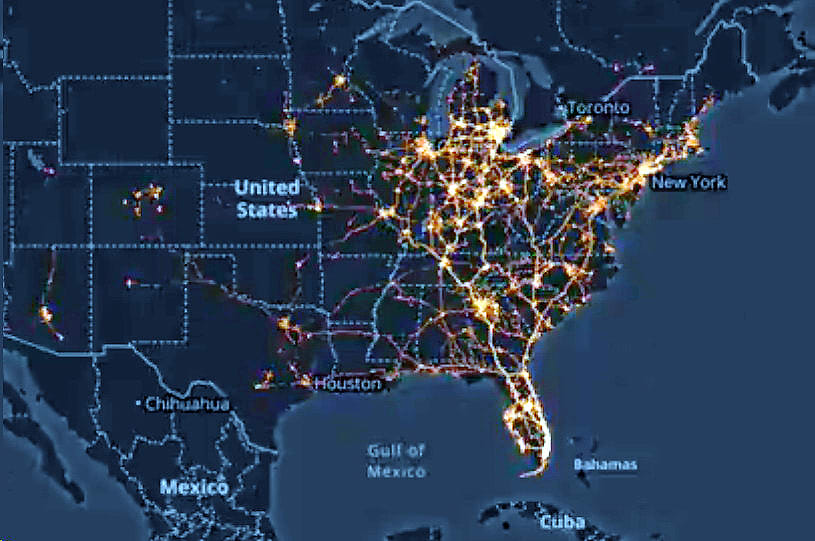
Virus' are spread by humans in motion. Apps can track travel patterns, but cannot necessarily identify possible carriers of the virus until they declare themselves infected and self-report, which could be 10 days or more after first contact.
Image: Fleetmetrica
4 min to read
Knowing where drivers have been, when they were there, and who they contacted can help fleets prevent the spread of COVID-19 internally, and potentially warn other fleets and customers of exposure to an infected driver.
One of the key elements in slowing the spread of the COVID-19 virus is the ability to track suspected carriers and trace their contacts during the contagion period. Since most people contact dozens or hundreds of others over the course of a few days or a week, it's nearly impossible to get a complete picture of that group. That problem is compounded by the delay between the time a person becomes infected and when the symptoms become obvious. It's believed that interval can be a week to 10 days, so imagine all the contact that may have taken place over that period.
"The key is early contact tracing," says Ward Warkentin, CEO of Fleetmetrica. "ELDs can provide that breadcrumb trail; where a driver has been, who they have come into contact with, and when."
But it shouldn't end there Warkington says. Fleetmetrica has developed a VirusTracker app for drivers that identifies overlaps in location stop points and time periods where and when drivers within the group, or the company, in this case, were in the vicinity of each other.
"I think it is important that fleet owners consider any and all solutions to help them strengthen their business continuity management practices, and that includes whatever tools are available to identify and prevent the risk of the virus affect the business," he says. "Our solution emphasizes early contact tracing which enables the company to warn drivers who may be at risk whenever a driver within the fleet becomes symptomatic. This gives drivers a heads-up prior to the symptomatic driver getting tested, which reduces the time for the virus to spread to other drivers or customers."
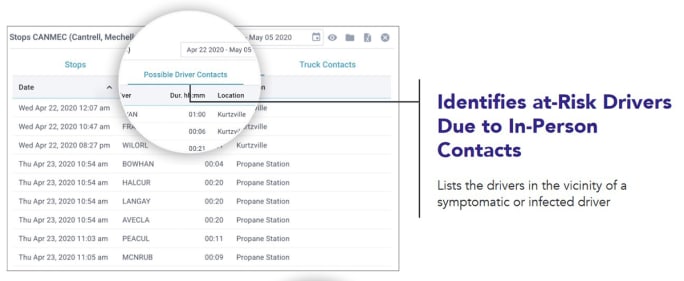
Fleetmetrica's VirusTracker app collects GPS data to determine drivers' travel history while the app cross-references possible contacts with self-reported symptomatic drivers to provide early warning of potential infection.
Image: Fleetmetrica
Within the app, drivers can confidentially track how they are feeling, noting any possible symptoms that might appear, such as a cough, fever, fatigue, body aches, shortness of breath, and loss of smell or taste. They can also note other conditions not usually associated with COVID-19 for comparison and possible use in clearing them of any contact with the virus, such as a runny nose and or a sore throat. The app is obviously not intended as a diagnostic tool, but more as an event logger, so if medical attention is required, health care professionals can see when the first symptoms began to appear and when the driver began to suspect he or she may have contracted the virus.
That timeline is important because there could be lag of several days between the time a driver feels ill and when they get tested — if they are tested at all. If there is a test, several more days could elapse before the driver is declared clear or infected. That could lead to more drivers who came in contact with the symptomatic driver spreading it to other parts of the fleet and to customers.
"Our solution isn't dealing with the data privacy issue, and the fleet doesn't need to worry about driver's opting out of the solution since the location data is already collected via the ELD," Warkington says. "Most importantly, the fleet is giving drivers an advanced warning that they have come in contact with someone that may test positive, which raises their awareness, especially if they begin experiencing symptoms of the virus. In that case, they are more likely to follow a health professional's recommendations to stay home and self-isolate."
It would be easy to try to compare Fleetmetrica's VirusTracker to the Apple/Google tracking app that has been in the news of late, but Warkington says they are quite different.
"Their approach is pushing messages out to drivers, or anyone, that may have come in contact an infected person and the level of warning is defined by the health organization for that region or country, but the warning usually comes only after someone tests positive," he says. Their app works by voluntarily sign-up, with the system keeping track of the person's interactions with other phones in the vicinity via Bluetooth over the previous two weeks and sends out a warning.
"In comparison, our VirusTracker solution is not collecting data from a driver's phone. The GPS data is already collected by the driver's ELD device and collected for all the drivers. More specifically, it is the ping data that is collected to identify overlaps in location stop points and time periods to determine where and when drivers were in the vicinity of each other," he adds.
Fleetmetrica hosted a webinar "Navigate COVID-19 with Early Contact Tracing" on Thursday, May 21.
More Safety & Compliance

FMCSA Pauses Biennial-Update Enforcement Amid Motus Transition
Carriers whose updates were due on or after June 1 have more time, while FMCSA works to stabilize its new registration system and warns of phishing sites impersonating its new carrier registration system, Motus.
Read More →
ZF Expands Commercial Vehicle Push in North America
ZF is expanding its North American commercial-vehicle presence with new transmission applications, electrification, trailer technology and autonomous-driving systems.
Read More →
Truck Drivers Need More Than Another Alert
Fleets have more visibility into truck health, safety events, and driver activity than ever. The next challenge is turning all that information into useful guidance for the person who has to decide what to do next.
Read More →
Tesla Wants a Self-Driving Semi. Are Cameras Enough?
Could Tesla’s camera-only autonomous driving technology work on an 80,000-pound Semi? In this commentary, HDT's Deborah Lockridge takes a look at Tesla, Cybercab, and how autonomous trucks see the road.
Read More →
What DOT’s Automated Vehicle Strategy Means for Trucking
The U.S. Department of Transportation issued a new automated-vehicle strategy that outlines plans for driverless-truck regulations, cross-state freight corridors, and federal safety standards.
Read More →
NYC Expands Speed, Pedestrian Safety Tech Across Fleet
New York City is expanding intelligent speed assistance and pedestrian-alert systems across its municipal fleet, moving the technologies from pilot programs into vehicle procurement and retrofit requirements.
Read More →
FMCSA Removes 110 Truck Driver Training Schools from Certified ELDT List
Federal regulators also are targeting more than 160 additional training providers and launching a nationwide audit of third-party CDL skills testers as part of a broader crackdown on trucking fraud.
Read More →
Beyond DOT Compliance: What Makes a Trucking Fleet Truly Safe?
A trucking fleet can follow every rule and still make unsafe decisions. The real test comes when safety conflicts with freight, productivity, or cost.
Read More →
Hours of Service Pilot Programs: FMCSA Readies for 2027 Rollout
Two pilot programs could eventually reshape hours-of-service rules, giving truck drivers options to pause their 14-hour clock or use longer split sleeper rest periods.
Read More →
New Guide Offers Pet Safety Tips for Truck Drivers
Hundreds of thousands of pets travel in truck cabs. A new safety guide from Volvo Trucks and the Center for Pet Safety offers practical advice for truck drivers who bring dogs and cats along for the ride.
Read More →